
The most keenly-awaited shower
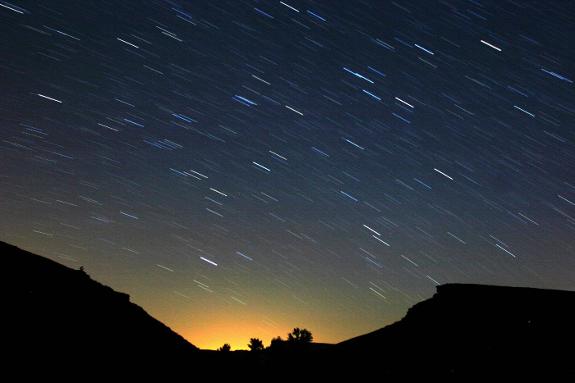
This weekend the Perseids meteor shower should be clearly visible in the night sky over southern Spain
FERNANDO MORGADO
It has only been a few days since there was a total eclipse of the moon and Mars was the closest it has been to the Earth for 32 years, but this weekend our eyes will be firmly set on the firmament again, this time to see something which never ceases to surprise us, even though it occurs every year. This will be the most keenly-awaited shower of the summer: a shower of stars, known as the Perseids or the Tears of San Lorenzo, because 10 August is the Day of San Lorenzo. This summer, the lack of moonlight in the night-time sky means the shooting stars should be clearly visible.
HELPFUL ADVICE
- Watch from a dark place. Light contamination from towns makes it more difficult to see the stars.
- Wear comfortable clothes, suitable for the outdoors. Long trousers are best if you are going into the countryside.
- Take a sunbed or mat. You can lie in comfort and watch the sky.
- Don't create light. The use of mobile phones and torches makes it difficult for our eyes to adapt to the darkness.
- Take part in a guided observation. For example, the ones organised by Astroándalus in Alfarnatejo, Astrolab in the Sierra de las Nieves and the Observatory of El Torcal in Antequera. These may be booked ontheir websites. The Sociedad Malagueña de Astronomía is organising a free observation in Arriate on Sunday.
Although the phenomenon started on 17 July and will continue until 24 August, it will be this Saturday and Sunday nights when the most Perseids can be seen in the sky. There is a simple explanation: at this time of year, our planet crosses the trail of dust particles and ice left behind by the 109P/Swift-Tuttle comet, a celestial body about 26 kilometres in diameter which orbits the sun once every 135 years. It is the particles left by the Swift-Tuttle that turn into the shooting stars as they pass through the Earth's atmosphere.
José Jiménez, the executive director of Astroándalus, a company which specialises in astronomical tourism, says this year the Perseids will be perfect.
"Unlike last year, when there was a full moon, there will be a new moon, which is like having no moon at all, and that means we will see many more Perseids," he explains. He also suggests that we take advantage of the occasion to look at Mars, Jupiter and Saturn.
The special interest in this shower of stars is due to a parameter, the Zenithal Hourly Rate or ZHR, which defines the number of shooting stars which can be seen every hour. This year it is 100, which is very high.
Although hundreds of stars will be crossing the sky on Saturday and Sunday nights, it is best to watch them from somewhere away from light pollution. "They can be seen with the naked eye, but it is best to go to dark areas like La Axarquía, El Torcal or the Serranía de Ronda," says Jiménez. Astroándalus is also organising a guided observation in Alfarnatejo on Saturday night, which can be booked on its website. Similar events are also being organised in other parts of Malaga province.
![[]](http://static.vocstatic.com/voc26/latest/assets/images/favicon/surinenglish/apple-touch-icon-57x57.png)