
Environment
Costa del Sol environmentalists denounce tightropes and zipwires on protected building
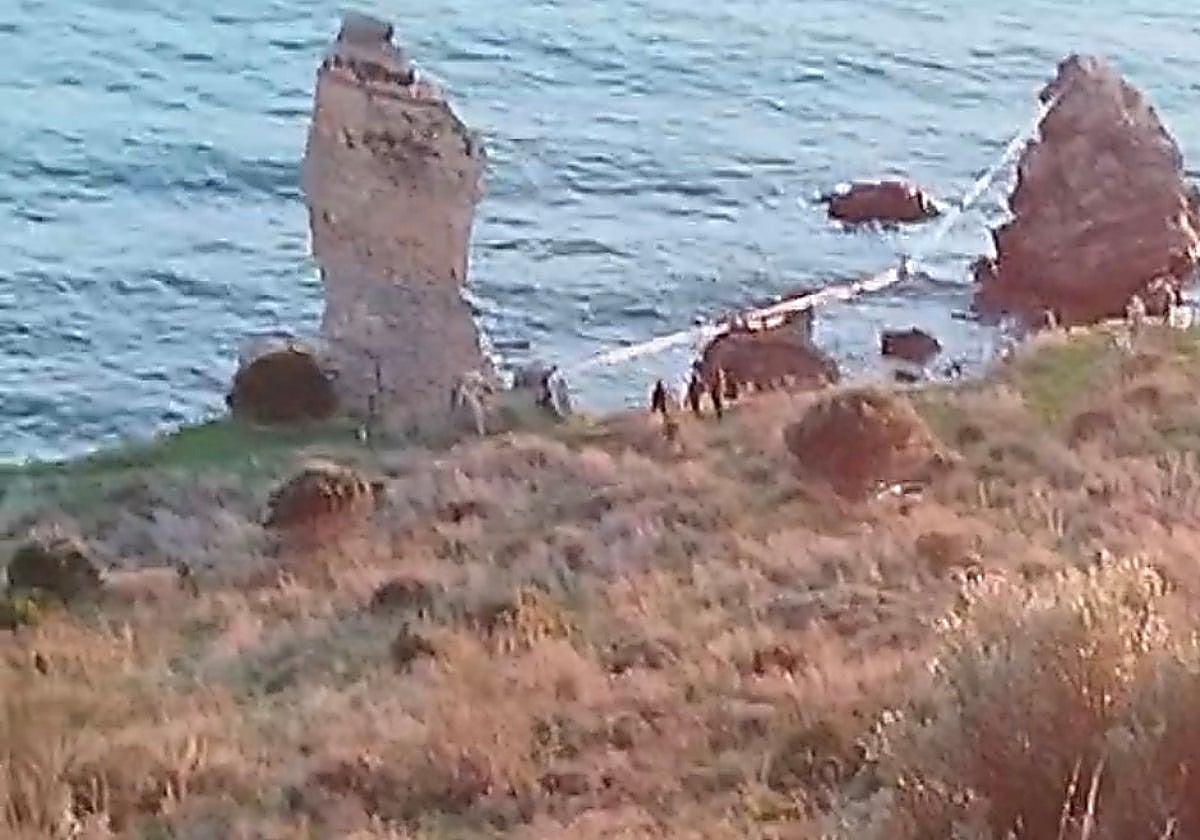
Environmental group GENA–Ecologistas en Acción has reported its concerns to the Andalusian regional government after detecting people on the Molino de Papel watchtower, a historic building that has been declared a Site of Cultural Interest (BIC) in the protected Maro-Cerro Gordo Cliffs
Eugenio Cabezas
The environmental group GENA–Ecologistas en Acción has formally reported concerns to the Andalusian regional government regarding the misuse of the Molino de Papel watchtower.
Located within the protected Maro-Cerro Gordo Cliffs on the border between Malaga and Granada, the 18th-century tower is a declared Site of Cultural Interest (BIC).
According to the environmental group, the watchtower is in an advanced state of disrepair and was added to the heritage 'red list' in March 2022. Despite its fragile condition, GENA reports that the structure is being used as an anchor point for ropes, presumably for tightrope walking or zip-wiring.
GENA has said that this unauthorised recreational use poses "an obvious risk to people" and, at the same time, causes direct damage to a protected site and the surrounding habitats. "We are witnessing the total trivialisation of a natural and cultural space that should be subject to strict surveillance," the environmentalists say in their report and accuse the Junta de Andalucía of "passivity" due to the lack of surveillance in the area.
The pressure group also pointed out that the site is protected by Law 2/1989 on Protected Natural Areas in Andalucía, forms part of the Natura 2000 Network as a Special Area of Conservation (SAC) and is listed as a Specially Protected Area of Mediterranean Importance (SPA).
Added to this is the specific protection of the Torre del Molino de Papel, whose misuse could lead to administrative and even criminal liability. The remains of the 18th-century building were added to the heritage 'red list' in March 2022 due to its dilapidated state of conservation.
This new complaint adds to those recently filed by GENA for allegedly illegal clearing and construction work in the area around El Cañuelo beach, which is also in the Maro-Cerro Gordo cliff protected area, as well as the proliferation of motorhomes parked for long periods of time, illegal camping, rubbish, traffic outside authorised roads and the presence of hunting dogs that are not on leads.
They argue that the area is becoming "a theme park without rules" without effective controls. "This is not responsible leisure, but illegal uses that degrade the territory and endanger both heritage and biodiversity," they point out.
GENA has asked the Andalusian regional government to take immediate action, initiate disciplinary proceedings and step up surveillance in the area. "If action is not taken now, the damage will be irreversible," they conclude. SUR has attempted, without success so far, to obtain an assessment from the Andalusian regional government regarding this new complaint by environmentalists about the situation.
The natural landscape of the Maro-Cerro Gordo Cliffs is one of the most valuable coastal areas in the Mediterranean due to its high biodiversity, a wealth that led to its declaration as a Specially Protected Area of Mediterranean Importance (SPA). Although protection has historically focused on the sea, it also has a 395-hectare strip of land that is home to "extraordinary natural values," according to biologist Rafael Yus, coordinator of GENA.
This strip of land is under increasing pressure from activities such as off-trail hiking, climbing, mountain biking, paragliding, parking of vehicles and caravans in unauthorised areas, camping and occupation of ruined buildings. Yus argues that these uses have a significant impact on biodiversity - trampling, littering, and habitat deterioration - and believes that the surveillance and deterrent measures of the Andalusian regional government are insufficient to curb the activity.
![[]](http://static.vocstatic.com/voc26/latest/assets/images/favicon/surinenglish/apple-touch-icon-57x57.png)