
Motoring
Spain accelerates roll-out of high-speed electric vehicle charging points
The Spanish regions with the highest concentration of EV battery rechargers are Catalonia, Andalucía and Madrid

Madrid
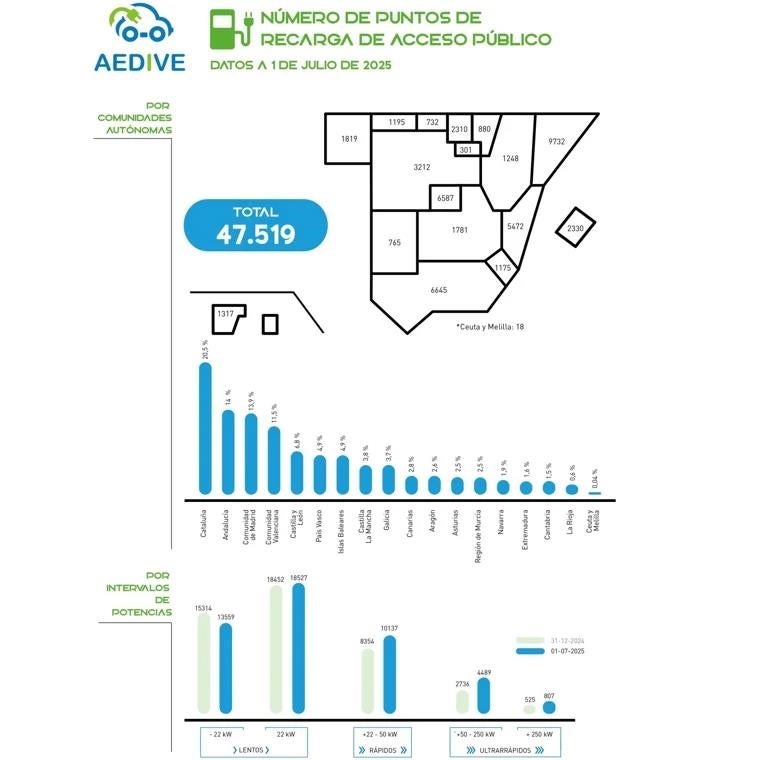
The electric vehicle charging infrastructure in Spain is experiencing solid and, more importantly, qualitative growth. According to the latest data from the business association for the development and promotion of electric mobility (AEDIVE), the network of operational public charging points reached 47,519 units at the end of the first half of 2025.
This figure represents an increase of 4.71% compared to the end of 2024, consolidating the upward trend in the deployment of critical infrastructure for electric mobility.
Most significant in this development is the strong push on high-power points - a key part of making long-distance travel viable and reducing drivers' "range anxiety".
In the first six months of the year, chargers from 50 to 250kW have seen a spectacular rise of 64.07%, while those above 250kW have grown by 53.71%. Even fast-charging points (from 22 to 50kW) have experienced a considerable increase of 21.34% in the same period. This trend reflects a clear commitment by the operators (CPOs) to a more efficient network capable of responding to the needs of modern electric vehicles.
The regions with the highest concentration of charging points are Catalonia, Andalucía and Madrid. Their leadership is not only crucial but also expected, given that these are the most populated regions, with the highest traffic volume.
AEDIVE CEO Arturo Pérez de Lucía stated that "if this remarkable pace of infrastructure installation continues", there could be around 55,000 public charging points in operation in Spain by the end of the year.
For its reports, AEDIVE has started to compare Spanish data to the European market's databases, which provides more robust and reliable information.
A crucial aspect of this new methodology is that only charging points that are active at the time of reporting are counted. This means that the "snapshot" of the infrastructure is instantaneous and real, although there may be variations (both upwards and downwards) if some points are temporarily inactivated due to breakdowns, maintenance or upgrades.
Spain vs Europe
Spain has undoubtedly taken a step forward so far this year, but it still has some way to go if we take the leaders in Europe as a reference.
One factor is that, while the number of charging points in Spain is increasing, the ratio of chargers to the electric vehicle fleet (which is also growing) still falls short of the continent's average. The gap becomes more evident when comparing Spain with countries such as Norway and the Netherlands.
Norway is a clear global benchmark in electric mobility. Its charging network is growing at an exceptional rate, which translates into a very dense infrastructure ready to support its large EV fleet. In addition, Norway continues to stand out as a leader in overall charging network growth (+6.1%).
Another major leader in charging infrastructure, the Netherlands has shown significant growth, characterised by a very capillary and accessible network, especially in urban and semi-urban environments.
Other major countries in the European landscape, such as Germany and France, also show a robust and steady deployment, with an increasing focus on fast and ultra-fast charging.
AEDIVE is optimistic about Spain's ongoing contribution to the European network, with a focus on charging quality and convincing more drivers to make the leap to electric mobility.
![[]](http://static.vocstatic.com/voc26/latest/assets/images/favicon/surinenglish/apple-touch-icon-57x57.png)