
Employment
Immigrants now contribute close to 20% of Malaga province's GDP
The data, collated by the CCOO trade union, does not include work done by digital nomads or those working in the underground economy through no fault of their own

Malaga
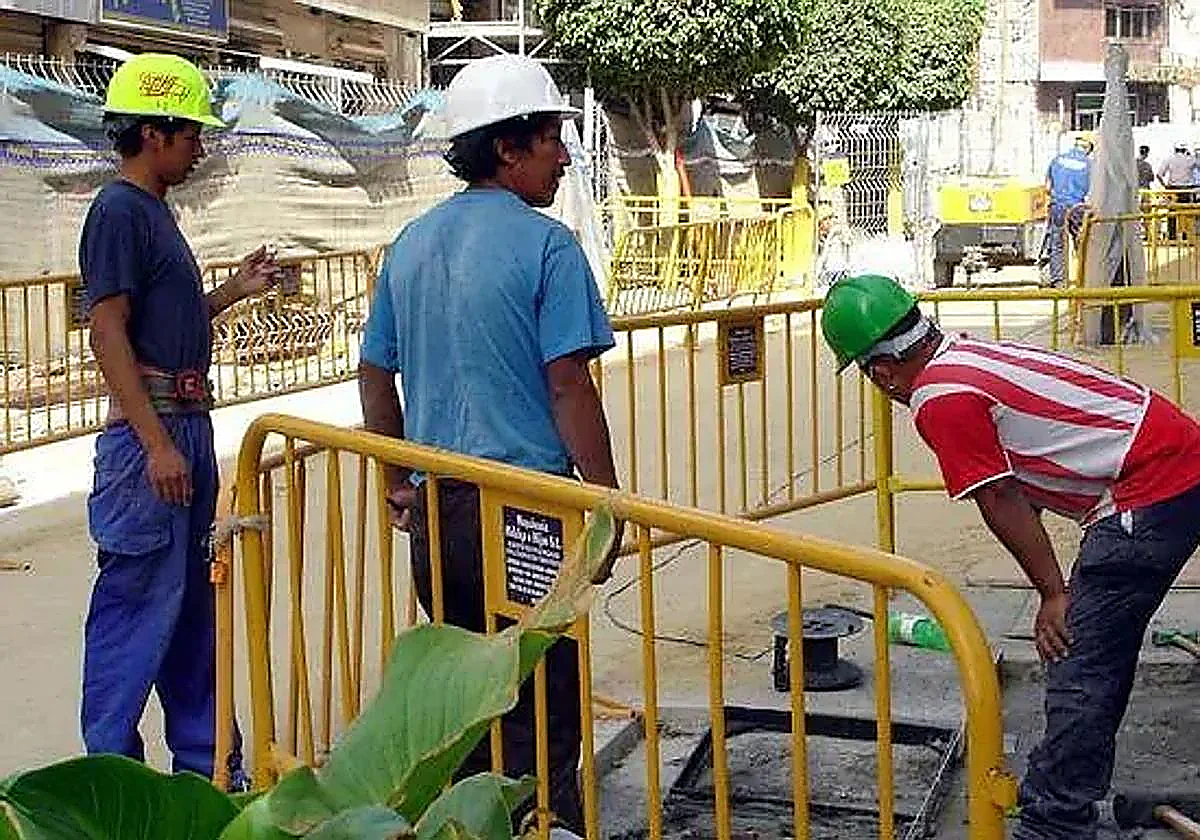
Nearly 121,600 foreign nationals were registered with Social Security in Malaga province as of October 2025. They therefore account for 16.4% of all contributors in the province - a record high. Based on these figures, the Comisiones Obreras trade union (CCOO) has done a calculation of their contribution to Malaga's gross domestic product. Using the estimated value of goods and services produced throughout 2024 (the definition of GDP), which exceeded 45 billion euros, this means that the contribution of migrant workers, now representing 16.4% of the province's total, is around eight billion euros. This figure, admits Fernando Cubillo, CCOO's provincial secretary, is likely to be higher. This is because there are more migrant workers in the province than are registered with Social Security: for one thing, there are those who work in Spain's underground economy, because many are condemned to irregular status before being able to obtain a legal job. For them to obtain residency and the right to work, they first have to prove two years of registration and having established roots in the country. Then there are those who are still registered in their countries of origin and work in Malaga, mostly from northern European countries.
16.4%
of Social Security affiliates in Malaga
are immigrants, a record high. Across Spain, the proportion of foreign contributors barely exceeds 14%.
The CCOO admits that this is a hypothetical and approximate calculation, as official data is unavailable. Furthermore, migrants face highly variable situations with very different contributions to gross value added depending on their line of work. However, economic theory argues that one of the most important factors for GDP is population: a larger population means greater wealth creation.
The contribution of migrants to wealth production in Malaga holds a greater share than that made in Spain as a whole. Across the country, foreign workers affiliated with Social Security account for 3.1 million workers out of a total of 21.8 million workers, meaning they only represent 14.2% of the total, two percentage points less than in the Costa del Sol province.
This report by the CCOO on the employment of the foreign working population in Malaga, released on Tuesday, also details how the number of foreign workers registered with Social Security in the province has evolved since 2019. The total has increased by 53.7% or by nearly 42,500 people, an increase that really picked up from 2021 onwards, when they accounted for 12.2% of the total number of contributors.
Geographical origins
Cubillo also specified the geographical origins of foreign workers in Malaga: the four main countries of origin are Morocco (12,395 workers), Italy (11,086), the United Kingdom (9,663) and the Ukraine (7,339). "Of the four main countries of origin, three are European," Cubillo remarked. This is followed by Colombia (6,588 affiliates), Argentina (5,655), Venezuela (5,555) and China (4,463). "Far from considering the immigrant population as a threat and singling out countries from the African continent, we can see that, with the exception of Morocco, the countries that bring the largest working population to the province are Italy, the United Kingdom, the Ukraine, Germany, the Netherlands and France. All from the European continent. Second are South American countries such as Colombia, Argentina, Venezuela and Paraguay. And lastly, China."
The report also reveals which nationalities are most prevalent across the different contribution schemes. Thus, in the General Scheme, it's a carbon copy of the aforementioned top four: Morocco, Italy, the United Kingdom and the Ukraine. Meanwhile, in the self-employed scheme (RETA), the most common are the British (5,169), followed by the Italians (3,219), the Chinese (2,587) and the Dutch (1,813). As for the agricultural scheme, two nationalities stand out, Moroccan (814 registered workers) and Romanian (372). Finally, among domestic workers, Ukrainian women amount to 1,050, 846 from Paraguay, 416 from Morocco and 197 from Romania.
As for the industry sectors where most of these people are employed, these are hospitality, caregiving, domestic work, construction and retail.
43.8%
of foreigners resident in Malaga
earn an income below 10,000 euros per year. The total in this situation is 148,000 people, 70,000 of whom are workers registered with Social Security.
Trinidad Salcedo, secretary for social action with the CCOO union in Malaga, highlighted other data on the social situation of the migrant population in the province. Firstly, some 43.8% of foreign workers earn an income below 10,000 euros per year. There are a total of 148,000 people in such circumstances, 70,000 of whom are workers registered with Social Security - half of the foreign workforce, therefore, earns less than 10,000 euros a year. Furthermore, 18.7% of foreign residents in Malaga earn less than 5,000 euros per year. "In collective bargaining, the employment situation of migrants must be improved," stated Salcedo. She then commented on the latest immigration law: "It leaves people who are already here in administrative limbo. The problem is that they cannot be hired: these people are working, but they're working off the books and we can't count them."
Cubillo also announced that the union is going to create a new immigration department in light of the growth observed in the number of union members of foreign origin. In the last four years, foreign worker memberships have increased by 31.5% for the CCOO in Malaga, now totalling 1,533 foreign members with a union card.
![[]](http://static.vocstatic.com/voc26/latest/assets/images/favicon/surinenglish/apple-touch-icon-57x57.png)