
Immigration
Around 50,000 people in Malaga province trapped with irregular status
Spain’s immigration law contains an awkward paradox: in order to obtain a residence permit and work legally, it is necessary to prove that you have lived in the country for a minimum of two years
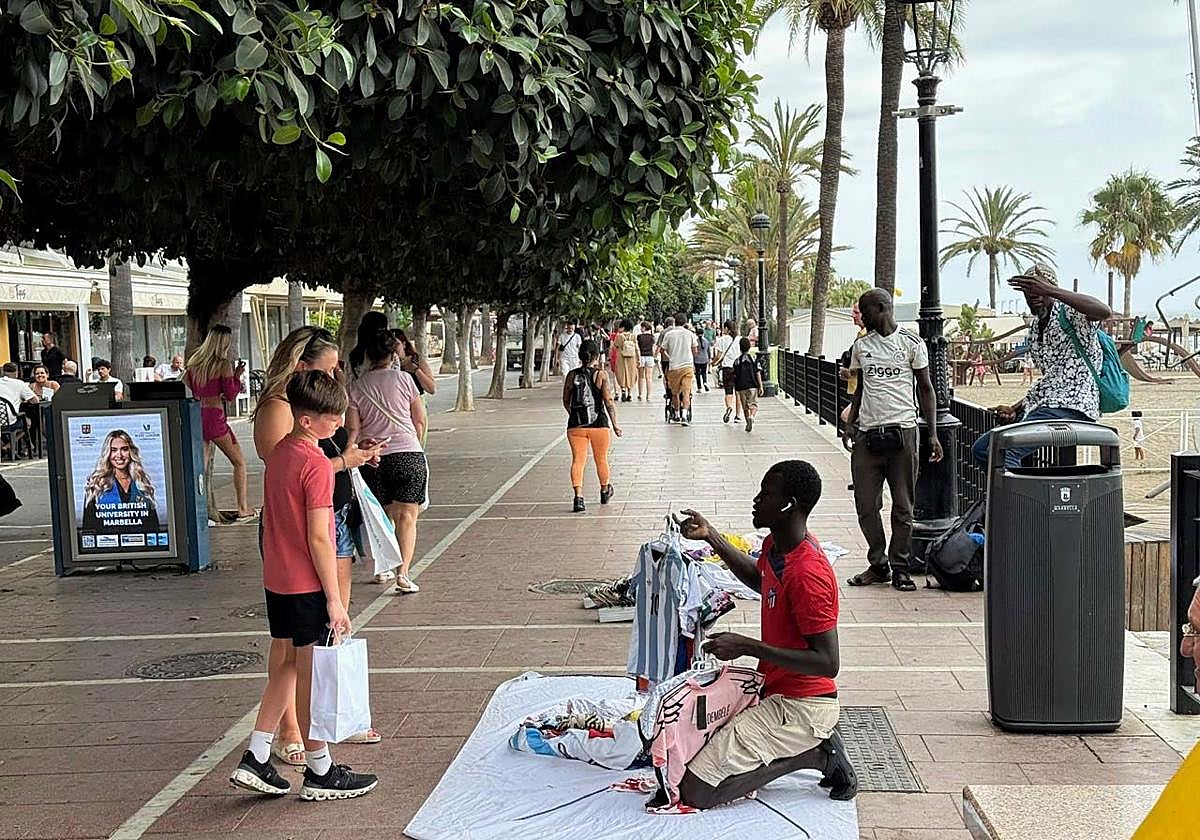

Altercations between the police and street vendors in Marbella and Bilbao; xenophobic violence in Torre Pacheco (Murcia); ban on celebrating muslim festivities on grounds owned by the council in Jumilla - these are only some of the cases this summer that highlight the situation of migrants according to the law in Spain. Street vending is only the tip of the iceberg of a situation that affects many foreign residents in Malaga province, in Andalucía and throughout Spain.
Although their activity is considered illegal, many foreigners are faced with no other choice, considering that they are not offered a contract and cannot obtain the necessary documents to live and work in Spain.
Rocío Roca is a lawyer with the Moroccan association for the integration of immigrants. She explains the legal process from the beginning - from the moment a boat carrying migrants reaches the Spanish coast and is intercepted by the Guardia Civil or any other law enforcement agency.
In that first stage, the immigrants are asked whether they are going to be seeking asylum (if they are going to request refugee status). An ex-officio lawyer advises them and prepares arguments against a possible forcible return to their country of origin, such as humanitarian reasons or the presence of family members already living in Spain.
Then, they are placed in a detention centre for foreigners (CIE) for a maximum of 60 days. If they have not been returned to their country within this period, they are released. The most likely scenario is that the migrant remains in Spain. The authorities cannot return a person if they do not have documentation and their origin is not known. It is also not easy to deport if the country of origin does not have an extradition agreement with Spain. This may be compounded by the fact that the country of origin is very far away, which makes the logistics of return very costly.
What happens from that moment on - from the moment the person leaves the CIE and can move freely around Spain? According to Roca, they often seek associations and advice or compatriots who live in the country. What they are advised to do is join the 'padrón' population register as soon as possible and keep documents and proof that they not only live in Malaga, in Spain, but that they are seeking to establish roots here. The rule is that, in order to apply for residency and a work permit, one must provide proof of registration and proof of residence on Spanish territory for at least two years prior to submitting the application. It used to be three years. During that time, absences from Spain may not exceed 90 calendar days.
Sale of registration
300 or 400
euros
is what landlords sometimes charge for registering in their homes
Joining the 'padrón' census is essential. There are some landlords who 'sell' the chance to be registered at their property for 300 or 400 euros. Town halls sometimes make things easier for the most vulnerable. Homeless people who use the municipal shelter can declare that this is their address. Additionally, there is registration by social exclusion.
In any case, there are at least two years between joining the census and being able to obtain residency (and a work permit), which is why Ahmed Khalifa - president of the Moroccan association for the integration of immigrants - states that migrants "are almost obliged by law to be in a situation of social exclusion". In the words of Roca, "they are doomed to exploitation" in the work field.
'People stay in Spain, but completely outside the administrative reality, so they work irregularly in the countryside, in the hotel industry or in the domestic service. They live badly until they can get access to regularise their situation in accordance with the law on foreigners. They can't do anything else'
The same conclusion is drawn by the Spanish commission for refugee aid (CEAR) in Malaga: "People stay in Spain, but completely outside the administrative reality, so they work irregularly on the land, in the hospitality industry or in domestic service. They live badly until they can get access to regularise their situation in accordance with immigration law. They can't do anything else. Being registered on the 'padrón' is only useful for the municipality to know how many people live there and to assign a school and a health centre. It does not entitle the person to any kind of help, except for access to the local food bank."
According to CEAR, asylum seekers can work legally once they have applied for international protection and until the procedure is resolved. However, if their status is denied, they lose the right to work and start their residency application from scratch, so they have to add the other two regulatory years to the time they have been waiting.
Roca states that one way of resolving the quagmire in which migrants arriving in Spain find themselves would be for them to be able to work and have a temporary employment permit during those two years in which they have to build their roots in the country. As CEAR points out, recruitment from the country of origin is not a realistic solution. "The legal channels for arriving in Spain are practically non-existent."
Population in limbo
It can be estimated that more than 55,000 people live in Malaga province without a residence or work permit. Some of them are registered in the municipality, but that's where it ends. To arrive at this figure, SUR has taken the population census from the national institute of statistics, which uses the 'padrón' as a source, and compared it with the statistics on people with residence permits from the government.
From the census, the foreigners taken to estimate the figures are those who still retain the nationality of their countries of origin, since after ten years in Spain it is possible to apply for Spanish nationality. Since 2013, more than 50,000 people have obtained Spanish citizenship in Malaga. To put the significance of the figure into perspective, it should be noted that at the same time there were more than 414,000 foreigners living in the province.
This is only a rough approximation of the number of people with an irregular status, given that no statistic can capture the number of unregistered residents and there are people who have difficulty joining the padrón. In addition, there are some nationalities with more residence permits than padrón registrations, as is the case with Ukrainians and Chinese, for example, who have been able to change their address. Also, in this ‘gap’ between those registered and those with residence permits, there are not only those of working age: there are also minors and people in all kinds of situations. People immersed in the procedure towards the granting of asylum also count as ‘irregular’. In 2024 alone, there were more than 8,000 people who started this procedure in the province, according to the CEAR.
The penal code is aware of the vulnerability of street vendors: 'The itinerant or occasional sale of products (...) shall be punished with imprisonment of six months to two years. However, given the characteristics of the offender and the small amount of the economic benefit obtained (...) the judge may impose a fine of one to six months or community service'
One of the outlets for people who are trapped in an irregular situation, in this administrative limbo in which they can neither live nor work here legally, is the itinerant sale of counterfeit products. It is an illegal activity, a crime, according to the penal code, which imposes prison sentences or fines for manufacturers, distributors and also for the last link in the chain - the vendors. "The itinerant or occasional sale of products (...) shall be punished with imprisonment of six months to two years. However, given the characteristics of the offender and the small amount of the economic benefit obtained (...) the judge may impose a fine of one to six months or community service of 31 to 60 days."
Ahmed Khalifa explains that immigrants who arrive in Spain do so because of the support networks they have with their compatriots. To start with something, they are given goods that they then have to return. Head of the intellectual and industrial property crimes section of the National Police José Luis Gómez has a different perspective. According to him, these are criminal organisations with a pyramid structure that exploit street vendors, taking advantage of their irregular status. Chief inspector of the second group of economic crimes of the National Police Isidro Almendros says that the network includes Chinese factories whose goods are unloaded in Algeciras or Barcelona, then arrive in Malaga and are stored in warehouses, such as those in the Guadalhorce industrial area. According to the police, Senegalese nationals are usually the ring leaders in contact with the Chinese manufacturers.
Gómez says that street vending extends along the coast from Cadiz to Gerona, with points in France and Italy. According to Almendros, the phenomenon hardly occurs in Malaga city due to regulations.
'The real challenge lies in attacking the root of the problem: dismantling these structured networks, not only pursuing those who sell on the street, who in many cases do so out of sheer necessity'
The police sometimes intervene following a complaint from a brand that has detected the sale of counterfeits of its products. Other times, they identify where the goods are kept. Senior associate at Baylos law firm María Molina says that Spain has a solid and protective regulatory framework to combat the marketing of counterfeit goods. However, she adds that its application is limited by the lack of material and human resources in small areas and by the pyramidal structure of networks, which makes it difficult to prosecute higher levels and leaves the focus on the lower links, which allows an immediate response but does not eradicate the problem. "Street vendors are the last link in the chain, the most visible, but also the most vulnerable. The real challenge lies in attacking the root of the problem: dismantling these structured networks, not only pursuing those who sell on the street, who in many cases do so out of sheer necessity," Molina says.
![[]](http://static.vocstatic.com/voc26/latest/assets/images/favicon/surinenglish/apple-touch-icon-57x57.png)