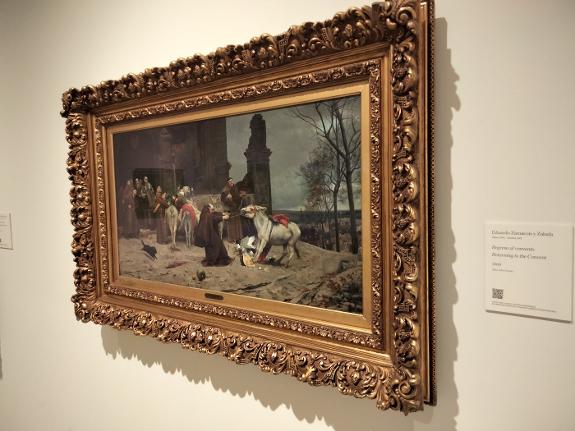
2 July 1841: Spanish painter Eduardo Zamacois y Zabala was born
One of his paintings is permanently exhibited in the Malaga Carmen Thyssen Museum
Alekk M. Saanders
Viernes, 2 de julio 2021, 10:30
The Malaga Carmen Thyssen Museum (Museo Carmen Thyssen Málaga) is home to a painting entitled Returning to the Monastery. This is a work by the Spanish painter Eduardo Zamacois y Zabala who was born on 2 July 1841. Other sources however claim his birthdate as 12 July 1841 and others even 2 July 1842.
Eduardo grew up in Bilbao, into an enlightened and large family. His father was a founder and director of the Santiago de Vizcaya school of humanities. Eduardo had twenty-two brothers and sisters, and, it appears many of them excelled in various branches of the arts and sciences as well.
When Eduardo was 15, his family moved to Madrid where he was enrolled at the Real Academia de Bellas Artes de San Fernando. Later, he went to Paris to study but his application to the Ècole des Beaux-Arts was denied. After his returning to Madrid, he started his painting career.
At the age of 20, Eduardo was commissioned to create decorative paintings in the quarters of the future king, Alfonso XII at the Royal Palace of Madrid (Palacio Real de Madrid). In 1862 and 1864, the painter was awarded medals at the National Exhibition of Fine Arts. In 1870, Eduardo Zamacois y Zabala conquered even the French capital where he won the gold medal at the Paris Salon for his painting The Education of a Prince.
The Spanish painter was also applauded in England. After a showing in London, one of his paintings was purchased by Charles Dickens. Another work by Zamacois y Zabala was sold in London at the end of the last century. In 1999, The Caf of the Swallows was bought for GBP 10,350 at Christie's. The painter died in the peak of his career in 1871, after a sudden disease, aged 29.
In the Malaga Carmen Thyssen Museum you can see his 1868 painting - oil on canvas - Returning to the Monastery, also popularly named Taming the Donkey.
This is another version of the painting on copper with the same title. Return to the Monastery is indeed a comical depiction of a group of Franciscans returning to the monastery after a visit to the market in the village. The focus of the composition is the anecdotal plight of the bald monk in the foreground who is unable to control the donkey. After this work was exhibited at the Paris Salon in 1866, art critics wrote that the painter's picturesque and grotesque pictures had the attraction of the bizarre and the perfect.