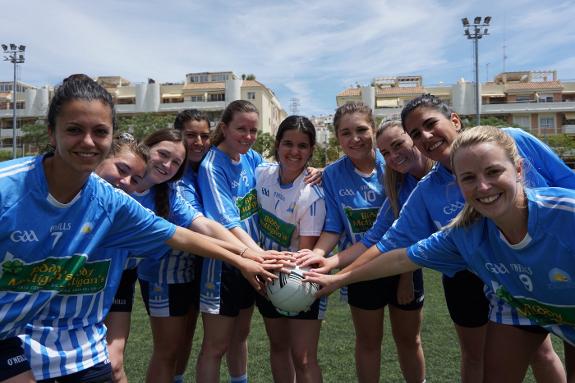
Gaelic football finds a home in Malaga
The city's first team is trying to expand this sport in which feet and hands are both used to pass the ball
FERNANDO MORGADO
Viernes, 20 de julio 2018, 17:22
The start of the first Gaelic football club in Malaga city was a personal dream of Liam Riordan, who like any other good Irishman born in Cork is passionate about this sport. Together with his friend Andy Stronge, Liam founded Celta Malaga in 2016; it isthe only team to practise this sport in the city and the fourth to be formed in Andalucía after Eire Og Sevilla, the Gibraltar Gaels and the Marbella club Costa Gaels.
GAELIC FOOTBALL
-
The rules. Played on football or seven-a-side pitches. Hands and feet are used to pass the ball, but goals can only be scored by kicking. The ball cannot be passed with both hands; instead, a move similar to a low service in volleyball is used. The goals are similar to football, but the posts extend further above the cross bar. Three points are given if the ball goes into the goal, and one above the crossbar.
-
www.facebook.com/gaamalaga
It is the efforts made by people like Liam and Andy to maintain their roots despite living far from home that have expanded this sport, which is very popular in Ireland even though all the teams are amateurs. In fact, the main venue for Gaelic football competitions is Croke Park in Dublin, the third-largest stadium in Europe after Camp Nou and Wembley.
Celta Malaga's second season as a member of the Gaelic Games Andalucía has just ended. This is controlled by Gaelic Games Europe, the organisation which regulates Gaelic sports on the continent. Gaelic football, together with hurling, rounders and camogie, is one of the four Gaelic sports which are principally represented in their country of origin by the Gaelic Athletic Association. In Spain there are 22 teams, of which half are in Galicia. The remainder are in Barcelona, Zaragoza, Madrid, Valencia and Andalucía.
In barely two years Liam Riordan successfully formed a competitive team - especially the women, who won the Andalusian league - and, above all, created an open club which is always pleased to welcome new players to its training sessions on Wednesday evenings at the Carranque sports centre.
"Sometimes there are enough women players to form two teams, but we have problems finding enough men, so anyone who wants to have a go is very welcome," says Liam.
Learning to play Gaelic football is easy, especially for anyone who has previously played another team sport. That's why Liam is keen for people to try it. The dynamic is simple: each team tries to earn points by scoring in the other team's goal, which are like a mixture of those used in football and rugby. If the ball passes over the crossbar and between the two upright posts the team gets one point; and if it goes right into the goal defended by a keeper, three points.
The ball cannot be passed more than four times without kicking, and it must not be kicked more than two consecutive times. Nor can the ball be passed with both hands: it is held with one hand and punched with the other in a similar move to the ones used in low serves in volleyball.
Although originally Gaelic football was played on pitches which were about 140 metres long, with teams of 15 players, in the Andalusian league the male teams adapt to the dimensions of a football pitch and the women to a seven-a-side pitch. Liam explains that this is not a contact sport, and nor are tackles allowed.
Different nationalities
In their last match of the season, the women's team at Celta Malaga beat Eire Og Sevilla by 55-15 at the José Ruiz stadium in La Cala del Moral, and became Andalusian champion thanks to great play by the captain, Aisling Freehill, who is Irish. She is the most experienced team member, having started playing Gaelic football when she was five years old. Aisling, who was born in Manor Killbride, in Wicklow, came to Malaga from Bilbao in September 2016 and says she is "very proud" that so many people play "my sport". Women of six different nationalities currently play in her team: Irish, British, Spanish, Canadian, Colombian and Italian.
Gaelic football has also become an unusual way of learning languages and meeting new people. The team meets up every weekend, enjoys visiting new places when playing away and hosts the Irish teams who come to train on the Costa del Sol in the winter.