
Nature
Why are Spanish flamingos threatening Italian risotto rice and putting farmers on the warpath?
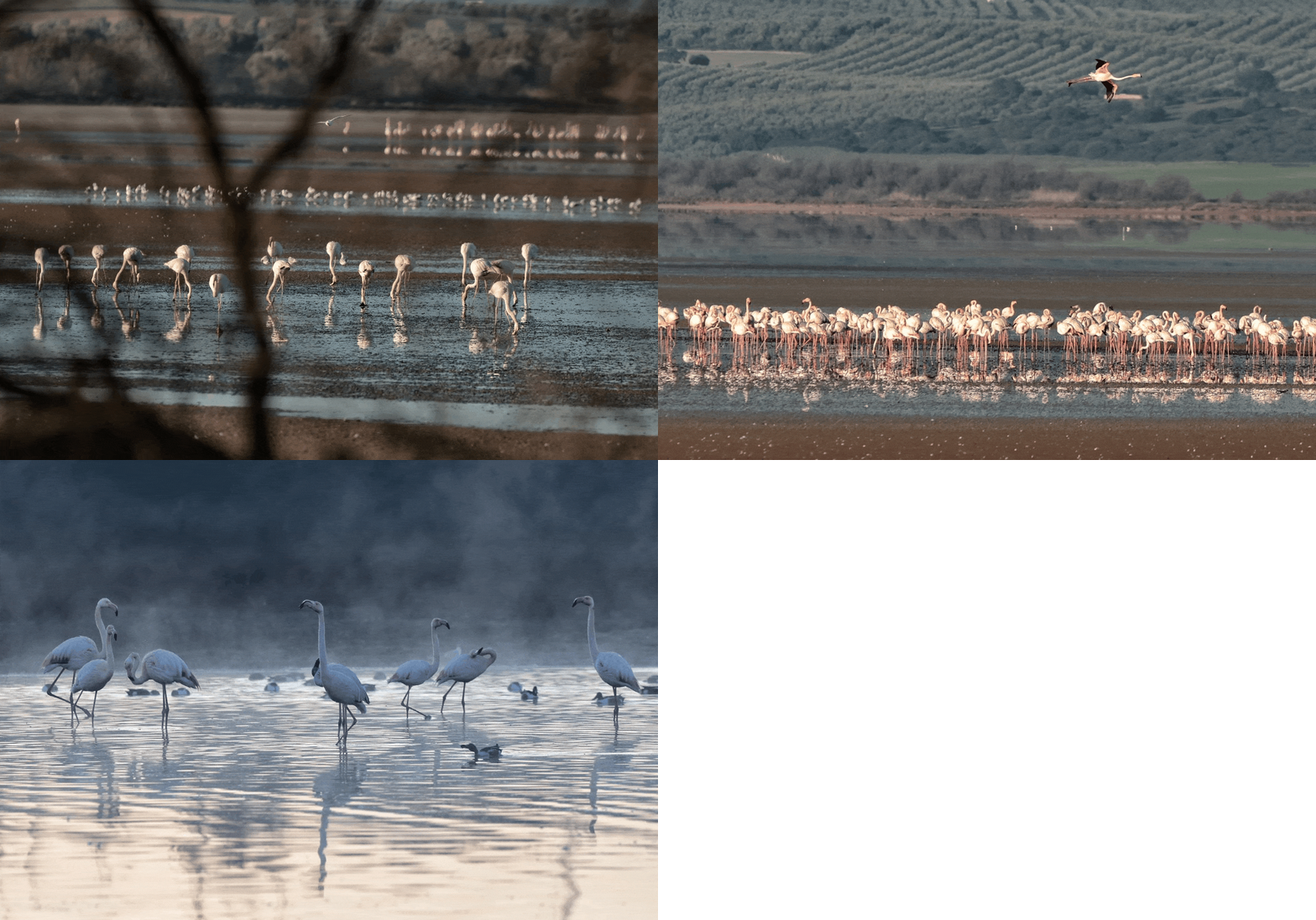
Paella in Valencia is also under threat while Fuente de Piedra, in the north of Malaga province, remains one of the most important breeding areas for the distinctive white and pink birds in Spain

Malaga
Flamingos have been declared a 'non grata' (not welcome) species by farmers in Ferrara - a northeastern Italian province near Venice, where these striking, wading birds are destroying rice crops used to make risotto. They could well pose a threat to Valencian paella in Spain as well.
The flamingos that have put Italian farmers on the warpath and threaten one of the emblems of Italian gastronomy are Spanish. In the early 2000s, they migrated from the south of the country to escape the drought and settled in the valleys of coastal reserve Comacchio. One can tell they come from Spain by observing the coloured rings they were marked with when they were chicks.
Fluctuating population
The population of flamingos in Spain is fluctuating because it relies on sufficient rainfall accumulated in the marshes and lagoons they inhabit. Currently, it ranges from 14,000 to 30,000 specimens. The lowest figure - 80 breeding pairs - was recorded in 2005. The peak was reached in 2013, with 38,354.
"It's not that they are disappearing or in danger of extinction; it's that they have gone elsewhere with better water conditions," said Mario Giménez, head of conservation at SEO Birdlife (Spanish ornithological society). The Western Mediterranean is one of the world's main breeding areas, where a more or less stable community of between 80,000 and 120,000 specimens moves between North Africa, Spain, Italy, France. According to Giménez, "rice fields are not their preferred environment", but they do migrate when there is no food.
These striking white and pinkish birds are highly mobile. "There are populations that live in Fuente de Piedra (Malaga) - one of the most important breeding areas in Spain, because it is a quiet lake where they feel safe," says Giménez. "They have no problem travelling 400 kilometres a day if they can find the best conditions for breeding and eating."
It is therefore not surprising that Spanish specimens have appeared in Italy. The problem is that, this year, they have invaded rice fields, seriously damaging crops: some farmers report losses of up to 90%. "They don't particularly like rice. In fact, they don't usually come when the grain is large, but they do when it is freshly sown and there is a lot of water," said Giménez. Destruction happens not so much because they eat the rice but because they trample the crop and ruin it. "They stir up the soil with their feet so that food remains suspended in the water - they eat larvae, insects, small crustaceans, molluscs, microalgae."
'I've been skint for three years, there's no way I can scare them away'
"I recognise that the animals are beautiful and tourists love them, but I have had to ask for a loan because they are ruining my crops," said José Felip Blasco. The 75-year-old Valencian has spent almost his entire life in the countryside, where he has always been used to the flamingos. At least until problems arose. "Before, they used to come from Africa for a week and leave, but now there is no way to chase them away. I go to the fields in the morning and in the evening and clap my hands loudly to chase them away. I have also tried putting up lights at night, putting up crocodile dolls... but nothing works. They get used to these threats, which have no effect, or they do leave, yes, but they come back after a few hours, at dusk. At night, they dig in the ground, make holes and eat everything they find, even rice."
José says that his son has even stayed in the tractor overnight in a desperate attempt to protect the crops. Farmers demand that the administration find a solution to alleviate the damages they have been suffering for some time. "Last year was horrible, you could see up to 300 or 400 flamingos together. I worked all year to end up collecting three times less. This year there are fewer, a hundred or so, but the losses are going to be similar," said José. SEO Birdlife recognises the challenges posed by the "coexistence" between farmers and flamingos.
Flamingos in Spain can usually be found in Fuente de Piedra lagoon (Malaga), the Ebro Delta, Doñana, Salinas de Santa Pola (Alicante) and in the Pétrola lagoon (Albacete).
![[]](http://static.vocstatic.com/voc26/latest/assets/images/favicon/surinenglish/apple-touch-icon-57x57.png)