
Language
These are some of the new entries included in the official dictionary of the Spanish language
The Real Academia Española has incorporated 330 new words, includings some foreign words that maintain the spelling of the language they come from -such as streaming and smartphone

Madrid
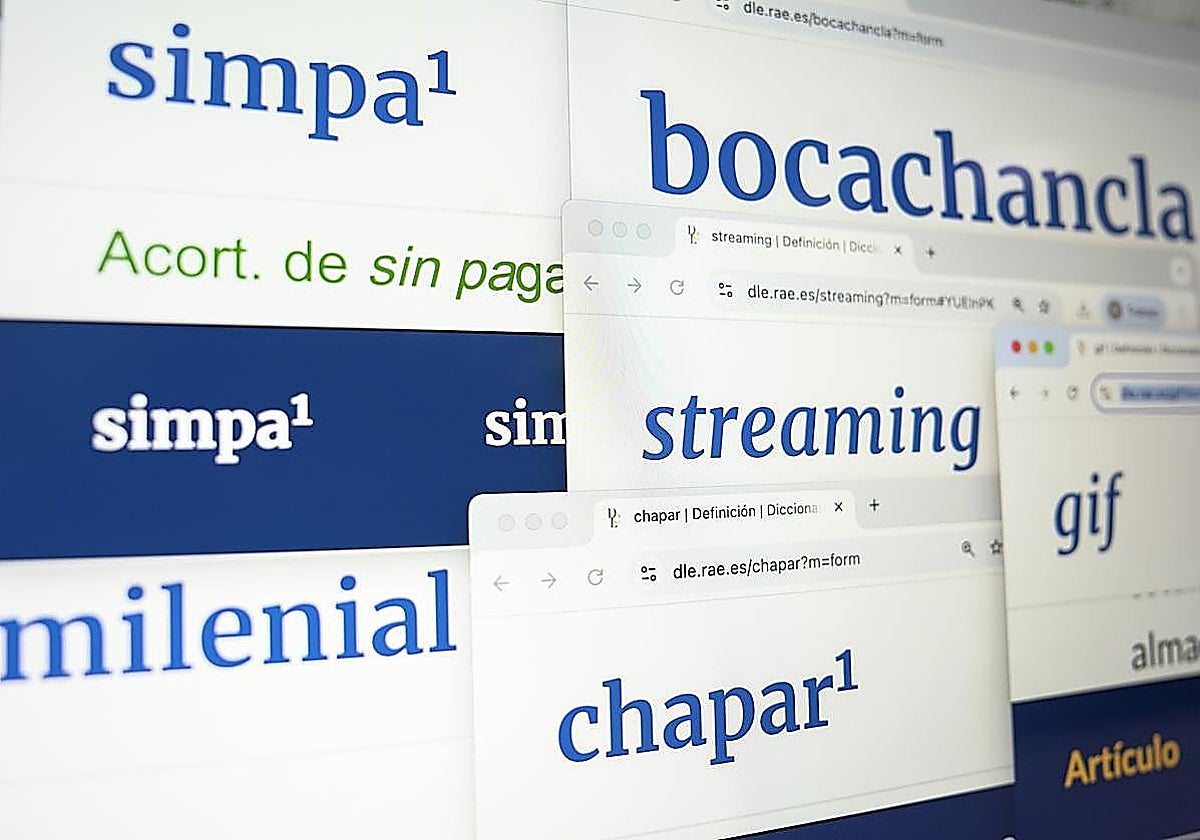
Words including milenial, 'bocachancla' (big mouth), 'simpa', brutal, 'chapar' and streaming are among the 330 new additions to the new electronic version of the Diccionario de la Lengua Española (the 23.8.1), which was presented on Monday 15 December by the director of the Real Academia Española (RAE) and president of the Association of Spanish Language Academies (Asale), Santiago Muñoz Machado, together with the head of the Institute of Lexicography, Elena Zamora. The new additions, which are already available on the website dle.rae.es, come from fields such as science, technology, the media and sport.
Among the new additions are various terms from the internet, such as 'log in'. Also added are foreign words that maintain the spelling of the language they come from and therefore must be written in italics in Spanish, such as gif, hashtag, mailing, streaming or smartphone. These words reflect "the small revolution of words that is taking place, driven above all by technology and its effect on language, and this is something that doesn't happen very often in history", Machado commented.
Once again this year, a significant number of new words belong to the field of science. These include terms such as graviton, from the field of physics, thermochemical, from the field of chemistry, or the medical terms narcoleptic, ovulatory or couperose, the skin disease characterised by reddening of the cheeks and nose. Linked to environmental studies, the term allelopathy has been added, which explains the process in which one living thing, especially a plant, secretes substances that positively or negatively influence another living thing.
From the field of meteorology come the words 'engelamiento' and 'engelante', the rain made up of drops of water that freeze immediately; from the field of nutritional diets comes crudivorism, a dietary regime that has become fashionable and consists of eating raw and unprocessed products; and from the lexicon of medicine comes, among others, autovaccine, that prepared from micro-organisms obtained from the patient themself.
330 new words
Self-consumption, Europhobe, exoskeleton, 'farlopa' (cocaine), fixing (the official exchange rate of a currency), bioterrorism (terrorism with biological weapons), 'marcianada' (in the sense of extravagant), 'microteatro', milenial, okey, 'simpa' (leaving a bar without paying), outlet, 'turismofobia' and 'mena' are some of the other terms that land in the dictionary.
It also includes 'buitre', in the sense of an unscrupulous person who seeks profit at the expense of others; brutal, as in extraordinary or marvellous; or 'braguetazo', which has been given the form of a noun: "It is a person who lives by giving braguetazos", Zamora pointed out by way of example.
Other new terms include teleportation, 'sirla' (knife) and 'sirlero'. From journalism comes 'fotonoticia', from video games comes 'comecoco', from sport comes 'centrocampista', and from martial arts comes 'nunchaco', a traditional weapon consisting of two short, solid sticks joined by a chain. Also added are piercing (which surprisingly was not there), 'cineasta' (as in film director) and the addition 'roja' to' alfombra roja', just the one that the RAE extends to these new 330 words in the new electronic edition of the dictionary.
The work adds not only terms and expressions, but also new meanings to entries included in previous editions. This is the case of the word 'direct', which incorporates the meaning referring to a radio, television or online broadcast, when it is transmitted at the same time as it is being made, or that applied in boxing and which designates the blow that is given by projecting the fist forwards in a straight line.
Another example in this sense is 'biblia', which in television refers to the document in which the plot line and the development of the characters of a series appear. The term 'bro' has not been included this time, which, according to the lexicologist Zamora, "is under study".
The digital version 23.8.1 of the document is "a sample of the work of all the academies prior to the publication of the new edition of the dictionary, number 24, which will be published next year". Muñoz Machado stressed that the 330 new words are not a "whim" of the academics and that their incorporation is the result of a "slow" process that is being studied and analysed both in Spain and in America.
![[]](http://static.vocstatic.com/voc26/latest/assets/images/favicon/surinenglish/apple-touch-icon-57x57.png)