
Military
Could military service return to Spain? Unlikely, it seems
Russia increases pressure and European countries respond with enticing offers to bolster their armed forces with younger volunteers

Madrid
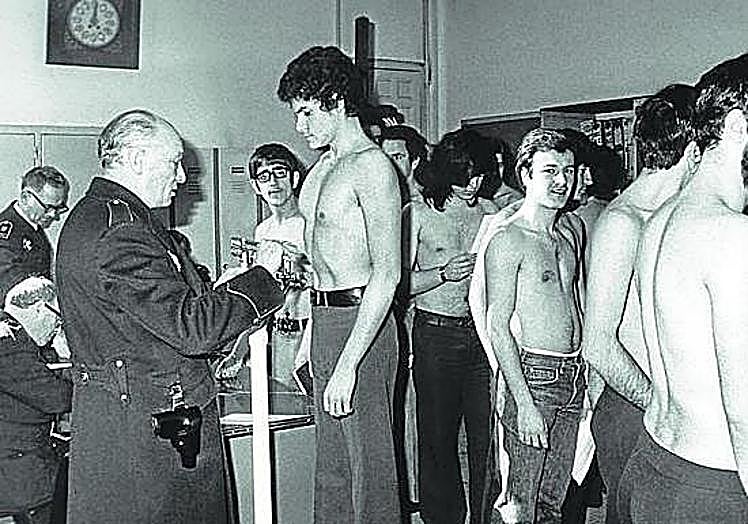
"Ladies and gentlemen, the military service is over," former Spanish minister of defence Federico Trillo announced on 9 March 2001. This historic phrase allowed thousands of youngsters to breathe a sigh of relief like never before. The nightmare of running around under the African sun in Melilla or standing guard in Burgos in an unheated guardhouse at -10C was over.
Prime Minister Aznar's government approved the decree to end compulsory military service and transit to a fully professional army as it is now. Dying for one's country was no longer a matter for everyone; only those who wanted to wield a rifle.
However, Russia's threat to the territorial integrity of European countries after the invasion of Ukraine has set off alarm bells and the possibility of the return of compulsory or voluntary military service has reopened a debate that was thought to be buried... at least in Spain. In Europe, there are already 16 countries, ten of them members of the EU, with compulsory conscription for young adults at some point in their lives.
Others, such as Belgium and Germany, are looking for volunteers to join the ranks and receive military training for a year. The Belgians offer new recruits a net monthly salary of 2,000 euros and the Germans raise the stakes to a hefty 2,600 euros gross. France, where compulsory military service was abolished 25 years ago, has been the latest to join the party and Macron has just announced a 10-month voluntary service for 18-19-year-olds to strengthen its defence.
Faced with an increasingly insecure Europe in which Putin is flexing his muscles, there is an important question: should Spain follow suit? Is the country prepared to reconvert a new generation into soldiers either out of conviction or necessity?
Federico Trillo, who at 73 is enjoying his retirement but is still very active, remembers perfectly the seven words he uttered to put an end to compulsory military service, which had been in force in Spain since the early 18th century, after the dissolution of the fearsome Tercios (the elite infantry units of the Spanish Empire, considered among the most formidable professional armies in history).
"When I implemented that decision, nobody wanted to do military service. We had two and a half million young people on deferment or conscientious objectors," he said. Today, conscription is suspended - but not abolished - as stated in Article 30 of the Constitution, point 2 of which states that "the law shall establish military obligations and regulate conscientious objection to compulsory military service".
119,366
active soldiers
as of 1 October, 2.4 per 1,000 inhabitants in Spain, far from the EU's 3.6 and Nato's 6 per 1,000.
The former minister does not see the need to recover the obligatory military service. On the contrary, he is a firm supporter of maintaining the professional model, but with more focus on the technological field. In his opinion, bringing back compulsory military service "would be useless and ineffective", because current weapons systems, war scenarios and threats, such as cyberattacks and drones, "require highly qualified personnel and not masses of recruits".
The battlefields of today
"In the past, the battlefield required what was brutally called cannon fodder; now there is no such conventional battlefield, but military targets that also reach the civilian population," the former defence minister said, advocating units that can be deployed rapidly on the ground and are capable of operating with advanced technology.
What about voluntary military service? "Perhaps as something complementary, but at the moment there is no need for it either, because in the event of a conflict, neither drones, nor cyberattacks, nor the handling of frigates, nor deployable forces, nor high readiness forces have anything to do with voluntary military service. I honestly don't know what we have to gain," he said, adding that the current system relies on volunteer reservists and civilian specialists (some 3,000 troops) who are already temporarily incorporated into the army - a model "that could be expanded with more places, without the need to return to compulsory or voluntary recruitment".
Trillo defends, however, that steps should continue to be taken to professionalise the armed forces (FAS). According to him, one of the most important is the retention of soldiers, preventing them from leaving the military to join other bodies with better salaries, such as the Guardia Civil or the National and the Local Police. "The military have to be well trained, well paid and well maintained," the former minister said.
Therein lies the crux of the matter. Miquel Peñarroya, a 63-year-old Valencian lieutenant in the reserve, presides over Asfaspro, the professional association of non-commissioned officers, the largest military organisation in the country, with more than 6,000 members, among whom, in addition to non-commissioned officers (an intermediate category made up of sergeants, brigadiers, second lieutenants and senior non-commissioned officers), there are junior officers (ensigns and lieutenants).
Peñarroya said that the army is going through an "unprecedented" personnel crisis and that if salary conditions are not improved to boost recruitment, Spain could be forced to consider a return to compulsory or voluntary military service, as other European countries are doing. "We prefer a professional army," he said, "but it must be paid as such".
Peñarroya said that the armed forces "lose personnel day after day" and that the ratio of applicants per position is so low that "practically anyone is accepted", which compromises "the quality and the demands" required to handle increasingly complex weaponry.
Working conditions
The phenomenon affects the 26,249 non-commissioned officers - "the backbone of the army", as Peñarroya described them - and even officers who leave the armed forces to join better-paid police forces. "It is scandalous that there are lieutenants who, after five years at the academy, give up their stars to become police officers."
He believes that the root of the problem lies in decades of stagnant salaries in a profession exposed to risk ("you get a recorder, we get a combat rifle") and in the lack of recognition of military training within the academic and employment system. He gave the example of a sergeant leaving the academy after three years of higher education and getting paid less than 2,000 euros. "The question is not why they leave, but how does anyone stay. The sad reality is that while billions are spent on the military industry, there is no investment in human resources. We can have 15 frigates, but only the personnel to sail one," he said.
One rung below the non-commissioned officers is the rank of troops and sailors, who are the first to deploy and enter combat in the event of armed conflict. In the army (land, navy and air), they make up 78,000 troops, the bulk of the armed forces. Atme is their main association and is chaired by Marco Antonio Gómez, 51, who has been denouncing for some time the "precarious" situation of the lowest-ranking soldiers and their salaries of "1,300 euros a month", little more than the minimum wage (1,184 euros). "More than a return to military service, which is a political decision, what we need is a professional army with decent salaries," he said.
In Gómez's view, there are neither the working conditions nor the pay to attract and retain personnel. "The army is not attractive to young people," he said, pointing out that the problem will get worse from 2027, when thousands of soldiers who joined after the abolition of compulsory service in 2001 will reach the age of 45 (the 'forced retirement' when they become special availability reservists), "far outnumbering" the new recruits. "Up to four thousand are going to leave a year and if only a thousand enter you have a serious problem, because a soldier is not trained in nine months, as in the military service, but acquires knowledge and handling of weapons with years of experience."
Lack of manpower
According to the latest report by the advisory military observatory, there is a shortfall of between 13,000 and 23,000 active-duty military personnel in the Spanish army. The 2007 military career law sets the maximum number of professional service members between 130,000 and 140,000, compared with the 116,739 cited in the report using 2024 data (as of 1 October, the Defence Ministry puts the figure at 119,366). In any case, this amounts to 2.4 service members per thousand inhabitant - well below the EU average of 3.6 per thousand and Nato’s 6 per thousand.
In contrast to those who put these figures on the table to demand a return to conscription to strengthen the army against a possible Russian incursion, president of the observatory, jurist and military law expert Mariano Casado, 63, believes that before speculating about such matters, the priority must be to guarantee the quality of life of active-duty personnel. For him, that means better pay, a more attractive career path "and resolving issues related to housing, geographic mobility and work-life balance".
Casado points to a demographic landscape with fewer young people (due to declining birth rates) and more opportunities to access better-paid jobs, especially for those with a technological profile, than "the thousand-odd euros" earned by a soldier. "We need to inspire young people; if we don't, we won't have the capacity to recruit active-duty soldiers in a geostrategic, social and economic context that has nothing to do with the one that existed nearly 20 years ago, when the law was written. The debate is far deeper than just yes or no to conscription."
Along similar lines, Félix Arteaga, senior analyst for security and defence at the Elcano royal institute, said: "Spain has no difficulty recruiting non-specialised personnel, because the number of applications still exceeds the number of available positions (nine thousand this year for enlisted ranks). But it could run into problems if the economy performs well and the military has to compete with private-sector salaries." For this reason, Arteaga calls for incentives "to attract young people and retain specialised soldiers."
Falling birth rate
There will be fewer and fewer young people to draw on to reinforce the armed forces. As for doubts about whether compulsory service is on the horizon, the Ministry of Defence won't even consider it and refers back to the most recent statements from its minister, Margarita Robles, in October: "I respect what other countries do, but in Spain it is neither planned nor foreseen."
The truth is that today's youth have little interest in putting on a uniform, no matter what the government orders. Recent surveys confirm that six in ten reject the idea and only one in ten "strongly supports" the return of mandatory military service. In the latest CIS barometer survey, war ranked as the 37th concern for Spaniards. So the day when a defence minister stands up and declares, "Ladies and gentlemen, conscription is back," does not appear to be anywhere close.
From civilian to soldiers: the choice of voluntary reservists
Defence experts argue that the best alternative to any form of compulsory or voluntary conscription is to create a "real operational reserve" made up of well-trained, well-incentivised civilians who are prepared "to be activated the moment the bugle sounds", says a former senior officer, speaking anonymously, who views this model as a bridge between society and the armed forces. This system, which would complement the existing professional military, would require "a whole legislative package" to ensure, among other things, that volunteers can "train twice a year and have their jobs protected by their employers".
The expert distinguishes between these "operational" reservists and the current civilian reservist system, which has 2,986 volunteers (400 positions have been announced for 2026) with an average age of 51, not including the special-availability reservists (7,732 members), former service personnel who have reached age 45 and receive a monthly stipend of 670 euros. "The current reservist system is not designed for someone to grab a rifle and head to the front immediately," he notes, citing the example of the US, where civilians with military training are ready to deploy to combat zones in the event of war.
![[]](http://static.vocstatic.com/voc26/latest/assets/images/favicon/surinenglish/apple-touch-icon-57x57.png)