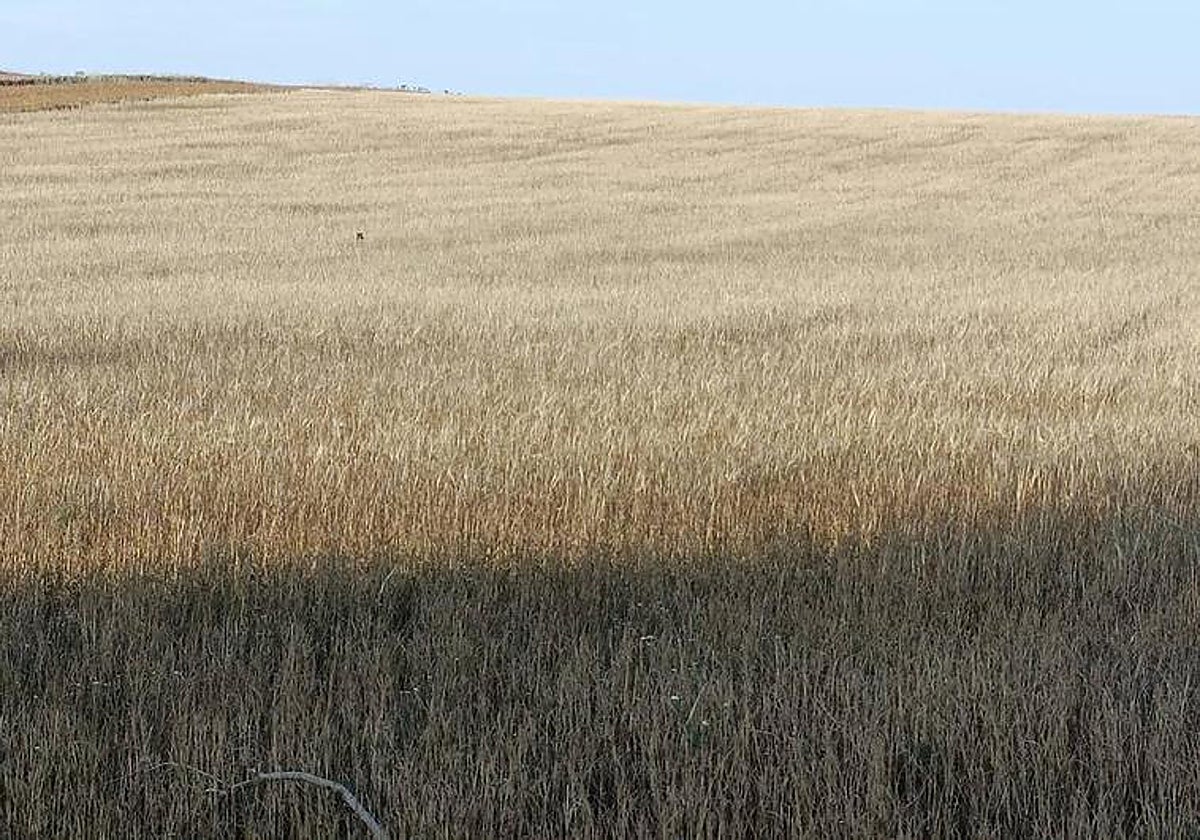
Recent rains not enough to salvage Malaga's cereal harvest
The province has about 38,000 hectares of cereals such as durum wheat, soft wheat, barley and oats, but farmers estimate that 85 per cent has been lost
Matías Stuber
Lunes, 12 de junio 2023, 14:49
Much of Malaga’s rainfed cereal harvest has been lost to the drought, farmers across the province say.
Malaga cereal farmers usually start this week reaping the wheat that has been cultivated, but the results are grim, especially in the Teba and Campillos areas. In some crops, the drop in yields compared to 2022 is as much as 85%.
President of the Campillos cooperative Benito Avilés gave his assessment of the current cereal situation to SUR: "In April and May, not a single drop fell. This has meant that the cereal has not set practically anywhere in the province."
Malaga has about 38,000 hectares of cereal crops, such as durum wheat, soft wheat, barley and oats. The areas where these crops are most concentrated are in Teba, Almargen, Ardales, Campillos, the area north of Antequera, the Serranía de Ronda and the Guadalhorce Valley. In 2022, the turnover was about 47 million euros from a production of 72,520 tonnes. In 2023, as Avilés confirmed, the harvest will be nowhere near last year’s.
"We will be light years away from 2022, which wasn't a year to shoot off rockets either," he said. If there is anything that has held up, it is in the cooler areas of the province. But there, the little grain that there is weighs very little and is not enough to prevent major losses, he added.
Mayor of Teba Cristóbal Corral said the damage is “very great". Asked if the latest rains have helped, he said that they hadn’t: "These rains only serve to improve the future olive season. The cereal harvest is practically lost." "Teba and Antequera, major cereal-growing municipalities, are screwed,” he said.
A black year
Dcoop's cereal director, Juan Carlos Rodríguez, has been working with cereal farmers in the province of Malaga for 30 years.
He described 2023 as the "worst in history". "No area in the province will be spared. In Campillos we are talking about losses of 80%, in Antequera 85% and I would go as far as to say that in Teba, there is even a 90% drop,” he said.
He also pointed out the problem of expenditure. Rodríguez said that the price of seeds has been one of the highest this year and fertilisers have reached a record price. "You have higher costs than ever before and a harvest that is tending towards zero. It is an absolute disaster,” he said.
The vast majority of the cereal grown in Malaga is destined for the production of animal feed. According to experts, 10% is used for human food (soft wheat). Another small part of the barley production is used for beer production. In 2023, none of the sectors will be able to be served with cereal from Malaga.