
Interview
Malaga Airport's 1.5bn euro expansion will allow the Costa del Sol to be connected to 200 destinations
In an exclusive interview with SUR, the airport's managing director Pedro Bendala reveals the schedule for the plans that will almost double the size of the current close-to-capacity airport

Malaga
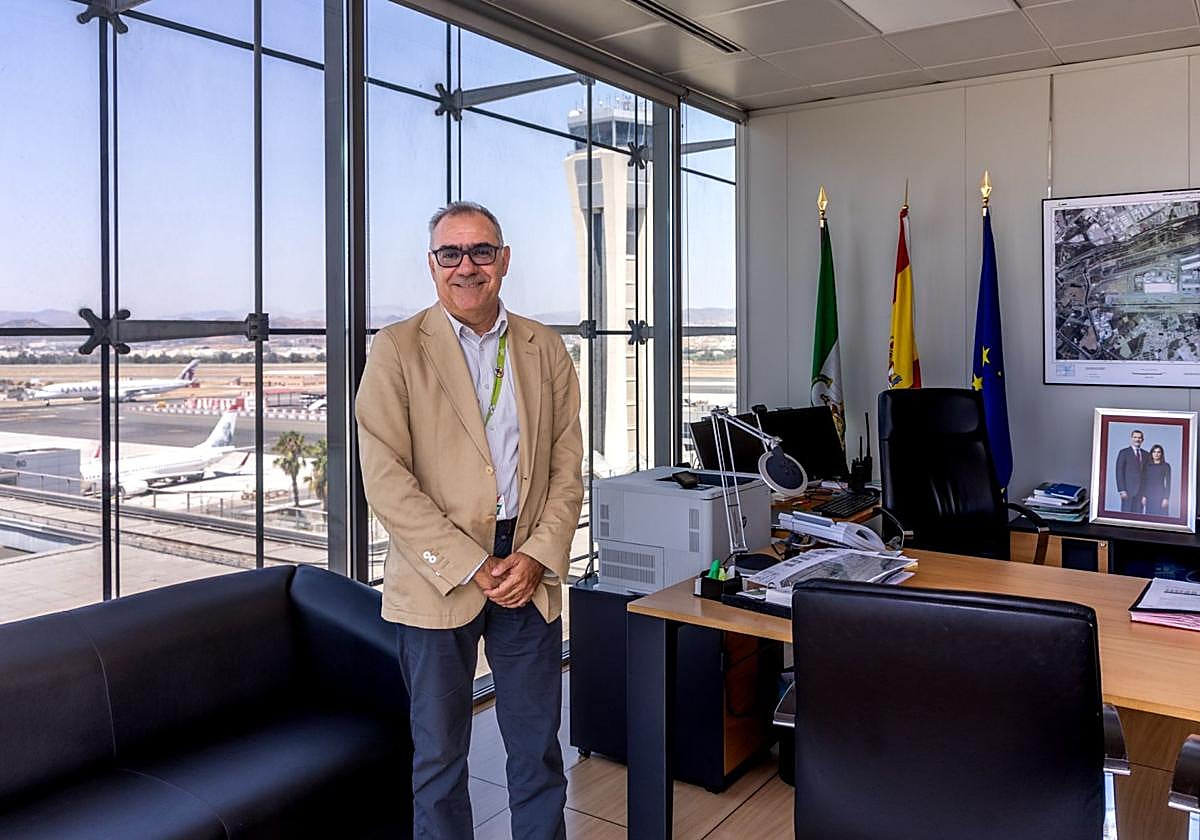
In an office with a whole wall of glass panels overlooking one of the runways where planes are constantly taking off and landing, Pedro Bendala, managing director of Malaga Airport, focuses his gaze on the functional design document for the airport expansion that he has in the centre of the table. He knows this document like the back of his hand because he and his team have been working for months and months on this project, a project that will entail an investment of 1.5 billion euros to almost double the surface area of this infrastructure, increasing the spread from the current 80,000 square metres to some 140,000 square metres.
Related story
-
Ignacio Lillo / Pilar Martínez
This undertaking will also increase the security control area equipment area by 112%, passport control at departures by 515%, the non-Schengen waiting and boarding area by 381% and the Schengen flights area by 126%. Bendala goes on to list the new features that are also stated in this document, expansion plans that could be a reality in eight years' time. "We are working to ensure that work begins in the last quarter of 2028," he states, without hiding the fact that this project is an exciting challenge. It is not the first time that he has faced such an expansion. He has already been at the forefront of the Barajas and El Prat airport expansions in Madrid and Barcelona. The expansion at Malaga Airport took off at the end of July with the approval by Aena's board of directors of the public tender to select and contract the specialised aeronautical consulting firms that will be in charge of drawing up the terminal renovation projects at an estimated cost of more than 36.5 million euros.
- What will the announced 1.5 billion-euro expansion of this infrastructure mean for the airport and for Malaga as a destination?
- It's going to mean a lot. We often talk here about our role in this area and the service that the airport provides to society. This expansion, with an investment, as you've said, of 1.5 billion euros, has three fundamental pillars. One is to increase the airport's capacity. The other is to improve all aspects of sustainability. We're going to use new technologies that will reduce our carbon footprint and our water consumption. Let's say that, from an energy sustainability point of view, we're going to put it at the top of our game. The construction of the buildings themselves will have the highest standards in terms of sustainability and efficiency. And the third pillar is to improve a commitment that has been made here in Malaga, in consensus with many associations, and that is accessibility. We want the airport to be a benchmark in terms of accessibility for all types of passengers. It will be global accessibility.
- When could the expansion work commence?
- We're working on them being able to start in the last quarter of 2028. Until then, the construction projects will be drawn up and the work will be put out to tender.
-What are the deadlines for making this overall project a reality?
- This is a very ambitious expansion and cannot be implemented overnight. It entails an investment of 1.5 billion euros and doing so in a short amount of time is impossible because there is no capacity to deliver to that timescale. As for the deadlines, the tender for drafting the project was put out on 29 July. Bids must be submitted by 18 September and I hope that, by the first quarter of 2026, we can award the contract to an engineering and architectural team to draft these projects. These projects will then have to be put out to tender. Logically, a tender for these amounts takes time.
Project: "The airport will have all processes digitised"
- How will these projects, which will almost double the current surface area, be carried out?
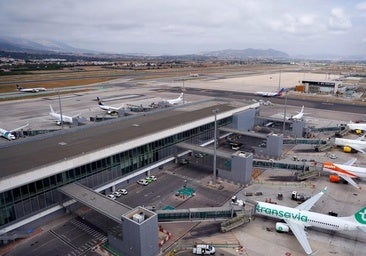
- There will be several phases because we are going to build a new pier, a new boarding dock for non-Schengen traffic, but we also have to work on the old piers B and C - where the boarding gates for non-Schengen destinations are currently located - which will be eliminated. We have to expand what is currently Terminal 2 to the south, expand the processing area, which is this large building that houses security checkpoints, and extend it to the east to increase its volume. Therefore, all of this cannot be done simultaneously. The work will have to be done in phases, I believe in four or five, and then they will gradually come into operation. Furthermore, we are subject to DORA (Spain's airport regulation document), which sets out the investments that have to be made, the quality of service that must be provided and the tariffs that we could charge. And in DORA III, which runs from 2027 to 2031, this work will begin. In DORA IV, between 2031 and 2032, we expect the first phase to be completed, which is likely to include the entire new boarding pier for non-Schengen traffic, meaning international traffic from non-EU countries and the processing area, with the expansion of security checkpoints and passport controls. By 2033-2034, the demolition of boarding docks B and C and the expansion of the Schengen areas to the south will be completed. It's a very ambitious process. Imagine investing 1.5 billion euros over five years, which is about 1,800 days, that means spending almost one million euros per day. That's a hefty rate of investment. Executing projects of this magnitude requires more time and a huge amount of human and material resources.
- But is ten years a feasible timeframe for this airport expansion?
- Yes, it will be ready in less than ten years. It will be during this DORA period, which starts in 2027, that they will start and it'll be within 2032-2036 when all the work will be completed. I believe everything will be done in about eight years.
- Are you concerned that, with the 36 million passengers expected in the expansion and with this project, the airport will use up all its surface area?
- No. The 36 million passengers is a starting point for airport systems including security checks, passport control, check-in, baggage reclaim, boarding and aircraft parking. The 36 million is a first phase. With the planned number of gates and square metres of departure lounge space, the capacity will be sufficient for far more than 36 million passengers.
Timeframes: "I hope we can award the project in the first quarter of 2026"
- Aren't you afraid of reaching the ceiling?
- No, there is no ceiling. The ceiling will be set by Malaga, not by the airport. We now have 26 boarding gates at the airport. When all the work is finished, we'll have 48. That's almost double. Obviously, if we say we can now handle 30 million passengers without any problem, then with 48 we should be able to handle whatever is needed. Furthermore, we're going to implement new technologies at passport control checkpoints that, as I said, will be digital, and at security checkpoints we will already have equipment that renders it unnecessary to take out of hand luggage any liquids or electronic equipment. We'll have all the most innovative technologies and, therefore, we'll increase the capacity of many systems with almost minimal interventions. What we'll have resolved are the important actions, which are the number of boarding gates, bridges and the square metres of space where passengers can wait. This is something we will have in the bag for many years to come.
- My understanding is that this is for more than the 36 million passengers mentioned so far...
- For many more. I don't want to give a specific number, but I stress that, if with 26 gates we have a capacity for 30 million passengers, with 48 (nearly double that), a calculation can be made. What we have to provide is capacity. Airports don't work with millions of passengers per year. We work with figures around how many flights per day, how many passengers per day, how many flights or how many travellers per hour?
- And if in July there were peaks of 689 flights and almost 100,000 people per day, what figures will we be talking about with this new expansion?
- Well, if with the current 26 gateways we have moved almost 2.9 million passengers in July, so with the expansion we almost double them, we could record five or six million passengers in a month like that. January and July are not the same thing, although we are deseasonalising at a very strong rate and I think this is very good for the region. The new profiles of technological professionals and digital nomads, who no longer only travel in search of the sun in July, but also in March, October and November, are having a great impact on this.
Capacity: "With 26 gateways, we have capacity for 30 million travellers. With 48 planned, a calculation can be made"
- Have you considered that, when the time comes, Granada airport could become a satellite airport to Malaga?
- No. Such a situation is so far off that I don't think any of us will ever see it. Granada is a complementary airport. I don't see on any medium or even distant horizon that Malaga Airport's capacity requires an alternative infrastructure. And I've already told you that there are airports around the world that handle 50 and 60 million passengers and would love to have our infrastructure, the size of our airport and its development capacity.
- Can Malaga climb a notch and become the third largest airport in Spain with this expansion?
- Expansions aren't done to get into any ranking. We want everyone to grow. The airport's role is to tell the tale of Malaga 1.0, which was the agricultural Malaga of the 19th century, where these facilities were one of the catalysts for Malaga 2.0 to exist, which was the Malaga of the 20th century with the development of tourism. It was already a destination where we didn't go elsewhere for work, but rather a place for people to come. Now, the new expansion project is aiming to develop Malaga 3.0, which is a Malaga faithful to what it's always been: a land open to the outside world.
- What will this 'version 3.0' airport be like?
- Well, it will obviously have to be digital, in the sense that everyone will have the autonomy they want to move around the airport, whether it's going through passport control or boarding a plane, or checking in without the assistance of real people. There will be staff because there are those who aren't digitally savvy and those who don't want to be. But other travellers who value their autonomy and not depending on anyone will be able to move around this way because the airport will have fully digitalised all its processes.
- In terms of connectivity, will it allow a leap into new markets?
- Yes, because the third point behind this Malaga 3.0 has to be a social Malaga that is committed to a type of tourism that adds value. Historically, this destination has had tremendous presence overseas. We are currently connected to 139 different cities and the airport expansion will allow us to increase that number and, in ten years' time, we will be connected to 200 cities and the five main continents. This will mean that the destination will have a cosmopolitan atmosphere like the world's great capitals without having to be the capital of a state. This will be the advantage that Malaga will have, be it professional, cultural or culinary. Just look at how this technological Malaga is making itself felt in the profile of travellers passing through the airport.
Connectivity: "There are state capitals that won't have as many connections as Malaga"
- So that readers can imagine what the new airport will be like. What new features will it provide?
- Indeed, it will provide new features. We aspire to have a hotel and a logistics area and we are also aiming to have an office area outside, more parking, more VIP lounges and more shops. There will be a large terrace. But, above all, we aspire to what is intangible and will add more value. That is, an accessible airport so you can leave the plane and, until you reach your car, you can get around in a wheelchair without having to separate from any companion, without having to take a lift, but instead all access via ramps. We want an airport where you feel a certain level of comfort because the lighting is natural throughout. We will also have air-conditioning and bioclimatic technologies. It will be a much friendlier airport, designed with the human touch. That's what we have to demand from the teams of architects and engineers. All of this is what will make the difference. We come from very functional airports. Now we want people to really feel at home at the airport. That's the challenge.
- We were just talking about that impressive figure in passenger numbers for July. What do you value most about this growth and what's your greatest concern?
- What I value most is that, with the good work of the Aena teams and the companies that collaborate with them and, in particular, the people who work here, we're doing more and more with less. We have very well-sized resources and we're managing the traffic that's arriving without any tension. In fact, we broke the record of almost 2.9 million passengers in July, but there's no indication, either in public opinion or in-house, of any excessive tension. We have the necessary tension to be able to manage, but not that we're on the verge of a nervous breakdown. We're all calm in the sense that we've been working through the winter in preparation for summer and, in some way, what you plan then comes to fruition. What worries me most, like everyone else, is the international context, because airports are very sensitive to movements and border crossings. Tourism is very sensitive to geopolitical tensions and it's something we cannot control, we can only manage it to a certain extent.
- What are the new challenges for this infrastructure?
- The challenge is the new airport, the Malaga 3.0, which has to be digital, environmental and social. The digital aspect is moving fast with the incorporation of artificial intelligence and new technologies that provide security in processing times. We now have control and information on almost everything that happens at the airport. It's not that it's a kind of 'big brother', because we don't know who the people are, but if you ask how many people have gone through security in the last 35 minutes, I can tell you, or how many people will show up at passport control in the next hour, or how many have boarded. I could even tell you how many made purchases in the shops. Everything will be digital and we can use that information, not for control purposes, but to improve the service and tailor it to real needs. We will be environmentally friendly because we will use the resources we have optimally. The first of these is the land itself. That's why, with the land we have at this airport, we don't need more, nor will we consume more. We will maximise its efficiency and we will do so by improving our procedures and being highly effective. And the third element is the social one, which is understanding the challenge of providing a service to society. One of Malaga's competitive advantages for the people of Malaga and Malaga-based companies is having 139 cities to which they can fly every day. We have very high connectivity.
- Speaking of connectivity, what are the expectations for new flights to China, Japan or new cities in the United States?
- As far as the United States is concerned, the temporary United Airlines route to New York, although we have to wait until the end of the season, is going quite well. From the airport's perspective, we see the flight performing well. We even always think that, if we had more capacity, the flight would also work well. As for the winter season, we see the airport becoming more seasonally adjusted. More and more airlines are extending their summer season, almost running to the end of October, and I think we're going to have a good winter season because airlines will continue to bet on Malaga. I hope that the medium- and long-haul airlines will do the same, but that's their decision. There's a shortage of aircraft worldwide and I think that, as the new fleets arrive, some routes that I think are currently viable will probably be implemented. In particular, the one to New York. I'm optimistic, but it's the airline's decision.
- And are there negotiations with new US cities?
- We participate actively and are very proud of the work being done at the connectivity roundtable where all the governing bodies and everyone else is aligned and success is viewed collectively. It's a team effort and I always congratulate all the participating authorities because I welcome their very generous attitude. Many things are discussed at these roundtable meetings. Obviously, expectations, dreams and desires, and we talk to the airlines, presenting business cases to them, telling them that, if they fly to this destination, they can get it for this cost and it could be viable at this average ticket price. I think things are going well. There are expectations. I think we're going to consolidate more and more flights to Europe. We'll soon announce new destinations with European capitals. We're going to be super-connected around this continent. There are many state capitals that won't have as many connections as Malaga Airport. We continue to strengthen our presence in the Middle East. Qatar Airways now flies year-round to its hub in Qatar, and in summer we have Etihad and Saudia, in addition to Turkish Airlines' daily flights to Istanbul.
- Could Qatar Airways' experience encourage other airlines to maintain year-round flights to Malaga?
- I think some may be considering it. Whether they take the plunge is another matter, because these medium- and long-haul flights carry more risk than short-haul flights. Plus, they have to fly an aircraft with more than 300 or 350 seats, which isn't the same as selling 180 seats. But, for example, these flights are doing very well, not only to these destinations, but also with stopovers. They're selling many connections not only to China, Japan or Korea, but also to the Maldives or India for people going on holiday there. These routes are doing well because of something we've always said: that we'd all like to have long-haul flights to Beijing, Seoul or Tokyo. But if we don't have them, it's no big deal because, with the two-hour stopovers offered by direct flights to Istanbul or Qatar, we're already flying from Malaga to Beijing, Seoul or Sydney. I'd even go as far as to say that the fares are even better than if it were a direct flight. One day, if the airline sees this as a viable business case, it will fly from Malaga non-stop.
- Are you confident that Malaga will have a direct flight to China by 2026?
- We have a lot of indirect traffic with China through these major hubs. The important thing is that airlines can get to say if there are so many people going via Istanbul or Qatar, then maybe I can consider exploring a direct route, because there's a large enough market.
- What's your assessment of the summer?
- Summer ends when it ends. It's like a football match where you say we've already played the first half and, if we've done well, I'm not going to tell you how well we've done when we still have the whole second half left and we have to fight for it with the same fervour, the same desire, the same professionalism and the same enthusiasm as the first half. So that's it. We can say that the first half went well and we have to keep fighting for the second half.
Markets: "With two-hour stopovers on flights to Istanbul or Qatar, you can now fly to Beijing, Seoul or Sydney"
- But are the figures released for August better than those for 2024?
- Yes, the scheduling of flights and seats is good in August. You can walk around the airport and see that the planes aren't empty, they're full. Let's hope they continue to fill up.
- I imagine we'll have to wait until the end of the year to make a forecast for the financial year...
- I can say that up to July we have had a 7.8% growth in passengers, but the international context, far from becoming more certain every day, is becoming more uncertain. That's why I reaffirm that I have to be more cautious about the second half of the year. Fortunately, Malaga is a very mature destination that has a well-established and recognised brand and it is highly valued for its safety. And that's an advantage when there is uncertainty in the world, because people are looking for safe havens and we are seen as such.
- At this rate, will we reach 30 million passengers, which is the maximum capacity, in 2027?
- I don't know, 2027 is a long way off. We're focused on 2025. Furthermore, 30 million is a capacity figure included in DORA II and is an indicative figure. Airports are airport systems and it doesn't mean that, when we reach 30 million, we'll run out and there's no room left. Rather, perhaps by increasing a security filter or putting a few more aircraft on the hard-standing [no gate and bridge] or adding more cabin space - in other words, by taking small steps, we can increase that capacity by one, two or three million if necessary without losing much quality of service.
- How do you view the expansion?
- Undoubtedly, it's an exciting challenge.
![[]](http://static.vocstatic.com/voc26/latest/assets/images/favicon/surinenglish/apple-touch-icon-57x57.png)