
Transport
Malaga transport forum discusses future of decarbonisation
More than 5,000 experts and 200 companies met at eMobility 2026 event in Malaga to discuss how to decarbonise transport without relying on solely on electric vehicles
Antonio Contreras
Málaga
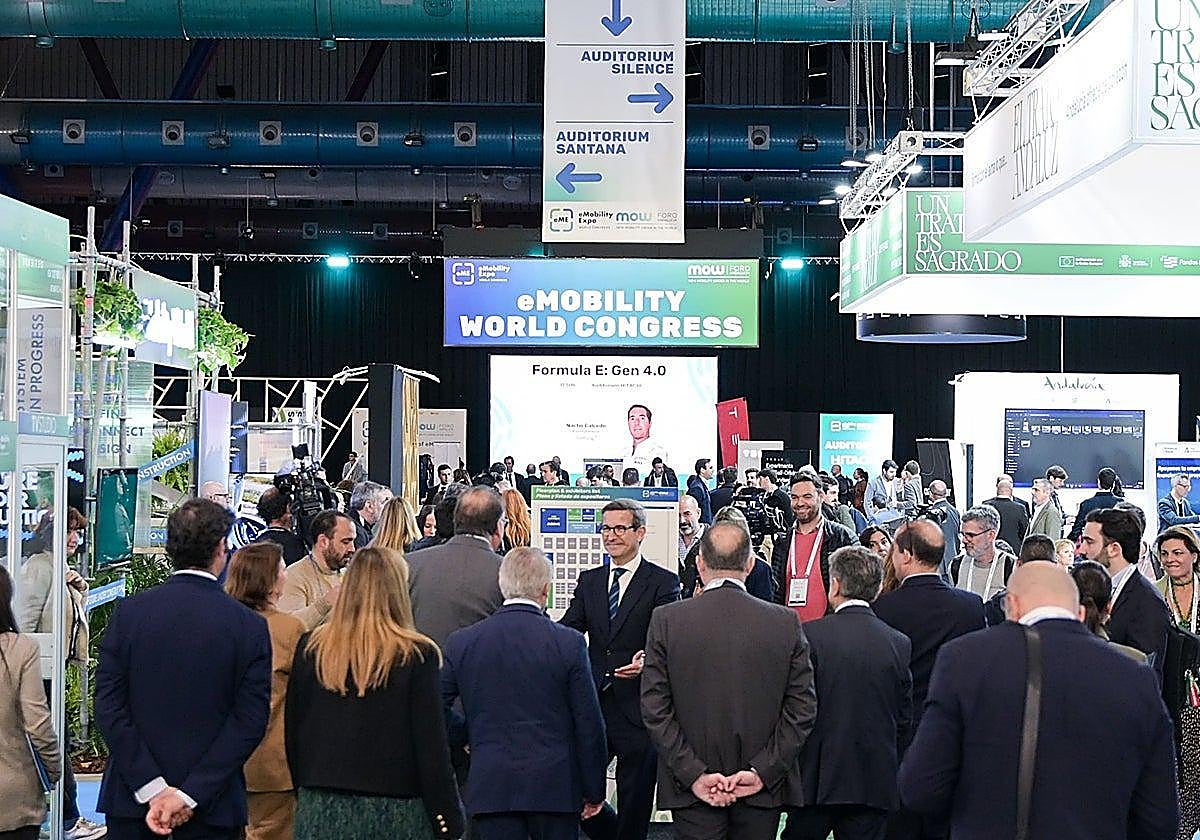
The eMobility MOW 2026 forum in Malaga over the past two days has ended with an idea that experts, institutions and manufacturers share: the decarbonisation of transport cannot only involve electric cars.
The event at the Palacio de Ferias y Congresos brought together more than 5,000 professionals and 200 companies to discuss the future of transport. They all agreed that the most successful model involves a variety of vehicles: from full-on electric vehicles to those that use hydrogen and sustainable fuels.
Meetings in five auditoriums focused on how to adapt the industry to the present and the future. A total of 376 experts from all over the world took part in debates on the future of the automotive industry, the air, rail and maritime industries, urban transport and logistics.
The objective is clear: pursue decarbonisation and get as close as possible to zero emissions, but remembering that the future is not purely electric. The future is multi-energy and the market must adopt new technologies in an organic way, without forgetting the fundamental right of free movement and people's economic capacities.
Head of the International Automobile Federation (FIA) Carmelo Sanz de Barros said that there is still room for other technologies on Spain's roads: "Reducing the debate to a single technology impoverishes the transition, while diversification strengthens it. Technological neutrality is not a defence of the past, it is a guarantee for the future, guaranteeing European competitiveness."
Transport challenges
The challenges facing transport are diverse. In aviation, for example, electric engines do not have the same place as in land vehicles. Instead, the sector is focusing on the application of artificial intelligence to optimise systems and on promoting sustainable aviation fuel, better known as SAF.
"AI has the capacity to analyse terabytes of data to find optimal performance," Valencia University Professor Pedro Manuel Quintero, said.
While some sectors and professionals view the 2030 agenda with suspicion, for Deputy Director of Transport & Environment Ioan Bucuras maintaining this goal is essential and strategic. "We have seen companies abandoning the agenda, but this discourages progress and investment," he said.
On land, the electric vehicle as the dominant technology is having a slower than expected transition. In 2025, it exceeded 100,000 registrations in Spain for the first time. However, infrastructure keeps lagging behind automotive developments.
"Of the 50,000 chargers in Spain, 20 per cent do not work. Of the remaining 80 per cent, 60 per cent are in cities, which is where they are least needed," Product Development Manager for Ayvens Salvador López said.
The outlook for motorcycles is even worse. While registrations of combustion engine motorcycles continue rising year after year, surpassing pre-pandemic levels, electric motorcycles have stagnated in recent years, with a negligible percentage of registrations (254,183 combustion engine motorcycles registered in 2025 compared to 11,037 electric ones).
Experts and companies advocate for technological diversity
For General Secretary of Anesdor José María Riaño, aid for the purchase of an electric vehicle discriminates against motorcyclists. "For an electric motorbike to be eligible for aid, it must cost less than 10,000 euros before taxes. This leaves a huge number of motorbikes out of the picture. In addition, those considered mopeds are not eligible for subsidies either," he said.
Another obstacle lies with charging stations: many of them do not have sockets compatible with motorcycle charging.
These challenges affect not only the type of vehicle but also its intended use. Accounts Deputy President at Scoobic Juanma Rufino stated that vans don't fit into the new urban landscape.
"We've been wasting our time for the last three years. If we were waiting for a gun to our head, now we have it. Vans and conventional vehicles have no place in this new urban concept," he said.
Subsidies for the purchase of vehicles for the self-employed
One of the major announcements of the Andalusian regional government during the MOW transport conference was the Renove plan, which will allow self-employed workers to give their old car or van for scrap and receive 3,000 euros to buy a new low-emission vehicle.
The Renove initiative involves the scrapping of cars that are at least ten years old. Applicants' new vehicles must have emissions of 120 grams of CO2 per kilometre or less. In addition, their price should not exceed 35,000 euros plus IVA tax.
Acquisition can be through direct purchase, leasing or renting. The biggest advantage is that the 3,000-euro discount is a direct benefit, with 100 per cent of the aid paid upfront upon approval. The regional government has earmarked five million euros of its own funds for the Renove plan.
Self-piloted drones for people, a hydrogen-powered boat and truck
In addition to the dozens of talks that took place, numerous companies took advantage of the event to showcase some of the latest innovations in the sector.
Dhamma Blue, for example, positioned an eight-metre-long boat in the middle of the esplanade. The main innovation of this vessel, developed entirely in Spain, is its propulsion system. "It's an electric boat that solves range problems thanks to a fuel cell powered by an eight-kilogram hydrogen tank. The only byproduct this generates is water vapor," developer Pedro Imaz said. Thanks to this technology, it is capable of travelling an average of 65 nautical miles at twelve knots.
Hydrogen and electricity are also the power source for the truck cab which EH2T and ITA brought to the exhibition. The major innovation of this system is creating a vehicle capable of charging its battery without needing to refuel, while still emitting no pollutants thanks to the hydrogen fuel cell as a generator. Furthermore, this project isn't based on a platform specifically designed for this system; instead, it recycles existing trucks, removing their conventional diesel engines and converting them into electric vehicles.
"The idea behind this truck is for it to be a rolling laboratory where companies can test zero-emission technologies under real-world conditions," one of the project managers said.
The star of this exhibition space was undoubtedly EHang with its EH216-S, an autonomous drone for passenger transport that aims to make this type of mode accessible to as many people as possible. They have already obtained authorisation to operate in China. According to Ehand's Deputy President for Europe and Latin America Ricardo Ortega, they are "collaborating with various civil aviation authorities and regulatory bodies to obtain this certification", with the intention of beginning operations in Europe before 2035.
The future of transport lies in multi-energy, not just electric cars
The eMobility MOW 2026 turned the Palacio de Ferias y Congresos into a fountain of knowledge, with more than 400 innovations from 203 exhibiting companies. Despite differing opinions, there is a common goal: reduce emissions and make the transport of tomorrow more sustainable than that of yesterday.
Special commissioner for reindustrialisation of the Ministry of Industry Jaime David Peris closed the forum by pointing out that "the transition towards decarbonised transport cannot mean a deindustrialisation of the continent", but "a unique opportunity to strengthen industrial bases, technological capacity and strategic autonomy".
He expressed his confidence that Spain can become "one of the European destinations for industrial investment in transport and energy transition", relying on a consolidated industrial base, qualified talent and a firm institutional commitment to projects.
"Sustainable transport must also be possible transport. Environmentally sustainable, yes, but also economically and socially sustainable. We cannot speak of a just transition if part of society is excluded. We cannot move towards climate neutrality by generating economic or territorial fractures. This sector provides millions of jobs and we cannot put them at risk", Sanz de Barros said.
![[]](http://static.vocstatic.com/voc26/latest/assets/images/favicon/surinenglish/apple-touch-icon-57x57.png)