Housing and communications mark the changes on the list of population figures
The stagnation of Vélez-Malaga and Torremolinos contrast with the exponential growth of Fuengirola and Mijas

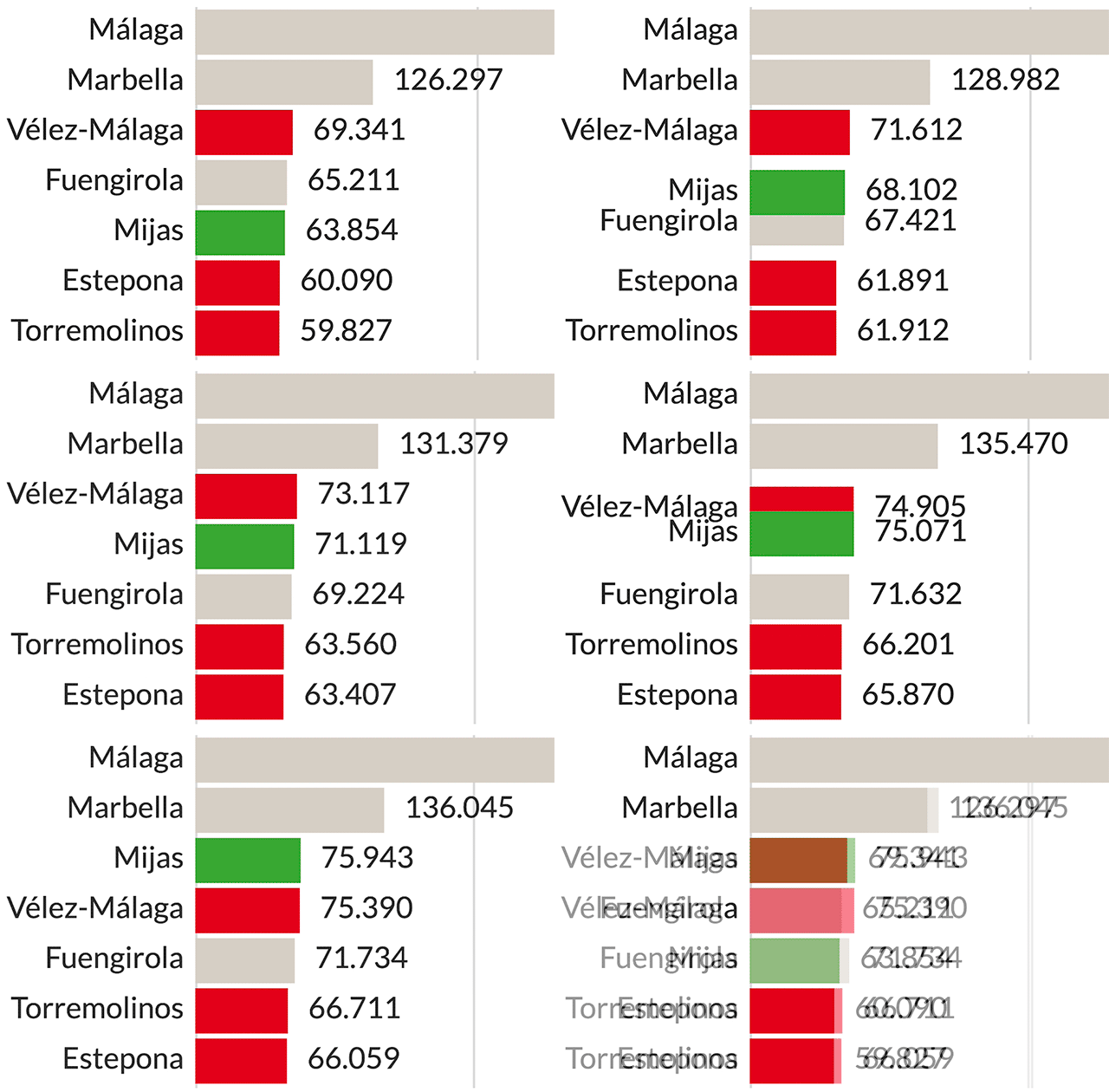
At the beginning of this century Malaga and Marbella occupied the top two places in the ranking of municipalities by population and they maintain those positions 22 years on, although they are practically the only ones which are still in the same position on the list.
The price of housing and inequality in communications have modified the rest of the map, on which two places on the Costa del Sol - Mijas and Fuengirola - stand out because of their high population increase, something that also applies to the 'dormitory towns' near Malaga city, where the numbers of inhabitants have almost doubled.
On the other hand there are towns where the population level has been more stagnant, such as Torremolinos and Vélez-Malaga, which have gone down several places on the list of 17 places which have more than 20,000 inhabitants.
Although Malaga city is by far the place with the highest population, in the past year the number of people registered as living there has dropped by around 1,000, leaving a total of 577,405. This is in strong contrast to Marbella, which has the second highest population in Malaga province. It is home to around nine per cent of the nearly two million people who live in the province (1.7 million, to be more exact) and has the seventh largest population in Andalucía, with more residents than some provincial capital cities such as Huelva.
According to data from the town hall, the number of people registered in Marbella on 1 January this year was 156,903, which is nearly 9,000 more than a year ago. This confirms the exponential growth on the Costa del Sol which can also be seen in nearby towns. Mijas is one example - since the year 2000 it has risen from sixth place on the list to third - and the increase in its population even applies to foreign residents: the total number is now back to where it was before Britain left the EU. In the past 12 months, the population of Mijas has grown by more than 2,200 to a total of 91,154, according to the municipal population register.
"Mijas is continuing to receive new residents, people who have chosen to live here because of the quality of our services and the friendliness of our people, and that shows that we are doing things well," said the mayor, Josele González, recently.
Among some of the most striking figures is the fact that people of 127 different nationalities now live in Mijas, and the British community is once again the most numerous at nearly 10,000 people. This makes Mijas the place in Andalucía with the highest number of British residents. The second community in terms of size is Scandinavians, with 2,886 of whom 900 are Swedish.
The situation in Fuengirola is similar, although it has only moved up one place (from fourth to third) on the list in 22 years. The population register showed 84,000 inhabitants on 1 January this year.
Benalmádena is another place which has seen a considerable growth in its population, having risen from tenth to seventh on the list. From approximately 30,000 inhabitants in the year 2000, it now has more than 72,000.
However, Vélez-Malaga and Torremolinos are at the other end of the scale. They have dropped several places on the list despite an increase in their populations, because their growth has been more contained than elsewhere, although for different reasons.
Noticia Relacionada
Commuter towns have doubled their populations in the last 20 years
In the case of Vélez, it has been hampered by an asymmetry in terms of communications compared with the western Costa del Sol, while Torremolinos is still having to work to its 1996 Urban Plan, which impedes its development.
"Torremolinos grew very fast in a very short time. It was the first, the bastion of growth on the Costa del Sol, and the standard of life is higher than in other metropolitan towns," says Remedios Larrubia, the head of Human Geography at Malaga university.
She says that some parts of the province (such as Vélez) have been left behind. "It is evident that the communication networks are more fluid on the coast and although it still has many shortcomings, the railway plays an important part. The suburban line could work better on the western coast, of course, but it doesn't exist at all east of Malaga," she points out.
In her opinion, the difficulties of connecting with a town like Vélez have a great effect, leaving it basically as an exclusively inland municipality. That is in contrast with the western side of the province, where the train and also the good roads provide greater dynamism.
"For years there has been a policy which has enabled people to make their lives in places like Fuengirola or Mijas without needing to go to Malaga or Marbella. They are also towns with good environmental standards and a location that attracts people," says Larrubia. She does, however, point out that even in this area some things are lacking: in fact, although Mijas has the space to continue growing (every year a new record is set for building licences), Fuengirola is more concentrated and apart from a few specific exceptions in the form of residential developments which are being built, it has no more land available.
"There is clearly an intention to create services for the growing population," says Larrubia, but she warns that education and health care are major problems. Despite more than 175,000 inhabitants living in Mijas and Fuengirola (in some cases on different sides of the same street), there is no local hospital. "In this case, their proximity to Marbella is clearly detrimental to them," she says.
Economic dynamism
In the inland region of the province the picture is very different. Remedios Larrubia says Antequera and Ronda have "a certain economic dynamism" but their populations are not increasing and they are not moving up the ranking. In the case of Ronda, it has gone down from ninth to 12th place, while Antequera has dropped from eighth to 11th. In both cases the populations have changed very little since the year 2000.
Despite this, she doesn't believe that Malaga is suffering as badly from depopulation as some other provinces of Spain, apart from very specific areas such as the Alta Axarquía and the Genal Valley. Even so, some positions on the list have been changing, such as in the Guadalhorce Valley where Coín has moved down compared with other towns like Alhaurín el Grande, Cártama and Alhaurín de la Torre, which are closer to Malaga city.
Within the province there are also cases like that of Júzcar, which was the municipality that gained the most population in 2020, according to a report published recently by the National Institute of Statistics (INE), which takes as a reference the information on the municipal population register in a year that was marked by the pandemic.
Júzcar (9.85%), Cartajima (7%), Canillas de Albaidas (6.9%), Casares (6.7%) and Atajate (5,9%) are the five municipalities which saw the greatest increase on their population registers in relative terms. Among the ten villages with the highest number of new entries, more than half have fewer than 1,000 inhabitants and none of them has as many as 20,000.
The statistics from the INE also show something striking: the two villages with the highest percentage increase in their population (Júzcar and Cartajima) border the two which have lost most of their relative population: Faraján and Pujerra, with a drop of 4.2 and 3.2 per cent respectively.