
Migrants
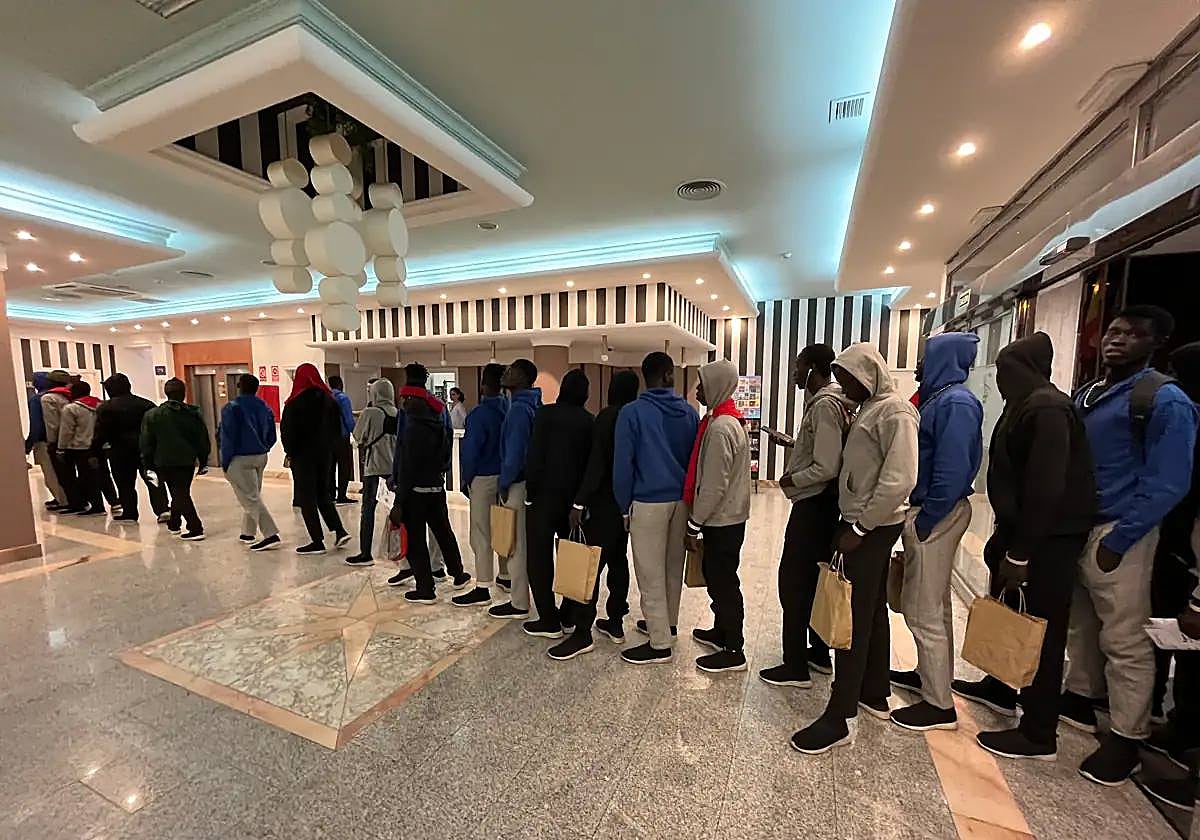
Red Cross programme to help almost 400 migrants in the Axarquía comes to an end
Mayor of Torrox Óscar Medina highlighted "the absolute absence of incidents" following controversial comments made by councillor Salvador Escudero in October when he compared the men to animals and suggested they might "steal a car"
Eugenio Cabezas
Torrox-Costa
The Red Cross programme to provide care and support to 385 migrants at the Urban Beach Hotel in El Morche, Torrox-Costa came to an end on Tuesday 14 December. The men, mostly from Senegal, but also from Morocco, Algeria, Tunisia and other countries, had been staying there since the end of October.
According to Red Cross data provided to SUR on Wednesday 13 December, of the 385 people staying in Torrox 61 were vulnerable, one minor was referred to the Junta de Andalucía’s protection services and 64 have requested international protection for various reasons. Around 300 have been leaving progressively "with their support networks", according to the provincial coordinator of the Red Cross, Samuel Linares.
Related articles
-
-
Migration
Eugenio Cabezas
-
Migration
Eugenio Cabezas
-
Migrants
Eugenio Cabezas
The wave of migration in the Canary Islands this year 2023 has been the largest in recent history, with more than 31,000 people arriving in small boats to the archipelago so far this year, surpassing the previous record registered in 2005 and 2006.
The record numbers led to Spain’s central government putting in place a special care plan, which included bringing people to mainland Spain and using hotels and other accommodation to house people.
Humanity
"Unlike other migration peaks, this time we have seen a greater dispersion throughout Spain and not so much to the Basque Country or Catalonia, which were often the places of transit to go to other countries," said Linares. He has been in the post since 2009 and has therefore experienced other large numbers of migrants coming to the country, like in 2018. "These people risk their lives, getting in small boats to seek a better life for themselves and their families, it is very difficult to feel anything other than humanity", reflected Linares.
He went on to say that despite the controversial statements made by Torrox’s councillor for culture and popular traditions, Salvador Escudero (PP), the stay of the 385 migrants in Torrox has been "peaceful, and without any incidents". The councillor compared them to animals and said on a local radio station: “We don't know if they are going to steal a car, it's like you’re carrying a time bomb.”
The Public Prosecutor's Office has opened a criminal investigation following complaints from political parties such as the PSOE, IU and the NGO Málaga Acoge, following Escudero’s comments.
Mayor of Torrox, Óscar Medina thanked the Red Cross for its work and highlighted "the absolute absence of incidents". He reiterated his regret once again over Escudero’s words and recalled that he asked for the councillor’s "sincere apologies" a few hours after the radio interview aired.
Empathy
“These people experience a very complicated journey, it is not at all easy what they are going through, risking their lives in a wooden boat across the Atlantic Ocean," he said, adding: “In my experience over the years, what they need are looks of understanding, not hatred or rejection.”
He believes that "Malaga society in general is aware, supportive and empathetic, although there may be outbursts, but regardless of ideology, we have to be able to solve the problems of these people who come looking for a better life".
"The local residents know that they come looking for an opportunity for a better life, they have been empathetic. The last thing they are looking for is a conflict with the host society, we have to see migratory movements as something natural to human beings," reflected Linares.
Migrants receive psychological support and counselling to help them cope with their new life. Depending on the case, they may be deported, but this does not mean that they will be immediately sent back to their countries of origin, as extradition agreements do not exist in all cases.
Even though migrants have documentation from their own countries, they are not legally living in Spain or Europe and getting legal status takes three years. This means that the vast majority of migrants are forced to work in the underground economy, especially in illegal street vending, on the seafront and at street markets in the province. "We give them skills, languages, knowledge of their rights and obligations, they go through a period of adaptation", said Linares.
![[]](http://static.vocstatic.com/voc26/latest/assets/images/favicon/surinenglish/apple-touch-icon-57x57.png)