
Art exhibition
Pompidou celebrates ten years in Malaga with a new collection which asks us To Open Eyes
The Parisian institution offers a 20th-century retrospective featuring masterpieces from Paul Klee, Jackson Pollock, Louise Bourgeois, Marina Abramovic and Duchamp
-U26833212100vtt-1200x840@Diario%20Sur.jpg)

Malaga
The new semi-permanent collection of the Centro Pompidou Málaga does not disappoint. The nearly 150 works by 80 artists once again demonstrate the breadth and variety of the catalogue of contemporary pieces from the Parisian National Museum of Modern Art. The new exhibition, which will be on display under the Muelle Uno Cube for a year and a half - until 31 January 2027 - is dotted with iconic masterpieces that invite us to learn about art and reflect on the world around us through paintings, sculptures, videos and installations.
These are the must-see pieces in the new collection To Open Eyes:
-
Room 1
Merda d'Artist (Artist's Shit, 1961), by Piero Manzoni
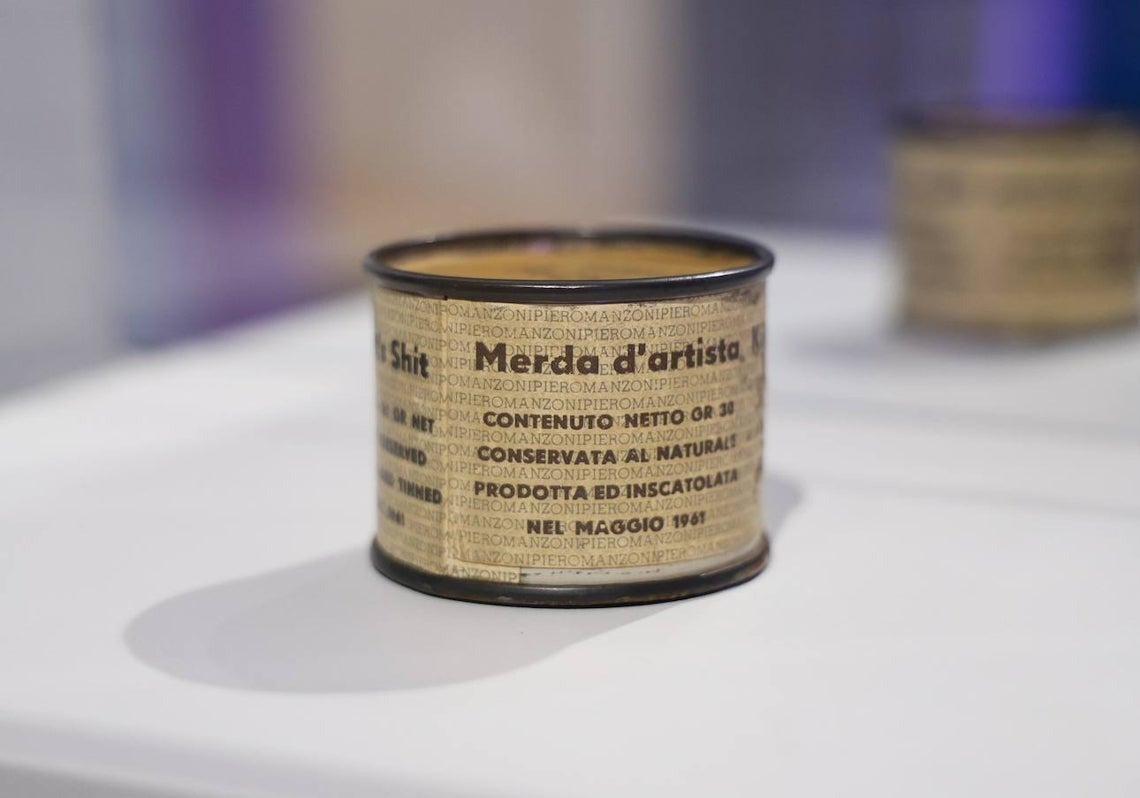
The work that promises to be the most photographed of the new collection is this controversial and rogue piece by Manzoni; a benchmark of conceptual art that took the questioning of art itself to the extreme. Ninety tins of this 'masterpiece' were labelled: 'Artist's shit. Freshly preserved, produced and tinned in May 1961'. Although there has been much speculation about its contents - plaster is the main theory - it is unknown whether the artist's claims are true. In 2016 one of these tins was auctioned for 275,000 euros, paradoxically confirming it as a myth and proving the Italian right: in consumer society anything can pass for art and be sold.
-
Room 1
Pfeil im Garten (Arrow in the Garden, 1929), by Paul Klee
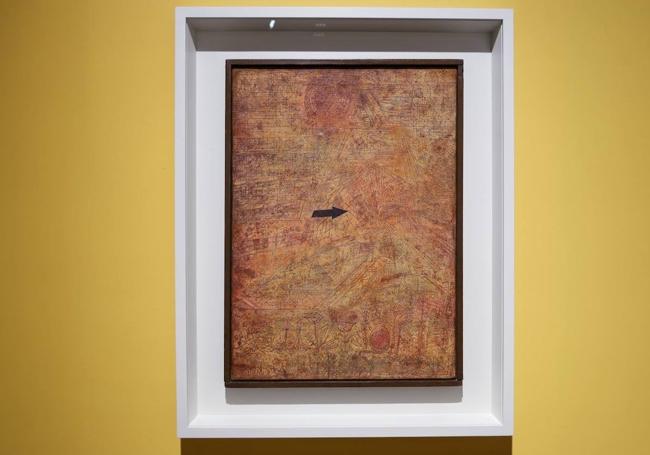
By marking the exact centre of the composition with a mysterious black arrow, a recurring symbol in his paintings, Paul Klee offers an illusory point of reference within a flowery landscape. Engraved into fresh paint, this garden is interspersed between a hedge of flowers in the foreground and a sun at the top, which dominates the piece and gives it a poetic undertone in the orangey-brown hues.
-
Room 2
Untitled, known as American Picnic (1918), by Juliette Roche
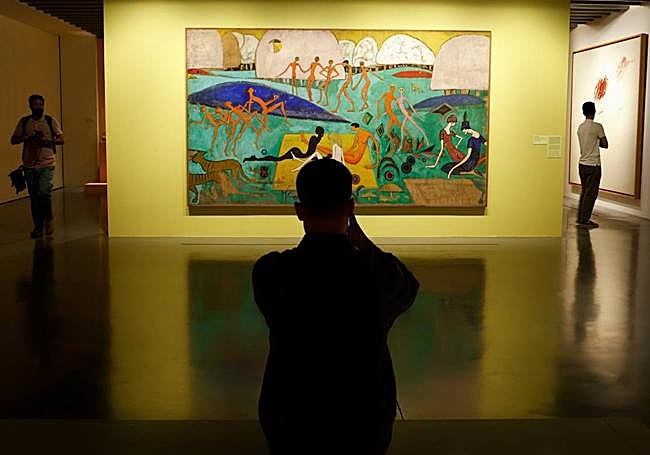
Roche painted this large-scale work during World War I in New York, and it pays homage to several of her contemporary artists. The slender, nude dancers evoke Matisse's The Dance, while in the foreground the three women refer to American diversity - nodding to native American culture - and reference another classic, Manet's Lunch on the Grass. On the far right, the artist herself sits in the company of a New York friend.
-
Room 3
Floorboards Data (2015), by Alice Anderson
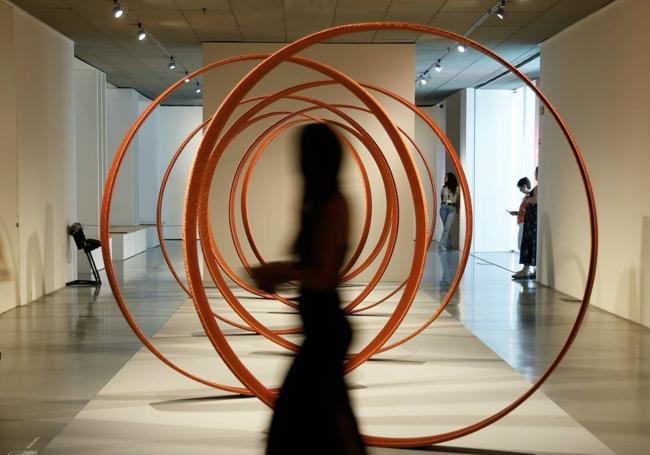
Somewhere between installation and sculpture, Alice Anderson's piece uses copper wires as a metaphor for technological connectivity between people, turning the works into "spiritual machines". Accompanied by a video, in which the creation of the piece is documented - the artist and other performers cover seven enormous circles with wire in the form of a dance performance.
-
Room 3
Number 26 A, Black and White (1948), by Jackson Pollock
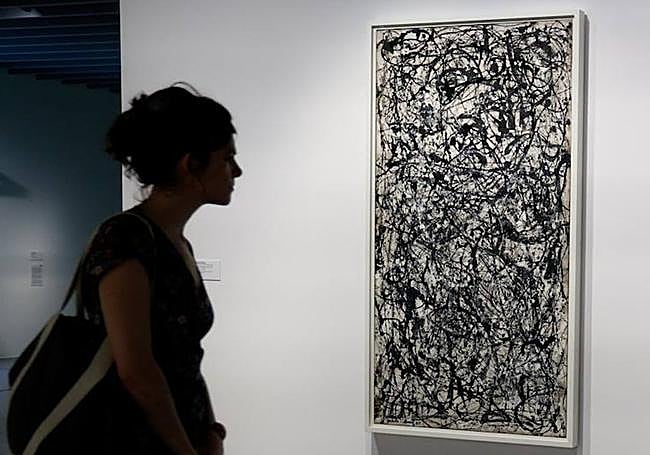
From 1947 onwards, Jackson Pollock abandoned figuration for expressionist abstraction with the techniques of dripping and pouring: spraying or dropping paint onto a loose canvas placed at his feet. "On the floor, I am more at ease. I feel nearer, more a part of the painting," said the American. In this oil painting Pollock uses a smooth, glossy, industrial paint to evenly cover the entire surface according to the principle of "totality". The work was included in the artist's first European exhibition: organised in 1952 by Studio Facchetti in Paris.
-
Room 4
Cape Count (2018), by Caroline Achaintre
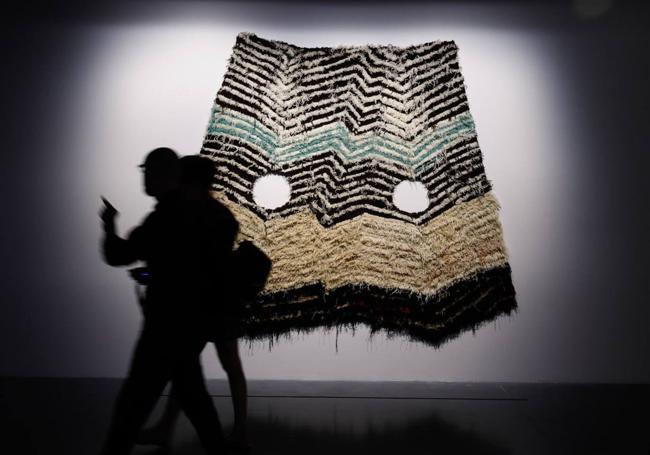
The work that features on the poster for Pompidou's new collection is this textile piece by Caroline Achaintre, made with tufted wool that is used for carpets. The artist added wool threads onto the canvas using a compressed air gun and the final result is reminiscent of a giant mask or a ghost costume with its two central holes staring out at us. This piece reminds us exactly why the new collection is entitled To Open Eyes.
-
Room 4
Ghost Drum Set (1972), by Claes Oldenburg
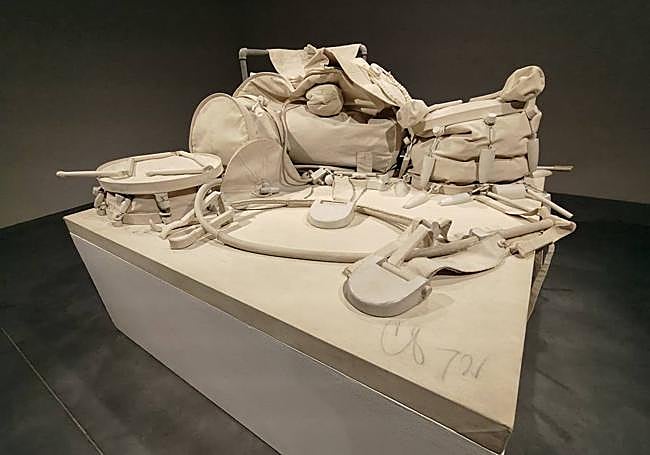
Claes Oldenburg's work stands out within pop art. His first soft sculptures appeared in 1962, in which he played with scale and material to create various colourful versions of a drum kit. In this 'ghost' version, he reproduces this instrument in fabric, which transforms into a flexible ensemble. As all vibration fades away, the work deflates and takes on a dimension that is as evanescent as it is evocative and ghostly.
-
Room 5
F582 Chair, known as Ribbon Chair (1966), by Pierre Paulin
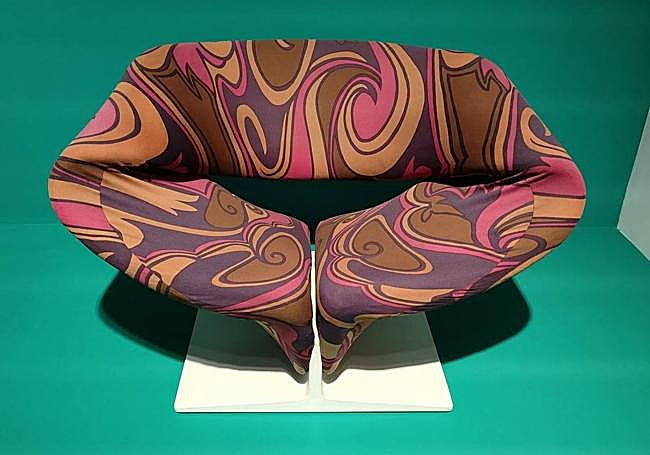
This iconic piece, halfway between a chair and a sculpture, has been imitated since its creation in 1966 by French artist and interior designer Pierre Paulin. He used materials that were new for the time, such as latex foam and stretch jersey fabric, to create this particularly comfortable seat. He was inspired by the way a ribbon folds into this shape, hence its popular title. Although from the front, the chair looks inspired by lips.
-
Room 6
Precious Liquids (1992), by Louise Bourgeois
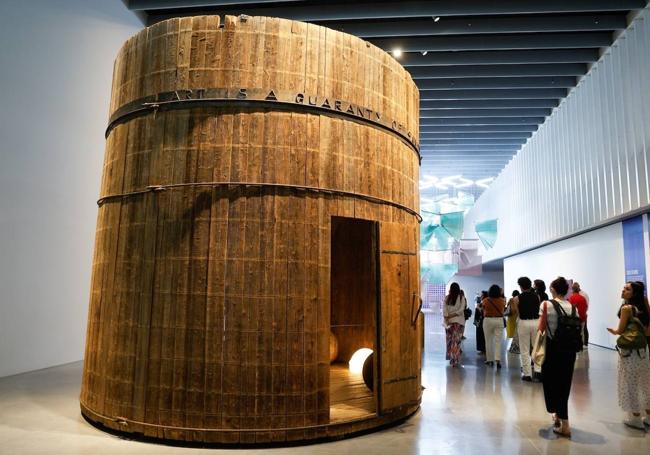
This old water tank from a New York building is transformed into a room which sets the scene of a tragedy. With a feminist gaze, Precious Liquids explores the mechanics of bodily fluids (sweat, tears, urine) secreted after intense emotion. The stains on the bed suggest motherhood, while the coat, suspended in a phallic form, symbolises paternal authority. Engraved on the metal band on the outside of the water tank is the inscription: 'Art is a guaranty of sanity'.
-
Room 6
Lingering Nous (2016), by Haegue Yang
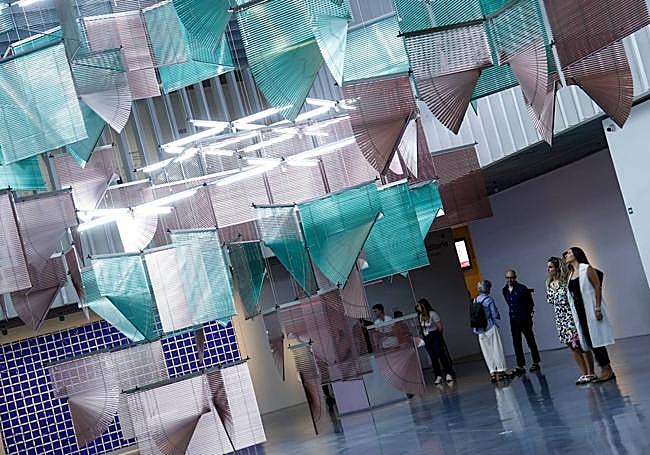
Created for the Centre Pompidou in Paris, this huge installation in the main hall of the Malaga museum is made of Venetian blinds: the preferred material of Korean artist Haegue Yang. The work features more than a hundred pink and green blinds - a labyrinth of slats hung from the ceiling, under a cold fluorescent supermarket light. A minimalist but large-scale work that questions the aesthetic and emotional qualities of everyday objects.
![[]](http://static.vocstatic.com/voc26/latest/assets/images/favicon/surinenglish/apple-touch-icon-57x57.png)