
Anniversary
Jaime de Mora y Aragón: the centenary of Marbella's bon vivant
100 years ago, one of Marbella's most endearing and charismatic characters was born. One of the town's avenues is named after him, as well as a monument and a bust erected in his honour
Alekk M. Saanders
Jaime de Mora y Aragón was certainly a controversial figure. Some have described him as a flamboyant dandy or an efficient promoter, while the encyclopaedia presents him as a Spanish aristocrat and actor. However, one thing is certain - he was a bon-vivant, a man who knew how to enjoy life. Almost always he appeared on the streets of Marbella walking with an eternal flower and at night he could be found in a disco. He was dubbed as ‘the king of the night’ (rey de la noche), and was known as Tio Jimmy to those close to him.
The multifaceted
Jaime de Mora y Aragón was born in Madrid on 18 July (some sources say 19 July) 1925 to Gonzalo de Mora y Fernández, the fourth Marquis of Casa Riera, and Blanca Aragón y Carrillo de Albornoz. He was educated in schools in Spain, England, Switzerland, the United States and mainly France, where his family went into exile from Spain with the establishment of the Second Republic.
He was a bon-vivant, a man who knew how to enjoy life... Almost always he appeared on the streets of Marbella walking with an eternal flower and at night he could be found in a disco
Jaime studied a lot, first for a Commerce degree in then Psychology, Sociology and Psychiatry and finally Law (this degree he did not complete). He was a polyglot, speaking nine languages fluently, which helped him open many doors.
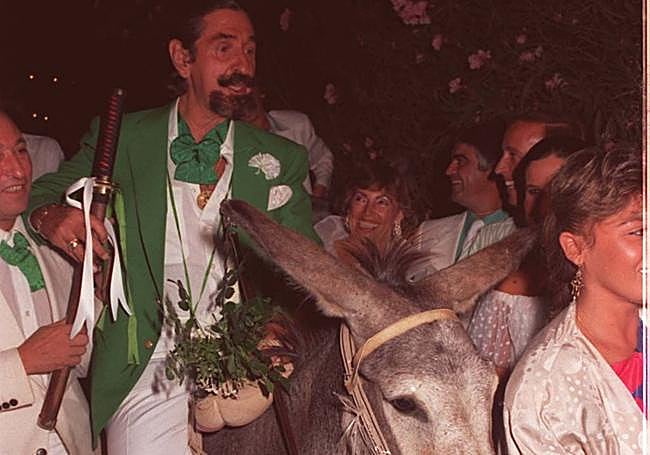
In 1940, Jaime returned to Spain to study in Alicante. In Palma de Mallorca, he married Mexican actress Rosita Arenas and moved with her to Mexico. It is believed that it was largely thanks to her that he became close to the film industry. In any case, since the early sixties, Jaime began to act in films, which eventually turned out to be more than thirty. One of the most successful was the film Love and Pain and the Whole Damn Thing where he played with British actress Maggie Smith.
The Marbella times
In the early 1960s Jaime de Mora y Aragón settled in Torremolinos, but soon moved to Marbella, to which he was devoted until the end of his years. It seems that in the glamorous resort, Jaime was able to realise a dream life. Marbella in the 70s and 80s was known to be a magnet for those looking for dolce vita and daily parties, meeting the rich and famous. Jaime was well connected. He was especially well regarded by the European aristocracy. (His sister Fabiola was Queen of Belgium as the wife of King Baudouin). He became a kind of populariser of quality tourism on the Costa del Sol. Additionally, Jaime de Mora was given a position in Marbella town hall - Head of Protocol. He advised various foreign investors, mostly Arabs. He himself invested in nightclubs.
Jaime was a kind of populariser of quality tourism on the Costa del Sol
On 5 July 1969, De Mora y Aragón opened Las Fuentes del Rodeo, a club famous for the token price of one peseta. Incidentally, on opening night, Jaime played a few songs on the piano to liven up the evening. His eccentricity led to him becoming a very popular singer. Jaime de Mora y Aragón was the organiser of various projects and events, from a charity bullfighting festival at the bullring in Nueva Andalucía to a motorbike rally. He was also a member of the Royal Academy of Fine Arts of San Telmo, Consul General of the Republic of Zaire, among others.
Jaime de Mora y Aragón was popular with the locals, who still remember his unconventional personality.
Francisco Sánchez, owner of Venta Los Pacos restaurant on Marbella's Golden Mile, spoke to SUR in English about his memories of Jaime de Mora y Aragón:
"My relationship with Don Jaime de Mora y Aragón began back in the years when he lived for a long time on the El Gazapo estate (before moving to the urbanisation of El Ancon), which is adjacent to my restaurant Venta Los Pacos. Don Jaime would often drop by as he enjoyed the coffee we served, as well as a glass of sherry for an aperitif. I remember Don Jaime as a very dynamic, outgoing and charismatic gentleman. He enjoyed telling stories from his life, always with the humour and elegance that was characteristic of him. I particularly remember one curious anecdote: he had inherited a flat from his mother in Madrid and, when he took possession of it, discovered that he had an outstanding debt to the community. He decided to pay it off by paying it in full with peseta coins. I would like to emphasise that Don Jaime also had a generous and friendly spirit. He liked to give the concierges at the Marbella Club Hotel boxes of Havana cigars, which he bought from our tobacconist shop across the street."
The 60th celebration
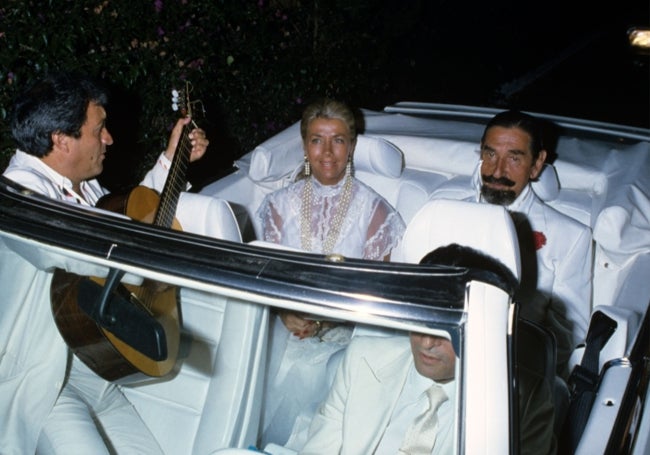
The celebration of his 60th birthday was particularly memorable. In 1985, Jaime celebrated his birthday at a disco named after his nickname, Jimmy, located in the Marbella Club Hotel. On 18 July, the night before his birthday, Don Jaime arrived at midnight in a borrowed white Mercedes convertible with his wife, Margit Ohlson, a former Swedish model… in all white, with a red carnation in his lapel and a scarf round his neck. Notable accessories were gold medals and a monocle. In one hand he held a cane, and in the other a cigar. That night he was greeted by about 900 VIP guests in white outfits with glasses of champagne.
Ten years later, Jaime died in Marbella, in the hospital of the Costa del Sol, as a result of a heart attack. The funeral was held in the parish church of the Virgen Madre. His closest friends bid him farewell singing the song Cuando un Amigo Se Va (When a friend goes away), a gesture that reflected the affection and admiration that many felt for him.
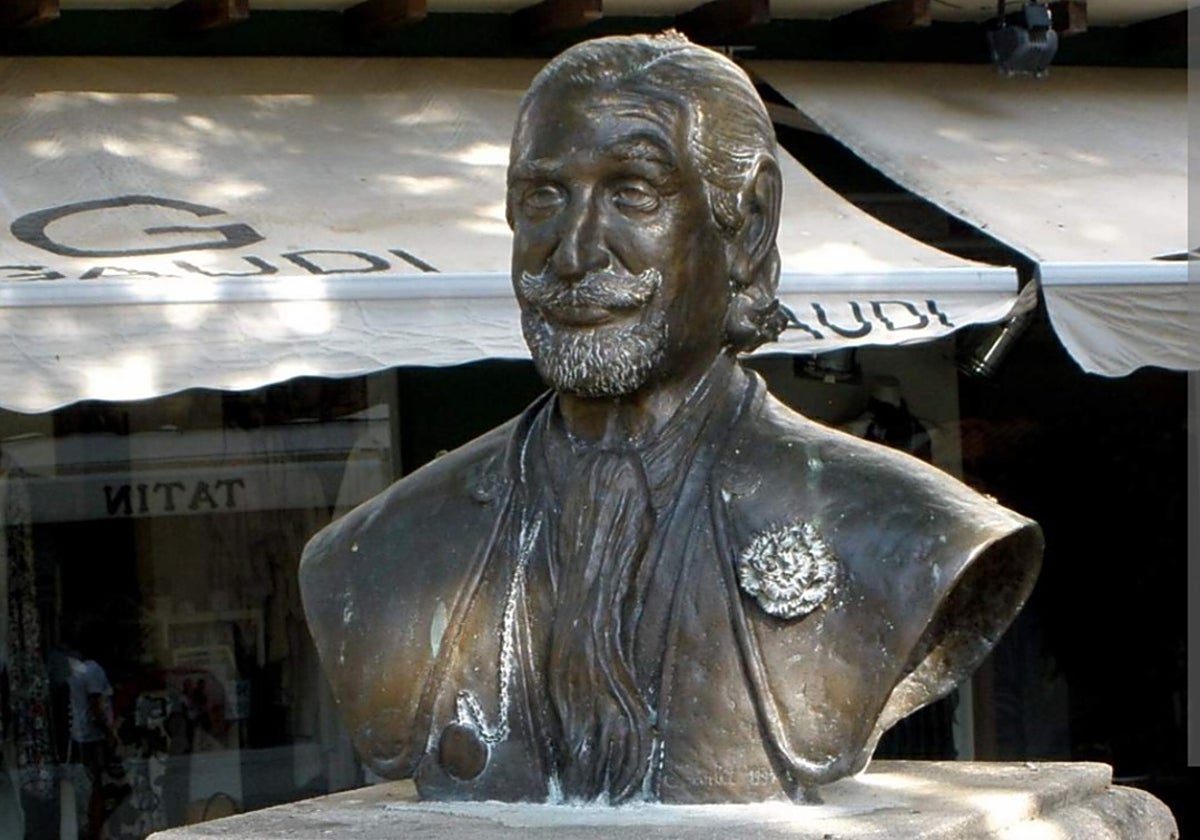
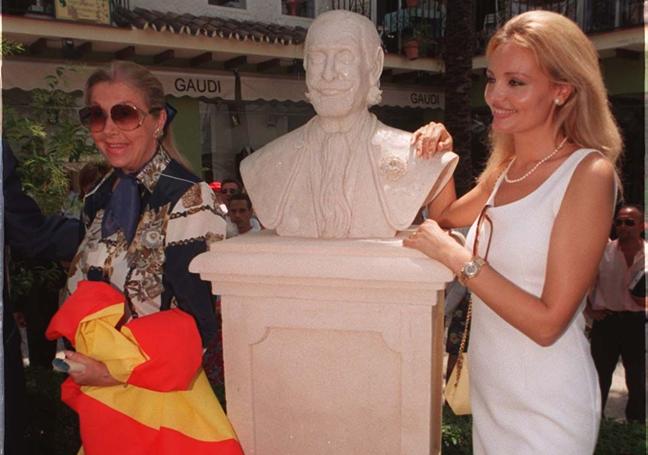
Marbella commemorated Jaime's contribution to the development of the town by naming an avenue in his honour, erecting a bust in the Old Town and erecting a full-length monument to him (at the Palacio de Ferias y Congresos) with his most characteristic symbols: his cane and the carnation he always wore on his lapel.
![[]](http://static.vocstatic.com/voc26/latest/assets/images/favicon/surinenglish/apple-touch-icon-57x57.png)