
Car hire firms bring welcome road tax windfall for small villages
The IVTM can cost up to 70 euros more depending on where it is paid; Ronda, Malaga and Benalmádena charge the highest amounts
FRANCISCO JIMÉNEZ
Anyone who has ever strolled through the peaceful streets of Montejaque would find it difficult to imagine a traffic jam in this small village in the Serranía de Ronda. In fact, they would think it could never happen, unless they were looking at official statistics: Montejaque has a population of just 1,100, but 9,328 vehicles are registered in the municipality. This is three times as many as five years ago and 1,800 more than in 2016.
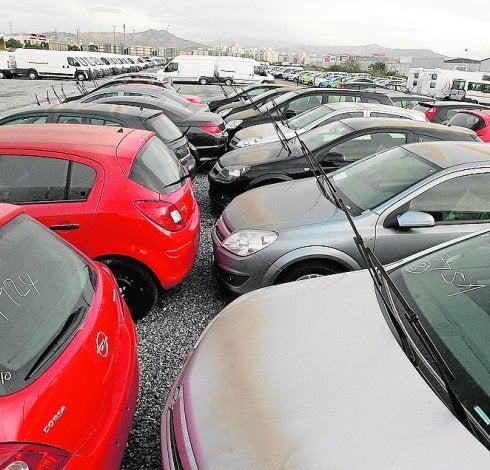
The figures suggest that this is the municipality with the highest number of cars per inhabitant. However in reality Montejaque, like other villages such as Macharaviaya, Colmenar and Riogordo, has taken advantage in recent years of the so-called registrations of convenience.
By reducing road tax to the legal minimum, and also applying generous discounts for firms, these villages are now the home of large fleets of vehicles belonging to transport and car hire fompanies - at least on paper. Most of these businesses operate from the airport, but very few pay road tax to Malaga council.
The only condition, in order to remain within the law, is that these companies have an address in the village.
This is a business in which everyone wins: the companies save a considerable amount of money on their Impuesto sobre Vehículos de Tracción Mecánica, the road tax known as IVTM, and the councils earn money by following the rule of charging less in order to gain more.
As an example, Montejaque council expects to collect ¤250,767 in road tax this year, and that is almost one fifth of its annual budget.
As well as large fleets of vehicles, private individuals also benefit from these road tax havens, although to a lesser extent; they are mainly people who have moved but whose previous address is still shown on their car documents, even when they buy a new vehicle. The tax is paid in the municipality that shows as the address on the vehicles registration certificate (permiso de circulación), in accordance with the Regulatory Law of Local Taxation.
This is a state regulation which also stipulates a range of charges. In the case of commonly used vehicles, these are either considered medium range (between 8 and 11.99 tax horsepower -CV) or fall in the medium-high bracket (between 12 and 15.99 CV), and the taxes are ¤34.08 and ¤71.94 respectively. After that, the local authorities have the power to increase the amounts paid by applying a coefficient which cannot be higher than two.
In Malaga province, only 29 villages (one third of the 103 municipalities) charge the legal minimum for road tax. The difference can be as much as 71 euros, depending on where it is paid.
The highest rates are in Cortes de la Frontera (2,464 vehicles registered for a total of 3,277 residents), and they are double the base rate, at ¤68.16 and ¤143.88 respectively.
Cortes council has had to adopt this measure this year so it can comply with government demands and access a liquidity fund to enable it to maintain services and reduce its debt.
Large councils
Most councils of large towns(except Estepona and Torremolinos, where the charge has only gone up slightly) take advantage of their freedom under this law to charge practically the maximum.
The closest to the maximum is Ronda, where the most common vehicles are charged ¤59.64 or ¤139.56, followed by Malaga city (¤65.80 and ¤138.90), Nerja (¤60.10 and ¤134.30), Benalmádena (¤61.34 and ¤129.49), Antequera (¤53.10 and ¤128.05) and Fuengirola (¤60.33 and ¤127.34).
There is no sense in the fact that the tax differs between municipalities because each council has to balance its accounts. It would be more logical as they do in other countries, for this tax to be standardised throughout the country and for the tax to be set according to how much each vehicle contaminates the environment, said the president of the Malaga Automotion Association (AMA), Carlos Olivo.
He considers it understandable for companies with a large number of cars to look for more advantageous rates. The car rental sector feels the same.
It is totally legal and it is logical for companies to try to minimise their costs by taking advantage of the discounts offered by some town halls, because there is an enormous difference in the amounts charged, said the head of the Association of Vehicle Rental Businesses in Andalucía (Aesva), Yolanda Alcázar.
These differences of up to 71 euros result in situations such as Alhaurín de la Torre and Torremolinos councils raising almost identical amounts from road tax (two million euros), even though Torremolinos issues 15,000 more bills (42,136 compared with 27,151).
There are 1.2 million vehicles in Malaga province, and in total their owners will pay the 103 councils ¤78 million this year. By volume, Malaga council will receive the most (26.9 million), followed by Marbella with ¤9.1 million.
![[]](http://static.vocstatic.com/voc26/latest/assets/images/favicon/surinenglish/apple-touch-icon-57x57.png)