
Picasso speaks the language of the Old Masters
A new exhibition at the Museo Picasso Málaga showcases the influences of Old Masters, such as El Greco and Zurbarán, on the Malaga painter
Regina Sotorrío
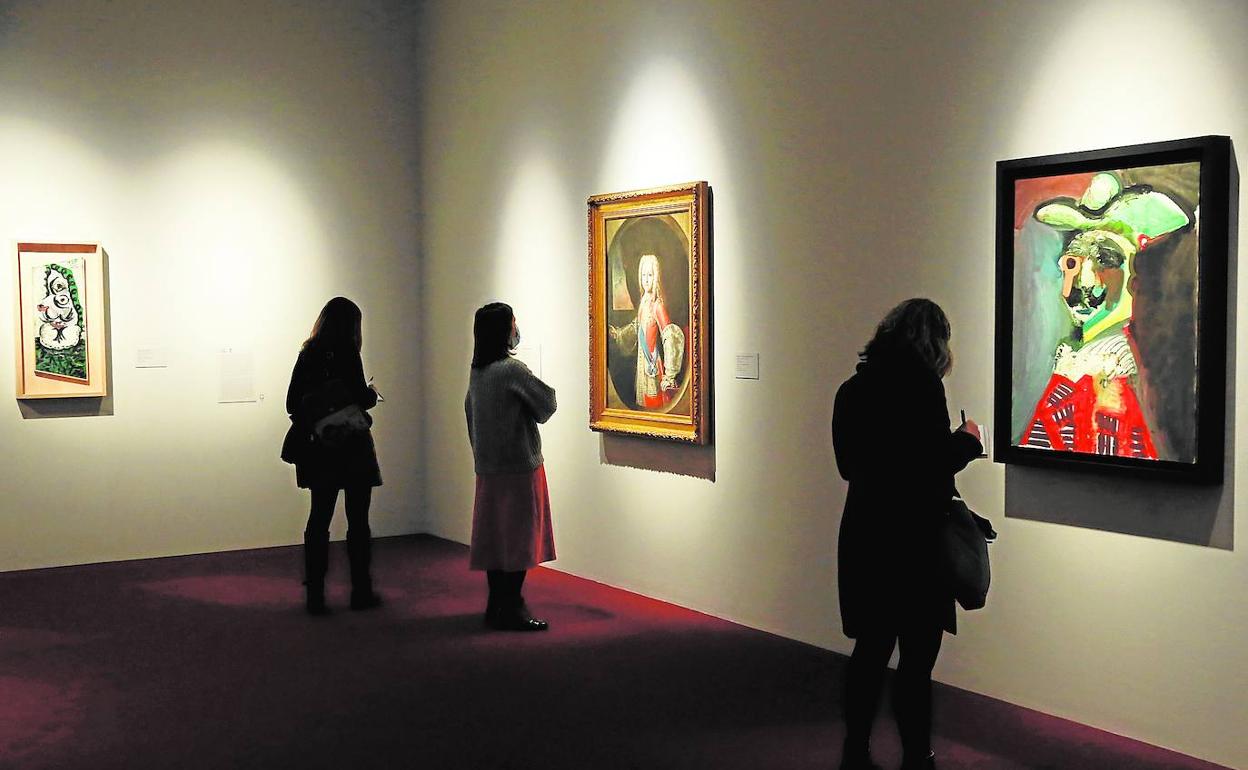
At 80 years of age, Picasso began painting portraits of people from times gone by, using his skill to recreate a musketeer's hat or a sixteenth century ruffled collar.
Comparing Picasso's work to that of Spanish painters El Greco, Francisco Pacheco and Bernardo de Llorente, not only highlights the genius of the Malaga artist's work, it also demonstrates his deep connection to Spanish artistic tradition.
"A lot of his work stems from tradition, and that is the great revelation of this exhibition," explained Michael FitzGerald, curator of Cara a Cara. Picasso y los Maestros Antiguos (Face to Face: Picasso and the Old Masters).
The small but powerful exhibition shows how the world-famous Malaga artist interacted with great artists from over 300 years ago. José Lebrero, the museum's director, describes Picasso as an artist who "creates the new while respecting tradition and the values of the past", like James Joyce does with literature or Stravinsky does with music.
"He always liked remembering and working with history," said his grandson, Bernard Ruiz-Picasso.
This is the first collaboration between the Museo Picasso Málaga (MPM) and the Seville Fine Arts Museum, where this exhibition was displayed last October, sponsored by the Almine Foundation and Bernard Ruiz-Picasso. Now, for the first time the work of Francisco de Zurbarán, El Greco, Giovanni Battista Caracciolo, Diego Bejarano, Francisco Pacheco, Cornelius Norbertus Gijsbretchs and Bernardo Lorente can be found at the MPM, the headquarters of avant-guard and modern art in Malaga.
The exhibition is structured around seven main links between Picasso and these traditional artists, to whom he may otherwise be considered to be very different and distant.
On one wall, El Greco's infamous portrait of his son (Portrait of Jorge Manuel Theotocópuli. 1600-1605) is flanked by two Picassos. The Spanish artist greatly admired El Greco, and his influence on him is clear.
"He represented both the heights reached by the Spanish masters and a sense of freedom from tradition, which inspired Picasso to create cubism," reads the card accompanying this exhibit.
Development through portraits
The exhibition emphasises the development of Picasso's own style through his portraits, from the meticulously detailed Olga Khokhlova in Mantilla (1917) to the ground-breaking Head of a Man (1971).
Over the course of 50 years, the painter's style changed drastically, but never lost sight of traditional Spanish portraiture.
Picasso's mastery of classical technique and colour is highlighted through the comparison with Zurbarán. He also sought inspiration in the dramatic scenes of baroque religious art, as a way to reflect on the issue of his time (always with a hint of irony).
During the First and Second World Wars, he depicted death in a similar manner to Giovanni Battista Cariccolo in Salome with the Head of John The Baptist (1630).
The exhibition invites the visitor to interact with the art, into making their own judgements and comparisons between the world-famous Malaga artist and the Old Masters.
Alongside the exhibition is a thirteen-minute documentary explaining Picasso's relationship with museums, an educational space to learn about various artistic concepts, and a variety of other activities.
"It's a historic exhibition," assured Patricia del Pozo, the councillor for culture, who attended the inauguration alongside Elías Bendodo, the councillor for the Presidency of the Andalusian government.
![[]](http://static.vocstatic.com/voc26/latest/assets/images/favicon/surinenglish/apple-touch-icon-57x57.png)