
Air travel
Wizz Air offers to plug gaps left by Ryanair's exit after spat and recover lost routes at airports in Spain
The Hungarian company has confirmed its expansion plans in the country, and one airport in Andalucía is among its targets
Javier Rodríguez
Cadiz
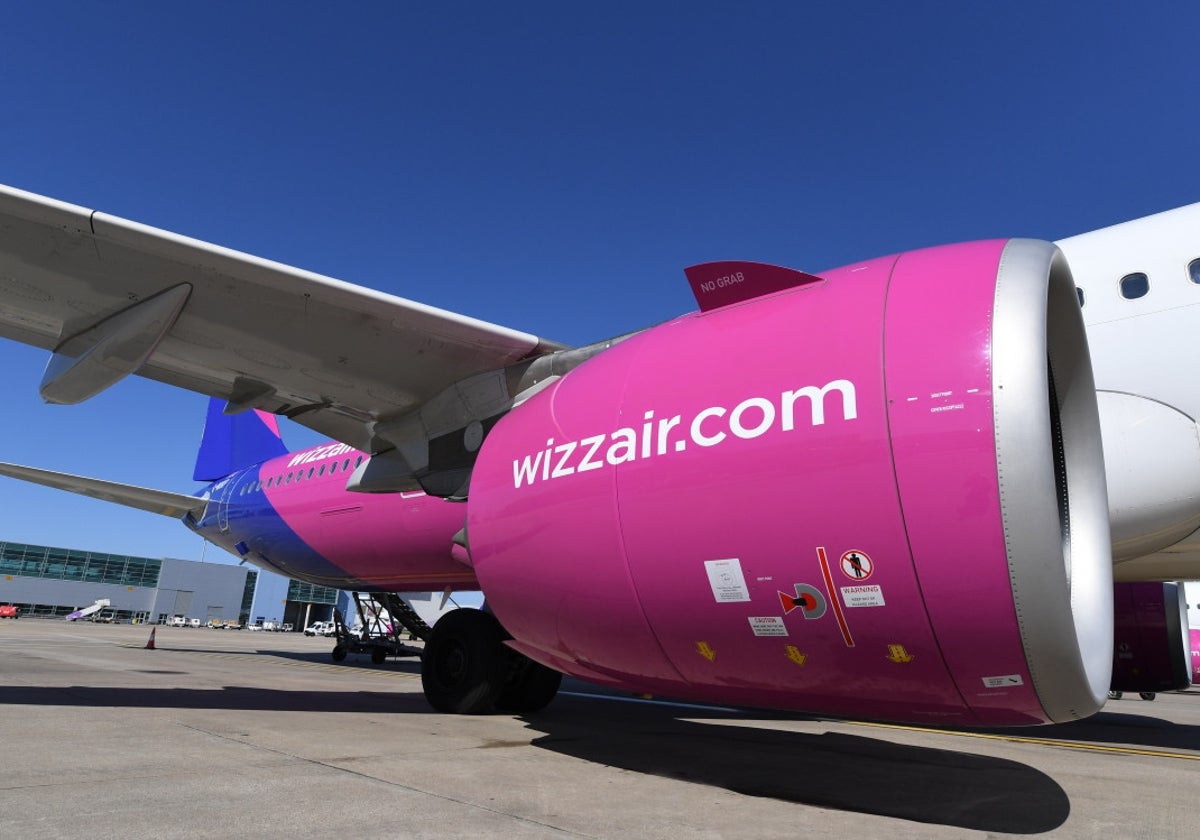
Hungarian low-cost airline Wizz Air is one of the companies offering to occupy the gap left by Ryanair at Jerez Airport. The well-known Irish airline ceased operations at Jerez Airport on 1 March, following a dispute with Aena over airport taxes. Ryanair's management accuses the Spanish airport operator of charging excessive fees, something that Aena denies. For this reason, Ryanair started a gradual cutback of routes in most of the Spanish airports, cancelling all of its operations in Jerez.
This has caused a significant drop in passengers at the Cadiz terminal, which other airlines are now trying to recover. Sources have revealed that there are negotiations with several companies. One of the companies that would be interested in providing services from Jerez Airport this autumn is Wizz Air, which already operates in Alicante, Barcelona, Madrid, Palma de Mallorca, Valencia, Castellón and, as of recently, in Malaga. Wizz Air has confirmed its expansion plans in Spain and its objective is none other than to take over the space left by Ryanair.
This airline has its focus on Eastern European countries, with flights to Sofia (Bulgaria), Budapest (Hungary), Bucharest (Romania), Warsaw (Poland). There are also flights to Rome and Milan (Italy).
For the moment, the company has confirmed the opening of 40 additional routes until March 2026 (many of which are already operational). According to Wizz Air's communication director Andras Rado, the decision "has nothing to do" with Ryanair, although the Irish company's withdrawal is an "opportunity" that its Hungarian counterpart is going to "take advantage of". Contrary to Ryanair's indignation with airport fees, Rado said that, while prices could "always be lower", they are still "competitive".
Related stories


Although it is still far behind Ryanair in market share, Wizz Air is well positioned to profit from the Irish airline's withdrawal. So far in 2025, the Hungarian company has reached a record of 10 million seats in Spain, where it offers a total of 120 routes to 15 countries. Wizz Air has consolidated the sixth position in the Spanish-European market, with a 3.5% market share and 2.1 million passengers between January and June 2025, according to data from the Ministry of Transport. Moreover, it has an advantageous position in some destinations, such as Barcelona-El Prat Airport, where it is the third largest operator.
A gap to fill in Jerez
Ryanair's departure from Jerez Airport has meant the loss of flights to Barcelona, Palma de Mallorca and London, causing a sharp drop in passengers. The loss of connections operated by the Irish low-cost airline has been reflected in the poor results of the first half of 2025, when 487,137 passengers passed through Jerez Airport, which represents a decrease of 59,900 passengers (-9.5%) compared to the same period last year.
This drop contrasts with the strong increase experienced in Andalucía as a whole - a total of 22,464,983 passengers up to July and an increase of 6.4% compared to the first six months of 2024.
Following the departure of Ryanair, Jerez de la Frontera Airport has sought to relaunch itself with six new routes for the autumn season, enhancing its strategy to attract airlines with the capacity for growth: Jet2 (with British flights), Volotea (connection with Asturias and from there to the whole of Europe) and Binter (which has increased the frequency of flights to Tenerife and Las Palmas de Gran Canaria).
Strategy
The Hungarian company forecasts a jump from 62.8 million passengers (8 million in Spain) to 75 million (9.6 million in Spain). Wizz Air is the sole operator of 52 connections between Spanish cities or between Spain and other countries. So far, the company has only announced work with Jerez Airport, without mentioning any plans for Galicia, the Canary Islands or other regional airports where Ryanair is cutting its capacity.
Barcelona-El Prat is the main point of activity for Wizz in Spain and the goal is to expand supply in Madrid-Barajas, where it debuted in 2004. "Between January and September, we achieved 6.7 million passengers in Spain, which represents an increase of 22%. Our capacity for this year has increased by 20%, by three million seats," Rado said.
Operating costs
Wizz Air can afford to offer cheap tickets, because it flies mainly to secondary airports that charge lower fees. The company's 8,500 pilots and cabin crew fly more than those of other airlines, up to 850 hours a year, close to the regulated limit of 900. Wizz Air aircraft have an average age of 4.5 years, which facilitates intensive use of 12.5 hours a day. The company also sells tickets through its website, without intermediaries. Additional services such as baggage fees and flight meals account for 48% of its revenue. Digitisation is also key to lowering costs.
Future plans do not include venturing into the long-haul low-cost market, but Wizz is acquiring aircraft capable of reaching the Americas. The company, however, does not plan on flying to New York or Latin America, as such operations would not be profitable.
New horizons
Wizz Air's strength lies in opening up new horizons for passengers. It flies between Spain and traditional destinations such as Paris, London, Vienna, Milan, Venice or Budapest, but also to more unconventional ones such as Tirana (Albania), Skopje (North Macedonia), Craiovia (Romania) or Gdansk (Poland) - all destinations that the company describes as "beautiful" places to discover "at a good price".
The company has launched a TV campaign using artificial intelligence, which also helps it cut costs. This disruptive technology is also already applied to commercial policy and problem solving in daily operations.
![[]](http://static.vocstatic.com/voc26/latest/assets/images/favicon/surinenglish/apple-touch-icon-57x57.png)