
Housing crisis
Government announces a 30,000-euro rent-to-buy aid scheme for young people in Spain
The new state housing plan for 2026-2030 will include this measure for subsidised (social) housing, as well as new incentives for homebuying in rural areas
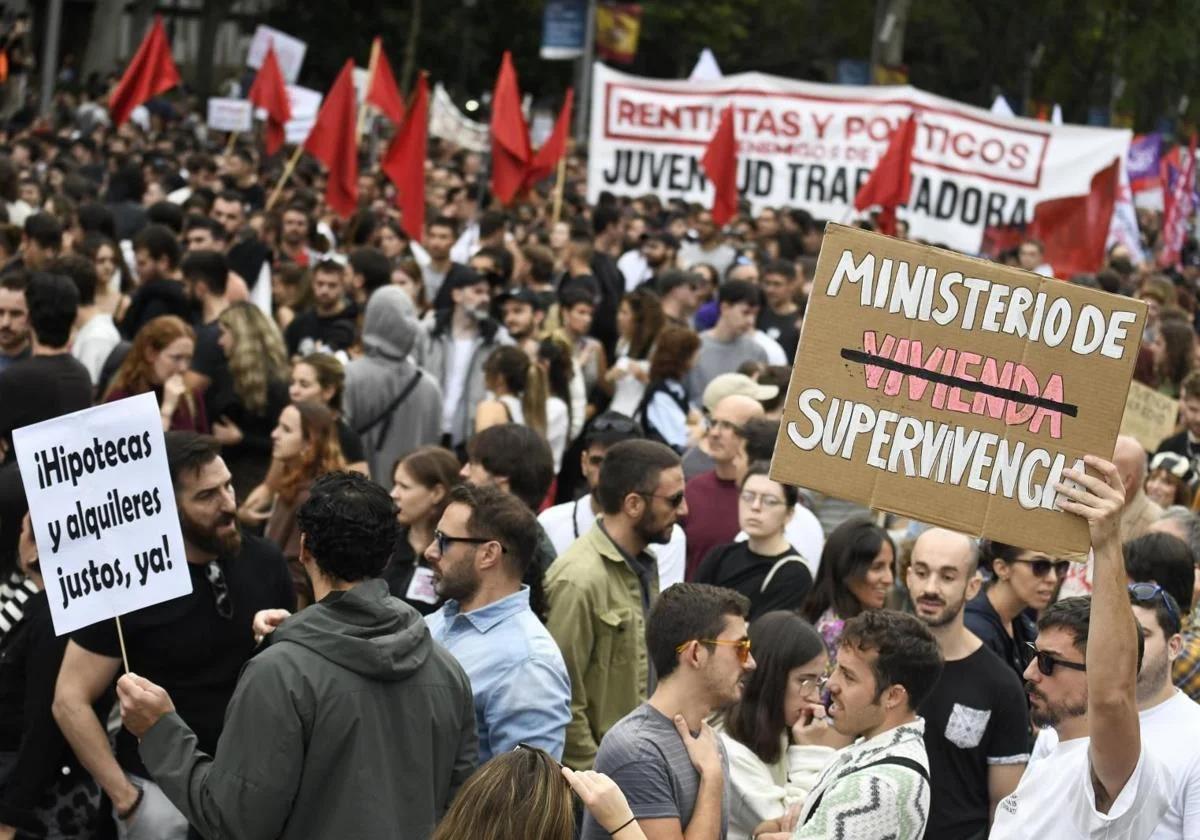

Madrid
Spain's central government is once again placing housing at the centre of its current term of office, at a time when accessing a rental property or obtaining a mortgage to buy a home has become a near-impossible task, with soaring prices that already exceed the levels forecast in the real estate bubble. Against this backdrop, Prime Minister Pedro Sánchez announced this Monday a new rent-to-buy (RBO) aid scheme worth 30,000 euros per person for eligible applicants.
"We are going to create a new rent-to-buy aid of almost 30,000 euros so that young people can live in permanently protected housing for years and eventually buy it", announced the PM during his speech at a meeting of the socialist parliamentary group. His announcement gave no further details of the initiative.
The fine print of the plan will thus be key to measuring the impact of this aid, which, according to the Ministry of Housing, will be included in the new state housing plan to be rolled out between 2026 and 2029. In principle, only tenants in social housing will be able to access the 30k, which will be deducted from the future purchase price. "That is, the price paid as rental income represents the advance payment for the future purchase price. The aid given will be used to pay the rent, allowing the young person to save up to buy the property", states the Housing Ministry, headed by Isabel Rodríguez.
The idea is that, since this is about permanently protected housing, the price will be fixed and cannot be freely set by the vendor at market price. This means that, if the property is sold in the future, it will have to be at a fixed price and to a person who meets the same requirements as the previous tenant who is now selling. "In this way, we are protecting homes paid for with state resources from market speculation," adds the ministry.
Little else is known about the proposal that central government in Madrid is working on, but sources consulted anticipate that there will be numerous limitations to the measure and that it will apply to a low percentage of the population, as the aid would be allocated only to subsidised rental housing, which, despite the recent upturn in construction, remains insufficient to address the country's structural deficit in this type of housing.
According to data from the Ministry of Housing, some 14,371 social housing units were completed in Spain in 2024, well above the 8,847 in 2023. However, this affordable housing stock still barely exceeds 3% of the total, compared to around 9% in the European Union.
"In order for rent-to-buy to be a valid alternative, both parties, sellers and tenants/future buyers, must be provided with security through well-structured contracts that include the deadlines for exercising the option to buy. They should also set a fixed purchase price, guaranteeing that all contributions made during the rental period will be deducted and that these amounts will not be returned if the deal ultimately doesn't go through", says Ferrán Font, research director at Pisos.com.
"It will be interesting to know how this incentive will be structured - whether it will be distributed monthly to cover the rent or whether it will be given all at once when the purchase is formalised - and what the tax repercussions will be for the beneficiaries," he adds.
In any case, the announced aid represents the reinstatement of an incentive that ceased to appear in state housing plans from 2013 onwards. Previously, public subsidies were included to promote subsidised housing under the rent-to-buy scheme, which basically means that a tenant can deduct their rent paid from the sale price if they choose to exercise that right.
Some regions of Spain have also introduced measures such as tax incentives for this scheme in recent years. The region of Madrid, for example, is planning to revive the scheme for social housing after eliminating it eight months ago in the face of a market shift that, among other things, led to lower prices for housing in the free market in some areas than prices for social housing.
Default insurance
While awaiting the details of the new aid announced by PM Pedro Sánchez, the Spanish government also plans to speed up other measures already announced in the area of housing.
The most immediate measures are insurance against non-payment of rent by young people and the plan to triple the budget transferred to the regions for housing policy.
In any case, insurance against non-payment (or default) also has some limitations, such as the fact that it can only be accessed by landlords who adhere to the Ministry of Housing's price reference index. Likewise, anyone wanting to access this state protection against possible non-payment must deposit the mandatory legal rent deposit. "The rents covered are those whose monthly amount does not exceed 50% of the net income of the family unit as stated in the contract," stated the government.
Another of the proposals for the new state housing plan is new aid of up to 10,800 euros to purchase homes in rural areas, limited to municipalities with fewer than 10,000 inhabitants and not exceeding 20% of the purchase price. This type of incentive is not unknown in these regions, as there are some that already apply similar measures in order to attract people to these places. "The problem is that demand is concentrated where the employment is, and jobs are scarce in rural areas, apart from small-scale initiatives. To achieve this, we would need to review the costs of self-employment, which are very high," say the experts.
![[]](http://static.vocstatic.com/voc26/latest/assets/images/favicon/surinenglish/apple-touch-icon-57x57.png)