
Property
Bank of Spain warns of shortage of 700,000 homes to meet housing demands
The financial institution has acknowledged a widening gap between supply and market needs only a year after lowering its estimate of the deficit

Bruno Pérez
Madrid
Barely a month had passed since the appointment of José Luis Escrivá as governor of the Bank of Spain back in September 2024, when the financial institution released a much talked-about paper on the state of the housing market. It readjusted the official reference that had been used until then to measure the magnitude of the housing shortage problem in Spain.
In one fell swoop, the Bank of Spain revised downward its estimate of the housing shortage. Previously, it had calculated a deficit of around 600,000 homes between the actual supply and the demand for new housing projected by the INE national institute of statistics. But in one of the final reports of former governor Pablo Hernández de Cos, the Bank reduced this gap by more than 100,000 homes, bringing the estimated deficit down to roughly half a million properties by using a multi-year measurement (2022–2024) instead of an annual one.
Not only was the magnitude of the problem downgraded, but it also opened the door to an improved outlook for the future. The report argued that, in reality, if only the gap between supply and demand for first homes by the resident population was taken into account, the shortfall would be 365,000 dwellings, because the remaining 120,000 corresponded to the unmet demand of non-residents. He also predicted a brighter future thanks to the improvement in housing construction data, the more contained increase in households and the mobilisation of residential housing in the areas most burdened by the lack of homes.
A bleaker future
Not even a year has passed since the publication of that report. On Tuesday, 22 September, current governor José Luis Escrivá painted a much gloomier picture of the real estate market.
Firstly, his office has recovered the annual measurement as a reference for estimating the housing that would need to be built to meet the current demand for 700,000 homes. This is a provisional figure, to be confirmed at the end of 2025. However, the gap is expected to widen by more than 100,000 homes over the year due to insufficient housing construction.
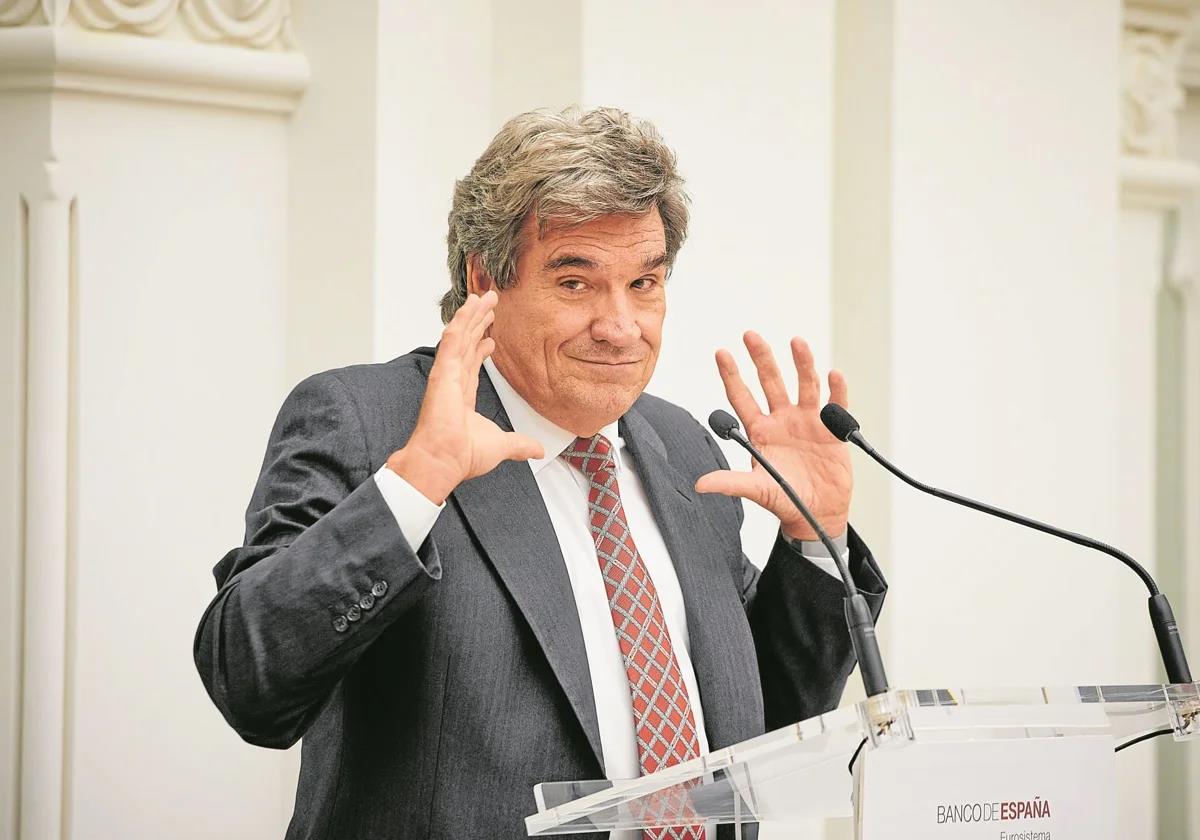
Escrivá pointed to this gap as the root cause for the increase in housing prices in Spain, declaring the issue as one of the four major risks to be faced by the Spanish economy in the future.
The governor, who reiterated his well-known position that the housing problem in Spain is more one of lack of supply than of demand, stressed that the issue has reached a sufficient magnitude for "all the administrations and even society as a whole" to make a joint effort to find a solution.
"If supply does not manage to grow at a much faster rate than it does now, which is going to be very difficult, the problem could get worse in the future," Escrivá warned.
The governor believes that the housing problem has already transcended its social and intergenerational dimension to become a major economic problem, which threatens to drag down the growth of the economy in the coming years. "The shortage of housing stock to cope with the growing pace of household creation is becoming a bottleneck for the labour market, especially in increasingly dynamic areas," Escrivá said. He also stated that this situation presents an obstacle to companies trying to attract talent, as they cannot offer candidates a place to live.
According to Escrivá however, the wider picture of the Spanish economy shows vigorous growth, registering a current account surplus and keeping private indebtedness at bay.
![[]](http://static.vocstatic.com/voc26/latest/assets/images/favicon/surinenglish/apple-touch-icon-57x57.png)