
Traffic accidents
Study finds seven out of ten pedestrians killed in traffic accidents in Spain were not at fault
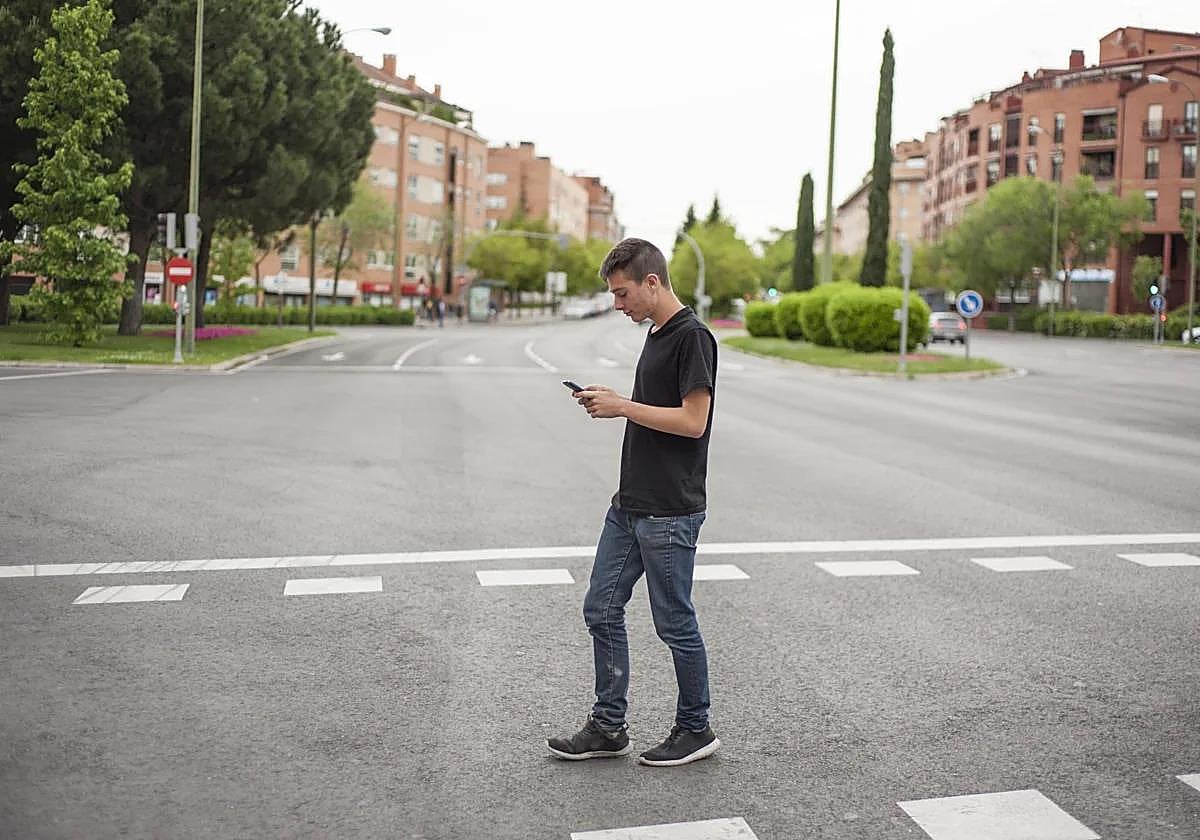
The report, however, highlighted the growing problem of young people who are distracted as they walk because they're looking at their mobile phones and/or wearing headphones, significantly impairing their observation skills

Madrid
Pedestrians are the most vulnerable road users in terms of road safety but, in recent years, they have become even more exposed to accidents due to the proliferation of cycle lanes, electric scooters and other personal mobility vehicles (PMVs), along with increased use of mobile phones and headphones that distract them while walking, sometimes with fatal consequences.
The fact that being a pedestrian has become more risky is confirmed by data presented this Tuesday in a study by Fundación Línea Directa (Direct Line Foundation), which analysed the accident and fatality rates of these road users (the most numerous) between 2014 and 2023. The report estimates that, over these ten years, pedestrians across Spain were involved in more than 124,000 road accidents, in which nearly 3,500 pedestrians lost their lives after being struck by something or someone. That makes an annual average of 350, representing one in every five road traffic fatalities. A further 130,000 were injured and more than 17,000 suffered injuries requiring hospitalisation.
The data is striking, "but it should not be used to blame the pedestrian", said Mar Garre, the foundation's director-general, at the presentation of the study's findings. In fact, in 72% of such accidents, the pedestrian had not committed any offence, although there were factors that could have influenced the accident rate for this type of road user.
According to Spain's National Institute of Toxicology and Forensic Sciences, 41% of pedestrians killed in road traffic accidents tested positive for alcohol, drugs or psychotropic drugs, substances that would affect their reflexes and risk perception. This percentage shot up to 58% in 2023, the last year analysed, when 353 pedestrians were killed in road accidents, the highest number since 2019, when 381 died.
"This behaviour does not constitute an offence in itself, it is more of a recklessness that influences the perception of danger and the ability to react", said Garre, referring to a fact that she found "tremendously striking".
Turning to other details in the report, 86% of pedestrian-related accidents occur in urban areas and 14% on main roads and highways, where the fatality rate is much higher (eightfold) due to the speed of impact. As might be expected, the most common pedestrian offences are crossing where there is no pedestrian crossing (16%), jaywalking and other illegal walking on the road (5%) and disregarding traffic light signals (4%). Meanwhile, in the case of drivers, the most frequent traffic violations involving pedestrians are running pedestrian crossings and traffic lights, plus speeding.
The foundation's report 'Walking safely: accident rate and pedestrian risks in Spain (2014-2023)', prepared in collaboration with Fesvial (Spain's road safety foundation), also reveals that the average age of pedestrians involved in such accidents is around 45 years old, although those over 65 have a fatality rate that is double the overall average. Furthermore, the fatality rate for men is more than double that of women. Men are more likely to be killed on the main roads and women are more likely to be killed on city streets.
The 'technological pedestrian' problem
The study draws attention to a new phenomenon we are seeing far more frequently on our streets, the so-called 'technological pedestrian'. Typically, they are young people, aged 18 to 25, who are distracted as they walk because they're looking at their mobile phones and/or wearing headphones, thus significantly impairing their observation skills and hearing to detect any dangers around them. This increases the risk of suffering an accident, especially in areas populated by young adults such as university campuses, leisure spaces and so on. Both types of tech reduce peripheral vision and hearing, delaying reaction time to an approaching vehicle.
In a survey of 1,700 people accompanying the study, almost four out of ten (37%) admit to using their mobile phone while crossing the road and 35% admit to doing so frequently in places where it is not allowed. The lack of control over these behaviours is a factor highlighted by those surveyed: 78% consider that surveillance is lacking and 76% believe that regulations are applied much more severely to drivers.
The survey also reveals that pedestrian crossings, far from being safe spaces, are perceived as high-risk zones, with 62% believing that cars do not properly respect such crossings. Furthermore, users of electric scooters and other PMVs are the worst rated, with eight out of ten respondents believing that these riders frequently violate pedestrian regulations.
Among the most requested measures to reduce the accident rate are increased fines for pedestrian offenders, road safety training in schools and colleges and road safety campaigns aimed at drivers.
The 'deadliest' street in Spain
By region, Madrid is the place with the highest proportion of pedestrian fatalities in road traffic accidents out of total fatal accidents, at 31%, ten points above the average. The Canary Islands (27%) and Galicia (24%) are next, all above the national average of 20%. At the other end of the scale are Castilla-La Mancha (13%) and Extremadura (14%).
The study also identifies the roads and streets with the highest number of pedestrian fatalities in Spain. In urban areas, the Gran Vía de les Corts Catalanes in Barcelona tops the list as the most dangerous, as do Calle Alcalá and Paseo de la Castellana in Madrid. Meanwhile, in the interurban environment, the stretch of main road with the most fatal road accidents is the TF-1 (between km 54.5-78.0), located in Santa Cruz de Tenerife, as well as the A7 in Malaga, between km 173.6 and 192.2.
![[]](http://static.vocstatic.com/voc26/latest/assets/images/favicon/surinenglish/apple-touch-icon-57x57.png)