
Politics
Spain politics: Prime Minister Sánchez says 'no to war' despite Trump's trade threats
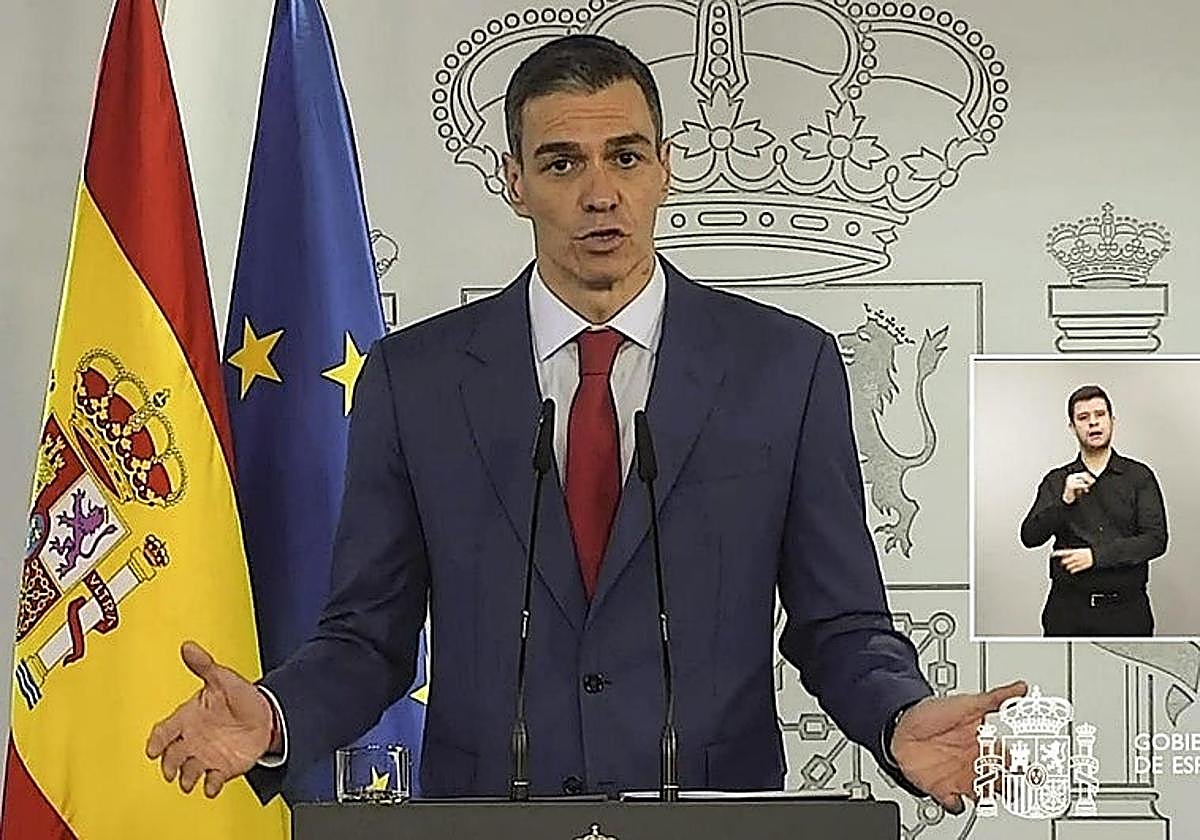
During an appearance at the Moncloa palace on Wednesday, Pedro Sáchez said that Spain will not be "an accomplice in something bad for the world for fear of reprisals"

Madrid
Spain's Prime Minister Pedro Sánchez has chosen peace over war for the country. Despite Trump's threats to cut off trade relations with Spain in retaliation for the lack of support in his attack on Iran, during an appearance at the Moncloa palace on Wednesday Sánchez firmly said "no to war".
The PM stated that, while Spain condemns the repression of the Iranian regime, the response from the rest of the world should be diplomacy, not violence.
"Some will accuse us of being naive. What is naive is to think that the solution is violence, to believe that democracies or respect between nations spring from ruins or to think that practicing blind and servile subservience is a form of leadership," Sánchez said.
Sánchez drew a direct parallel with the 2003 Iraq war to remind the population that following Washington in its wars does not guarantee security or prosperity.
In just a week, Spain will commemorate the victims of the 11-M bombings at Madrid's metro in 2004. The terrorist attack in the Spanish capital was a punishment for the country's direct involvement in Iraq.
According to Sánchez, the Spanish government at the time, with former PM José María Aznar at the head, made a decision that only led to "more jihadist terrorism, a serious migratory crisis and an escalation in energy prices". Sánchez also alluded to the First World War to warn of the danger of the "chain reactions that get out of hand because of miscalculations".
"We are not going to be accomplices in something that is bad for the world simply for fear of reprisals from someone else," Sánchez said.
He highlighted "the solidarity of the Spanish people with the countries illegally attacked by the Iranian regime" (nine countries in the Middle East and the British base in Cyprus). Above all, he blames the US and Israel and reminded the public that nobody knows what the real objectives of their attacks are.
The conflict has already caused hundreds of deaths, the collapse of the stock markets, the disruption of air traffic and the Strait of Hormuz, through which, until very recently, 20 per cent of the world's gas and oil transited.
As a "full member of the EU, Nato and the international community", Spain demands a cessation of hostilities.
Sánchez outlined four lines of action on Wednesday: the evacuation of Spaniards in the Middle East, with the foreign service and the army working "day and night" in what he described as a "very sensitive" operation due to the insecurity of the airspace; the study of economic protection measures for households, workers and companies, similar to what happened during the Covid-19 crisis; collaboration with the countries in the Middle East that are committed to peace; and demand for an immediate cessation of hostilities from all parties, including the US, Iran and Israel.
The prime minister emphasised Spain's position as a "full member of the EU, Nato and the international community". In response to claims that the country is being naive in its approach, Sánchez said that they stand on the values of the Constitution, the founding principles of the EU, the UN and international law.
"We are with many other governments that think like us and with millions of citizens throughout Europe, North America and the Middle East who do not want more war or uncertainty, but more peace and more prosperity," he said.
Message of calm
The Moncloa sends a message of calm to the Spanish population. Sources have stated that any review of the trade relationship must respect the autonomy of private companies, international legality and bilateral agreements between the EU and the US.
This is not the first time that Trump has threatened Spain with trade retaliation. He did so in The Hague in June 2025 and in October. On neither occasion have the threats materialised.
After the latest threats, European Commission spokesperson Olof Gill warned that the EU will respond to any measure against any of its member states.
On the domestic front, leader of the opposition Alberto Núñez Feijóo accused Sánchez of putting at risk the "security, stability and position" of Spain in the world in order "to win a few votes". Government spokesperson Elma Saiz accused the opposition of trying to "make a profit even in an extremely serious situation".
![[]](http://static.vocstatic.com/voc26/latest/assets/images/favicon/surinenglish/apple-touch-icon-57x57.png)