
Terrorism
Spain detains 95 jihadist suspects so far this year, six more than in all of 2024
In the 50 police operations carried out since January, eight radicalised minors - the group that consumes more violent content on social media - have been arrested

Madrid
Vallfogona de Balaguer - a village of barely 2,000 inhabitants located in the La Noguera area of Lleida in Spain - was the scene of the latest anti-jihadist operation in the country ordered by a court of the Audiencia Nacional. On Monday, 18 August, two people were arrested for their alleged involvement in terrorist crimes, in this case indoctrination and collaboration. After a year and a half of secret investigations, the National Police, with the help of their Moroccan counterparts, carried out the operation, having determined the high level of radicalisation of the two suspects and their prolonged consumption of jihadist material. One was imprisoned after appearing before the judge.
A total of 95 people have been arrested so far this year for their links to jihadist terrorism, according to data confirmed by the Ministry of the Interior. Almost a third of them were detained in Catalonia. The figures also reflect an increase in the number of minors brought before the prosecutor's office (eight) and their high level of radicalisation. Of these 95 under investigation, 84 were arrested in Spain and 11 abroad in the more than 50 operations carried out since January.
In total numbers, the 95 arrested so far have surpassed the figures of the two previous years. A total of 90 people were arrested in 2023, while the number of people with links to jihadist terrorism arrested in 2024 was 89. These last three years have seen a significant increase in arrests compared to previous years, as in 2020 there were 38 arrests, the following year 40 and in 2022 - 51.
Judicial operations have been carried out in 12 of the 17 regions of Spain, as well as in the city of Melilla. In collaboration with other security forces, the police have participated in operations against jihadist terrorism in Cuenca (Ecuador), Portugal, the UK, France and Belgium. Some of the Spanish towns where suspects were arrested are: Fuensalida (Toledo), Crevillente (Alicante), via Melilla, Leganés (Madrid), Padrenda (Ourense) and Santa Coloma de Gramanet (Barcelona).
Minors and digital content
The National Police are focusing on the eight minors arrested up to 24 August. Among them are a Spanish girl in the Valencian town of Cheste and three boys in Fuensalida (Toledo). Their number has grown since the Covid-19 pandemic, as confinement left minors exposed to the online world for longer hours. Moreover, jihadist content has migrated to the social media most used by young people, such as TikTok.
There is no specific profile of radicalised minors. The police have discovered that Spanish converts without family interference and minors from very humble or upper middle-class backgrounds are also susceptible. In any case, all children know how to move around the internet at a level that allows them to evade parental control.
From 1 January to date, four women have been arrested, one of them a minor. On 30 May, the police reported the arrest in Madrid of two sisters, 19 and 21, for the crime of terrorist indoctrination through the creation of a virtual platform. Under the pretext of teaching religion to other Muslim women, it operated as if it were a "jihad academy".
With regard to the nationality of the 95 arrested in 2025, Spaniards predominate, followed by Moroccans, although there are also Syrians, Algerians, Pakistanis, Tajiks, Lebanese, one Ukrainian, one Palestinian, one Belgian and one Portuguese.
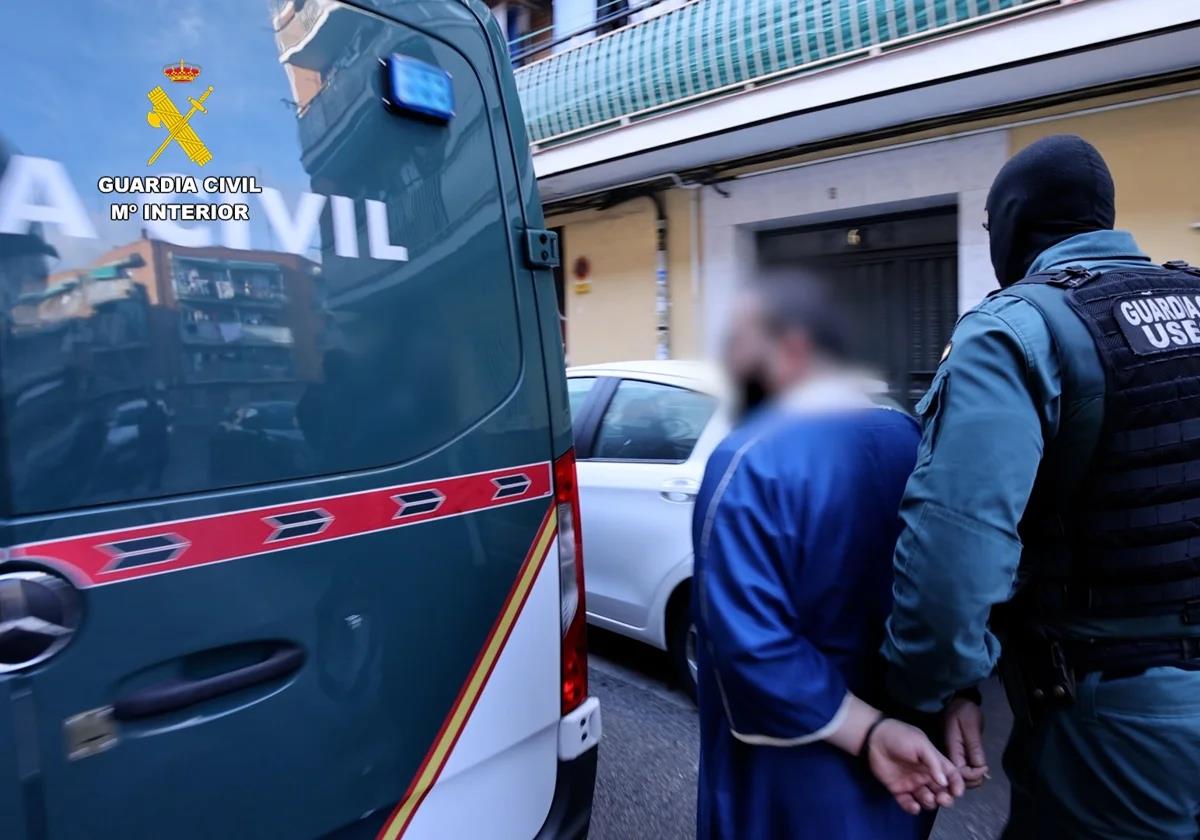
Among the operations with the highest number of arrests this year is the one carried out by the Guardia Civil at the beginning of February, in which 11 people were arrested - seven of them in the provinces of Pontevedra and Madrid.
![[]](http://static.vocstatic.com/voc26/latest/assets/images/favicon/surinenglish/apple-touch-icon-57x57.png)