
Spain-UK relations
From London to Paris, Spain's prime minister seeks to regain ground on the international stage
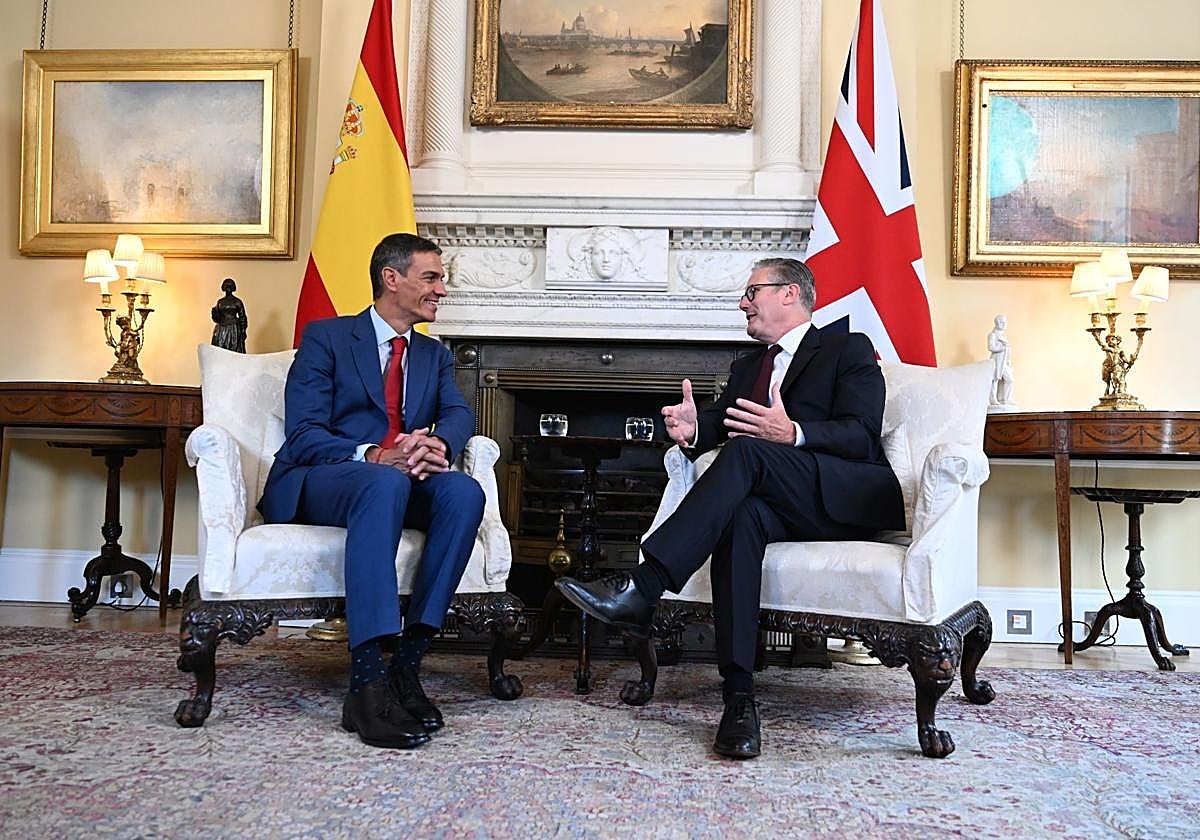
Pedro Sánchez held his first bilateral meeting with Keir Starmer at 10 Downing Street this Wednesday before the Ukraine meeting with other world leaders on Thursday

Madrid
Spain's prime minister Pedro Sánchez travelled to London on Wednesday to meet his British counterpart Keir Starmer and sign a strategic collaboration agreement between the two countries.
The meeting was the first sign of Sánchez's aim this new political term to reposition himself internationally. The Spanish prime minister was not invited last August by Donald Trump to the summit with the Ukrainian president Volodimir Zelenskyy and the leaders of the large EU countries plus the United Kingdom and Nato. The political reading that emerged from this absence was that the head of government has lost his capacity for influence in the international arena, an area in which he has always stood out from his predecessors.
The agreement signed in London on Wednesday covered economic and commercial matters, but also other fields. This was a significant move for the British prime minister, who since taking office has sought a rapprochement with Europe to heal the wounds of Brexit, but also for the Spaniard, who has hardly any ideological allies on the continent. He can finally add to his album a photo at 10 Downing Street, something he did not achieve on his previous trips to the UK with the Conservatives Theresa May, Boris Johnson, Elizabeth Truss or Rishi Sunak.
The meeting came at a good time in the relationship between the two countries, after the agreement on the status of Gibraltar was finally sealed in June. Brussels is now working on the final draft for its expected ratification in December. Its implementation will involve the demolition of the border and the disappearance of the controls and barriers that currently apply to people and goods.
The agreement is relevant because the UK is Spain's preferred partner and its main market outside the EU, but closer ties with Starmer are of value in their own right for Sánchez, in diplomatic and political terms, given his weight in the international arena.
Critical summit
The Nato summit in The Hague last June showed Sánchez more isolated than ever by his decision to openly oppose Donald Trump's demand to raise defence spending to five per cent, refusing to sign a document that many other leaders signed. For Sánchez, signing it would have meant a confrontation with Sumar, his partner in government, and his parliamentary allies on the left, and, between domestic and foreign policy, he preferred the former. The government believes that the price was worth it and that in reality it was not so high.
This Thursday Prime Minister Sánchez will also travel to Paris to take part in the meeting of the leaders of the Coalition of the Willing, which, under Franco-British impetus, brings together countries allied with Ukraine such as Canada, Japan and Australia, as well as several European countries. The meeting seeks to take stock of progress in discussions on security guarantees for Ukraine and to increase pressure on Russia to accept a ceasefire, something in which the United States is keen to be involved.
The Spanish government also defends the role it has played in relation to Gaza, another issue on the agenda of the UK prime minister, who, as Spain did just over a year ago, leading a campaign that few countries took up at the time, is now considering recognising the State of Palestine, as is France.
In an interview in The Guardian on Wednesday, Sánchez expressed his satisfaction that other countries are following Spain's example, but also acknowledged that the response of the EU as a whole to put an end to the massacre of the Palestinian population at the hands of Israel is "a failure".
![[]](http://static.vocstatic.com/voc26/latest/assets/images/favicon/surinenglish/apple-touch-icon-57x57.png)