
Wildfires
Fires rage in Ourense, León and Zamora with seven more seriously injured in Spain
Three people have lost their lives in the fires with more than 10,000 people evacuated from more than 50 villages around the country while around 30 hotspots are still active

Madrid
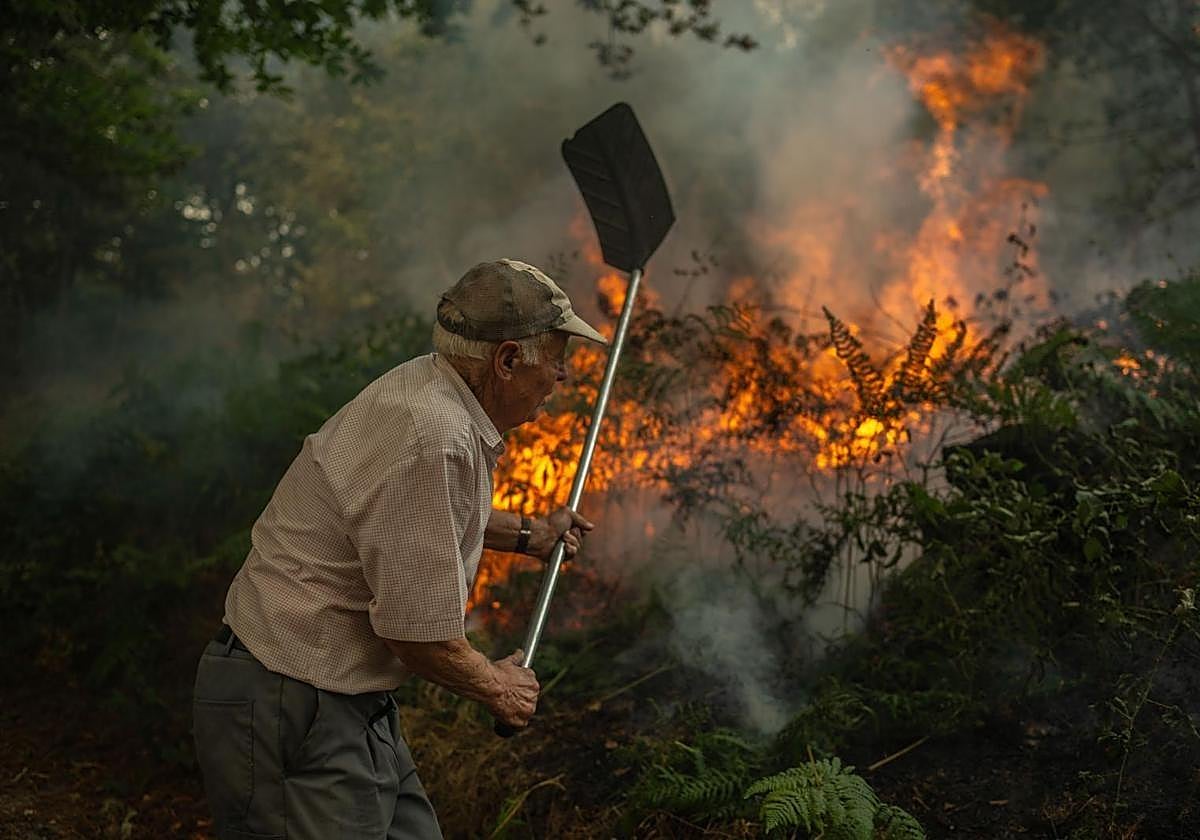
Fires that have been raging in at least 30 places in Spain since the weekend left a devastating toll on Wednesday: seven seriously injured and dozens more of varying degrees of severity; more than 10,000 people evacuated; some 25,000 hectares of forest and woodland, including the World Heritage site of Las Médulas, ravaged by the fires. The fires have claimed, directly or indirectly, the lives of four people: Abel Ramos, 35, in León; Jaime Aparicio Vidales, also in León; Mircea Spiridon, 50, in the Madrid town of Tres Cantos; and the firefighter who died in a traffic accident on the way to help in the extinguishing of a fire in Ávila last week.
Spain's PM Pedro Sánchez updated the public through his profile on X (formerly Twitter), confirming that the situation "remains serious" and that "extreme caution is essential". Minister of the Interior Fernando Grande-Marlaska called for the cooperation of the public, urging everyone to follow "the instructions of the emergency services" to avoid more serious consequences.
The current situation is: 30 outbreaks still active, ten of them large, in eight regions from north to south.
The good news is that the extinguishing teams have put under control the main fires in Andalucía, Castilla-La Mancha, Madrid, La Rioja and Asturias. There are no notable cases in the Basque Country following the fire in the town of Labastida that broke out on Tuesday, originating from La Rioja. The fire was extinguished in a few hours.
Unfortunately, the fires in Ourense, León, Zamora and Cáceres were still burning on Thursday morning. A new source joined the list on Wednesday, when the regional ministry of Valencia requested help from the military emergency unit (Ume) to fight the fire in Teresa de Cofrentes, caused by a lightning strike.
The two main fire hotspots - Ourense (Galicia) and parts of León and Zamora - have remained unchanged since the beginning of the week. There are 12 active fires in Ourense, which have resulted in 8,000 hectares burned so far. In Galicia as a whole, there are 13,800 hectares devastated. The dangerous situation forced the suspension of the high-speed AVE train link to Madrid and the evacuation of several villages, as well as that of 50 elderly nursing home residents. More than half of the burned land has been devoured by the fire that originated in Chandrexa de Queixa, whose mayor - 78-year-old Francisco Rodriguez - said that he had not slept for 48 hours. "I don't remember such winds. It was a hurricane and the fires started again, passing rivers and everything," he said on Wednesday.
Devastation in Molezuelas
Of the 16 active fires in Castilla y León - six of them at level 2 of severity - the most devastating is the Molezuelas fire, which has devastated more than 15,000 hectares and has forced the evacuation of more than 50 villages in Zamora and León. A total of 9,500 residents have been evacuated to shelters in La Bañeza, Astorga, Ponferrada and Tábara. Abejera resident Beatriz Madrid, 44, was sent to Tábara, from where she reported that the experience was like "a horror film". "We didn't have time to evacuate and we were eaten by the fire," she said.
The Yeres fire that scorched Las Médulas, another major fire in Rebosa (Palencia) and a new one in La Bastida (Salamanca) are also still active, but the second most important fire is the one in Puercas (Zamora), in which six residents were seriously injured by burns on Tuesday night after they did not leave their village - Abejera - when the Guardia Civil asked them to do so. As a result, two people were admitted to the ICU and four others to burns units. According to the regional government, a 56-year-old woman was admitted with burns on 50% of her body; a 64-year-old man with 35%; a 36 year-old-man with 50%; and a 37 year-old-man wtih 85%.
The third point of greatest risk is between the Jerte and Ambroz valleys in Cáceres, posed by the fire that started by a lightning in Jarilla. It has already consumed more than 800 hectares and is advancing out of control. The fire has cut off 25 kilometres of the A-66 motorway and the N-630 between Oliva de Plasencia and Casas del Monte: from kilometre 446 (Zarza de Granadilla-Casas del Monte) to 471 (junction with the EX-370, Plasencia). It has also led to a lockdown for the residents of Oliva (292 inhabitants), who, early on Thursday morning, received an urgent ES-Alert to stay in their homes with windows and doors closed to prevent smoke from entering. Isolated houses in Las Pizarrillas residential area and the guests of the Hostal Restaurante Asturias have been evacuated.
Fires under control in La Rioja
The good news for the people of Cáceres is that the fire that started in the town of Navalmoralejo in Toledo and spread to the province, forcing the evacuation of several villages, has now been stabilised. The same goes for the other fire in Toledo, which forced the confinement of 5,000 residents of Calera because of the smoke on Tuesday.
Eight fires in La Rioja have put the emergency services in check. Although they were brought under control on Wednesday, they had destroyed 60 hectares in one day, almost the same figure as in the whole of last year (62.2) and more than in 2023 (53.2).
The southerly wind in Asturias is hampering firefighting efforts, which prompted the regional ministry to raise the emergency level to 2 and request the help of the Ume. A dozen outbreaks are still active, including three in Cangas del Narcea and one in Cabrales, where access to the Cares route is still cut off.
Spain requests two large-capacity air tankers from Europe
Minister of the Interior Fernando Grande-Marlaska has announced that the Spanish government has asked the European civil protection mechanism for aid from two Canadair air tankers, each with a capacity of more than 5,500 litres, for combating "very difficult" situations that could arise due to adverse weather conditions.
![[]](http://static.vocstatic.com/voc26/latest/assets/images/favicon/surinenglish/apple-touch-icon-57x57.png)