
Leisure
Spain set to get steepest downhill alpine coaster ride in whole of Europe
Scheduled to open by the end of 2026, the tourist attraction will be almost three kilometres long, with over 700 metres of vertical drop, and the exhilerating experience will last for around 10 minutes

Ana I. Martínez
Aragon
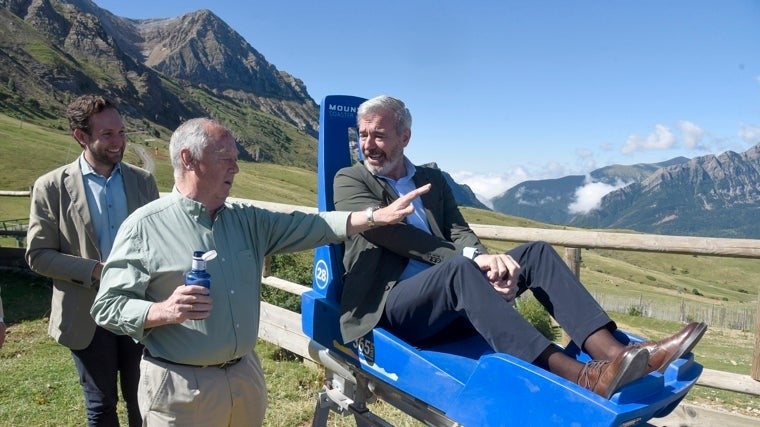
The president of the regional government of Aragon in northern Spain, Jorge Azcón, took part this week in the laying of the first ceremonial stone for what will be Europe's steepest mountain slide ride. The attraction will be located in Panticosa and will be almost three kilometres long, with a gradient of over 700 metres. The downhill run will last nine minutes at a maximum speed of 40 kilometres per hour. Its 50 sleds will allow up to 1,100 people per day to enjoy the ride.
Last January, at the Fitur travel trade fair run by Spain's national tourism institute, Panticosa presented its entire range of sporting, cultural, nature and health attractions and activities. Among all these, the town revealed that, under the Pyrenees Plan (a 10-year plan with a 250-million-euro investment), it was going to build the steepest mountain slide in the world and one of the longest . The goal is that, once it is up and running, it will be operational in all seasons, including winter, thus helping to further reduce seasonality in the Tena valley.
The aim of the new infrastructure is to diversify the tourist offering and ensure that tourism is not concentrated just in the winter months. Construction has only just begun, so the slide will not be operational until the end of 2026.
The Aragonese company Viacron SA will be in charge of the project. Installation of the mountain slide consists of a monorail with 90 sleds with backrests and 30 "state-of-the-art" adapters for children, according to the company, so that an adult and child can ride together. It will have an automatic vehicle garaging system, an anti-collision system between two consecutive cars and will be fully lit. Viacron estimates a frequency of 120 downhill trips per hour and will operate using gravity, taking advantage of the mountain's natural slopes.
This infrastructure will have a budget of 7.7 million euros, of which 7.2 million euros will be provided by the Aragonese government and the rest by Panticosa town hall.
"This alpine coaster can serve tourists for ten months of the year and will be a key element in reducing the seasonality of tourism faced by the ski resorts", said Jorge Azcón while at the ceremony to lay the first stone. He commented that "more than 500,000 people visit Formigal and Panticosa every winter to enjoy the snow and almost 20,000 do so every summer to take the cable car" and, therefore, "we must redouble our efforts to ensure that tourism continues throughout the year." Moreover, it will be an addition to the existing sports facilities available in the area, as it can also be used during the winter and in snowy conditions.
Other alpine coasters
This type of infrastructure, known in English as an alpine coaster, is a gravity-powered thrill ride that is very popular in mountain areas. Last June, the regional government of Cantabria announced its own project to construct something similar in the Cabárceno nature park to "expand and diversify the offering and provide the park with more attractions to attract new visitors and reduce seasonality", according to regional minister for culture, tourism and sport, Luis Martínez Abad.
The slide will be approximately 1.2 kilometres long (330 metres uphill and 854 metres downhill) and will be equipped with 25 two-person sleds that will go down the rails over a 75-metre gradient along an 854-metre route with various twists and turns. The maximum speed will be 40 kilometres per hour, depending on the user and their brake control.
Andorra is home to Tobotronc , a facility that the regional government of Aragon has visited and studied. It is the longest alpine coaster in the world at 5.3 kilometres long. Located in the parish of Sant Julià de Loria, in the Naturland park, each user decides on the speed of their descent depending on how much or how little they brake.
However, it is not the only one. The neighbouring country of Andorra also has Magic Gliss in Canillo, another alpine coaster with a 555-metre descent and a 180-metre ascent that reaches speeds of up to 40 km/h. It is located within Mont Magic Family, a leisure and multi-activity centre.
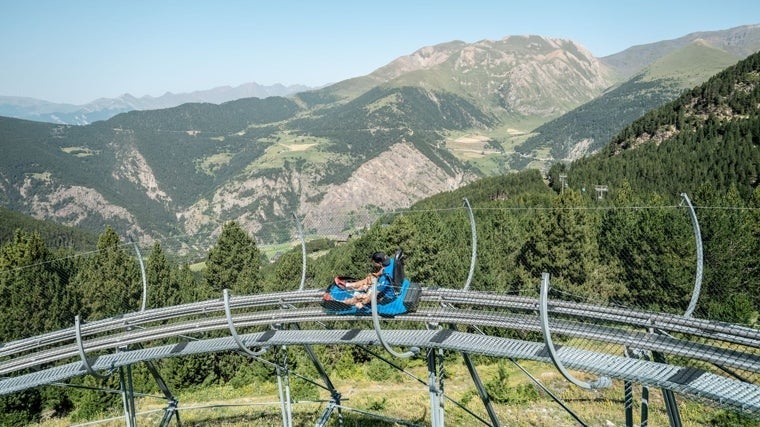
In the Pyrenees you can also find more: Lou Bac Mountain in Les Angles, a 2km-long ride with a gradient of 430 metres and a maximum speed of 42 km/h, Mountain Luge with 700 metres of descent at the Hautacam leisure park in Beaucens and the recently-opened Draco'Snow in Font-Romeu, with 820 metres of downhill, 410 metres of uphill and a 96-metre gradient.
![[]](http://static.vocstatic.com/voc26/latest/assets/images/favicon/surinenglish/apple-touch-icon-57x57.png)