
Road safety
David Landazábal: 'I crashed my bike and was dead for three minutes. When I woke up, I couldn't move'
His parents were killed by a reckless driver, his brother died in another road accident and he crashed into a lamppost. Landazábal urges holidaymakers to: "Enjoy the journey"

Madrid
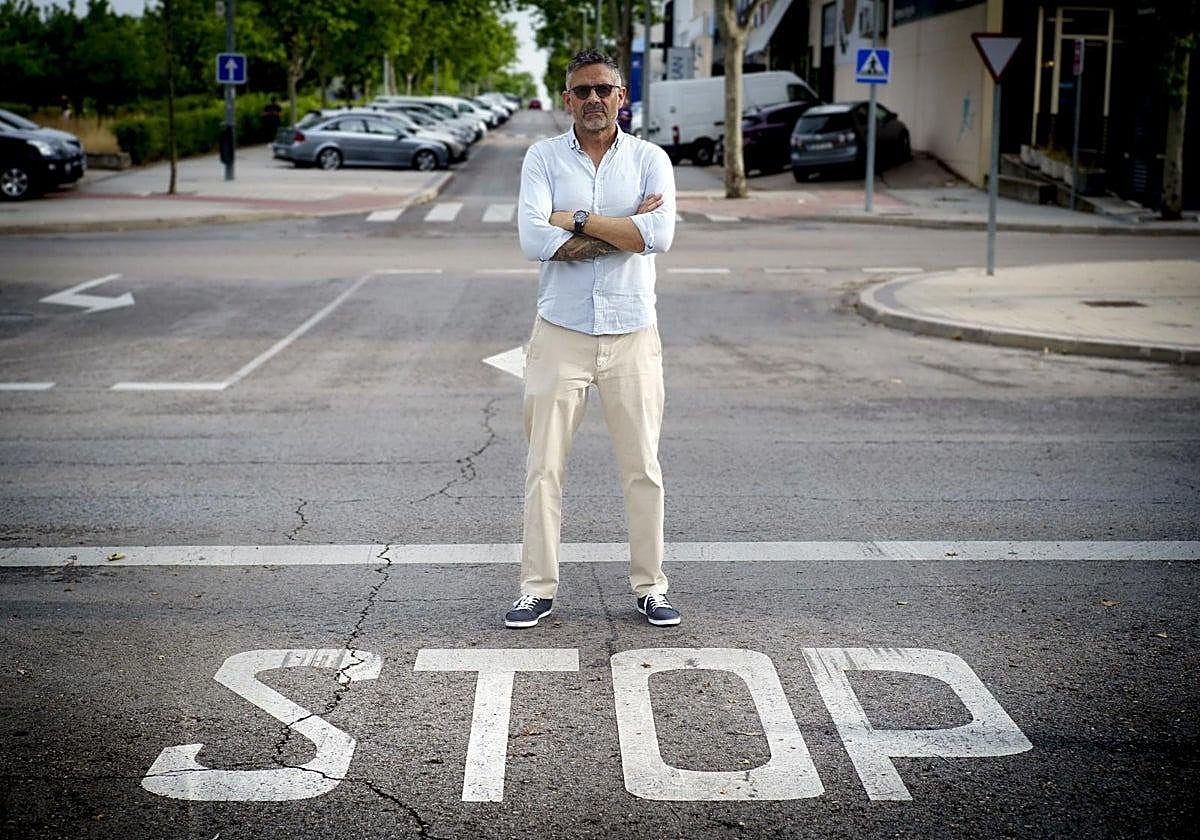
David Landazábal, 57, has overcome the pain of loss and his own experience with traffic accidents as a volunteer for Stop Accidentes. This organisation has been accompanying victims and their families and working for road safety for 25 years. The Madrid resident recounts the story of losing his parents and his younger brother in two road accidents in addition to his own very serious motorbike accident that required fifteen operations. In this season, when millions of drivers get in their cars for the summer holidays, his story gives us food for thought before getting behind the wheel.
-How did your parents die?
-My father was on a business trip and my mother was accompanying him. They were driving along a road in Valladolid when they came across a man who was driving faster than he should have been, he changed lanes and crashed head-on into my parents' Audi 100. The bonnet disappeared on impact. My father died instantly and my mother eleven days later. Their names were José and Paquita, they were 49 and 46 years old. It was in September 1987, but I want to erase the exact date from my memory. I'd rather not have it etched into my memory. Just as I have never been to the cemetery to see my parents' graves. I'm weird like that, it's still a trauma, but I don't like to go there, with that stigma on top of it. It's enough for me just to remember the good times.
-At the age of 19 you become an orphan, with three siblings: two older and one younger.
-Yes, and life changed completely. The man who crashed into my parents' car (who also died) didn't have insurance. We were compensated with 250,000 pesetas for each child (the equivalent of six thousand euros). That was the value of my parents' lives. And from then, the four of us had to carry on.
"I raced a Mercedes and, after accelerating quickly, my bike got away from me because it was raining and I crashed into a lamppost at 160 kilometres per hour"
-And the following year, you crashed a motorbike at 160 kilometres per hour...
-My parents' accident did not help with an already complex adolescence. On the contrary. I went out every night, I had problems with alcohol... my head didn't want to know anything. It was a terrifying year. I had a Kawasaki ZX-10 at the time. That night I went out with friends, we had a few drinks and at five in the morning I headed home. At a traffic light on Paseo de la Castellana I stopped next to a Mercedes. We got into a competition and started to fool around, you know: I accelerated, as did the other driver, and so on until it turned green. I accelerated quickly, but it had rained a bit, the ground was wet and the bike got away from me. I crashed into a lamppost at 160 kilometres per hour. I never wore a helmet, but that day, as luck would have it, I saw that it was raining, so I took it. It saved my life.
-But you were declared dead...
-Yes, I was dead for three minutes. I was resuscitated by Guardia Civil and National Police officers who were guarding the US Embassy, opposite where the accident happened. I was on my back and it was a funny feeling because I was in no pain at all. I was kind of floating. I didn't know what had happened to me until I tried to move and couldn't. From the neck down I couldn't move anything at all. I thought that at the age of 20 I had become quadriplegic and all kinds of situations started to go through my head: I wouldn't be able to do anything, not even attempt suicide. 20 years old and unable to move. I liked motorbikes, going out with my friends, skiing. I was an active guy and suddenly all that was going to end. What was going to become of my life lying in bed?
-But in the end...
-Yes, I had a haemorrhage in my bladder, bruises all over my body, but the most serious damage was to my hands and legs - with an open fracture of the femur. I had to undergo fifteen operations. I was in hospital for two months. When I was admitted, I weighed 90 kilos and I came out 56 - at 1.92 metres tall.
-And you never touched the bike again?
-I panicked and didn't ride it again until many years later. After the accident I started to get my life back on track, I got married when I was 24, I became a father at 30.
"In my talks as a volunteer, wherever I go, I tell my tragedy smiling and joking"
-And in 2011 tragedy struck again...
-Sergio's accident, my little brother. He was seven years old when my parents died and my older sister took him in as if he was her son, she raised him and gave him all the love in the world, but it's not the same. He had this feeling of loss and was messed up by the situation. He wanted his parents back. All of this created a very complex family dynamic. In fact, when my little brother died, we hadn't spoken to each other for two years, we had argued about which of us had suffered more from the death of our parents. How stupid! He also had problems with alcohol, but then he got hooked on boxing and gave up drinking. One night he went out and met an ex-girlfriend and they argued. I don't know what happened but he drank, got in the car to go home and drove into a roundabout. He killed himself. He was 33 years old.
-Do you remember the call to tell you that your brother had died?
-My sister called me, and I didn't speak to her either because she had stopped speaking to all my siblings. They didn't deserve that, I should have sorted out a lot of things earlier on, especially with Sergio.
-That took its toll on you...
-I fell into a terrible depression. I didn't know what to do; I was out of my mind. And it all coincided with my divorce proceedings. I would wake up crying and go to sleep crying. I would go to the psychologist. One day she asked me about my children. I told her I didn't care about them. Imagine the state I was in. At that time I got back on my bike and went out to see if I could crash somewhere. I came close to doing it a couple of times.
-And a message on Facebook helped you to redirect the pain...
-In those months when I was in a terrible state, I posted a message on my Facebook wall about how you suffer when you don't have the chance to say goodbye to people. I felt so guilty, I felt responsible for my brother's death because I had not seen him for two years. A few days after posting that comment, I received a reply. It was from a friend of Sergio's who I had met at a birthday party. They had also argued and their situation was similar to mine. She was devastated and so was I. We met for a coffee and had an instant connection. We started to cry while talking to each other and as time went by we started a relationship. Now she is my wife and we are happily married. Christel has had strength, patience and a way of seeing things that has made me grow as a person in all aspects.
-What else could happen?
-I've stopped asking myself that question. I avoid it.
-And that's not counting the death of Josechu, your older brother.
-He was diagnosed with cancer six months after Sergio's death. Is one thing related to the other? I don't know, but it happened.
At Stop Accidentes for a fine
-Have you forgiven yourself for Sergio's death?
-Yes, in the end life is a journey towards acceptance. We can't change what has happened, but as well as suffering, we can learn from these traumas and change our perspective.
-And now you are putting all that experience to good use by giving talks with Stop Accidentes. How did you find this association?
-By chance. About seven years ago at a stop sign where there was no traffic I didn't stop at all and a couple of Guardia Civil officers spotted me. They fined me and took four points off my driving licence. I wanted to get them back in a points recovery course at a driving school. A teacher, sometimes a psychologist and a victim came to tell us about their experiences. One of them was Fernando Muñoz, a volunteer from Stop Accidentes. He told us that one night his son stayed up very late in front of the computer. The next morning he was leaving on a trip with his girlfriend and fell asleep while driving on the motorway. He crashed into an unprotected bridge pillar and died. I was struck by how a father stood in front of six guys and told us how his son died without a tear. Something in my head clicked. I had to do something to show that people can change. In my first talk about my experience, I was sweating like a pig. And now, six years later, I handle it much better. I give talks at driving schools, high schools, colleges, integration centres and prisons. I have a small renovation company and I find time in my schedule for the talks: Friday afternoons, Saturdays or Sundays.
-And when you talk about your experience in high schools...
-The kids empathise when I tell them: imagine that this afternoon when you leave school and get home, your parents are not there and you will never see them again. They grieve. And when I tell them about my story with Christel, which they always enjoy, they smile, cry and so on. And wherever I go, I always tell them about my tragedy smiling and joking. It's not that I've gone crazy, but if you just tell someone about your suffering, they will switch off.
-At Stop Accidentes they have been talking about road safety for 25 years... .
-And about broken lives, about people who leave home and don't come back. It's 25 years of suffering and of working hard to avoid many traumas and many situations. But we often have the feeling that we are on our own on the road. 95 per cent of accidents are avoidable. We need a broader education from a young age. We are always talking about young people, but I don't think young people are the most dangerous, the most dangerous are the people of my age group, who think that nobody is going to teach them anything anymore. If I take my 15-year-old son in the car and I go 200 kilometres per hour, my son will most probably drive the same as me. There has to be clear societal disapproval as well, which there is not.
-Is there impunity for repeat offenders?
-It is unacceptable that people who have several drink-driving offences can still get behind the wheel. For me, a person who drinks alcohol every day is an alcoholic. I don't care if it's a lot or a little. I have had problems with alcohol and now I drink my sparkling water, my non-alcoholic beer and if I have a glass of wine from time to time, I don't drive.
-You're not in a hurry anymore...
-No, I'm not rushing anywhere. If I'm late, then I'm late, that's fine.
-What advice would you give to those who are going to drive their car or motorbike to start their summer holiday?
-There is no rush to leave and no rush to arrive; the holiday begins the moment you leave work. Enjoy the journey.
-When you are in your car and someone overtakes you at 160...
-I think they're a degenerate.
-What if you see a driver with a mobile phone in the city?
-I beep and gesture for them to put it down. Any day now I'll get a penalty for honking, but I'll keep on doing it.
- At the press conference about the results of the summer campaign in 2024 (with 241 deaths), you told your experience to Minister Marlaska, together with other DGT officials and several journalists. Everyone was moved...
-That attracted a lot of attention. A few days later they announced that they were going to lower the acceptable blood alcohol level... I'd like to think that we contributed towards that.
-Thirty-two amendments have been tabled to this new regulation...
-We are talking about life and death: everyone had to agree to reduce the alcohol rate. Abstentions for the sake of votes are not valid here.
-Have we normalised the data of deaths?
-Yes, in the sense that we think it won't happen to us, until it does. I don't even think we pay attention to the campaigns any more. They tell us in the recovery courses that the most striking thing is the victim's testimony - because it's a real-life case.
-Do people get off lightly for killing by car?
-Yes, it needs a more serious punishment, because in many cases those who cause death don't even go to prison.
-David, how do you help a mother who has lost a child to a drunk driver?
-You can't help them. Nor can you say that time heals everything and this will pass. It doesn't matter what I tell them. Children and parents have a very close bond. You can only tell them that you know how they feel, that they can unburden themselves, that they can lean on you and that if they need you, you are there for them. That's all you can do.
![[]](http://static.vocstatic.com/voc26/latest/assets/images/favicon/surinenglish/apple-touch-icon-57x57.png)