
Wildlife
Spain's most endangered bird species escapes the devastating wildfires that swept much of the country
Although this summer's forest fires could have threatened their survival, the latest census reveals a slight increase in the number of capercaillie

Javier Palomo
Cantabria
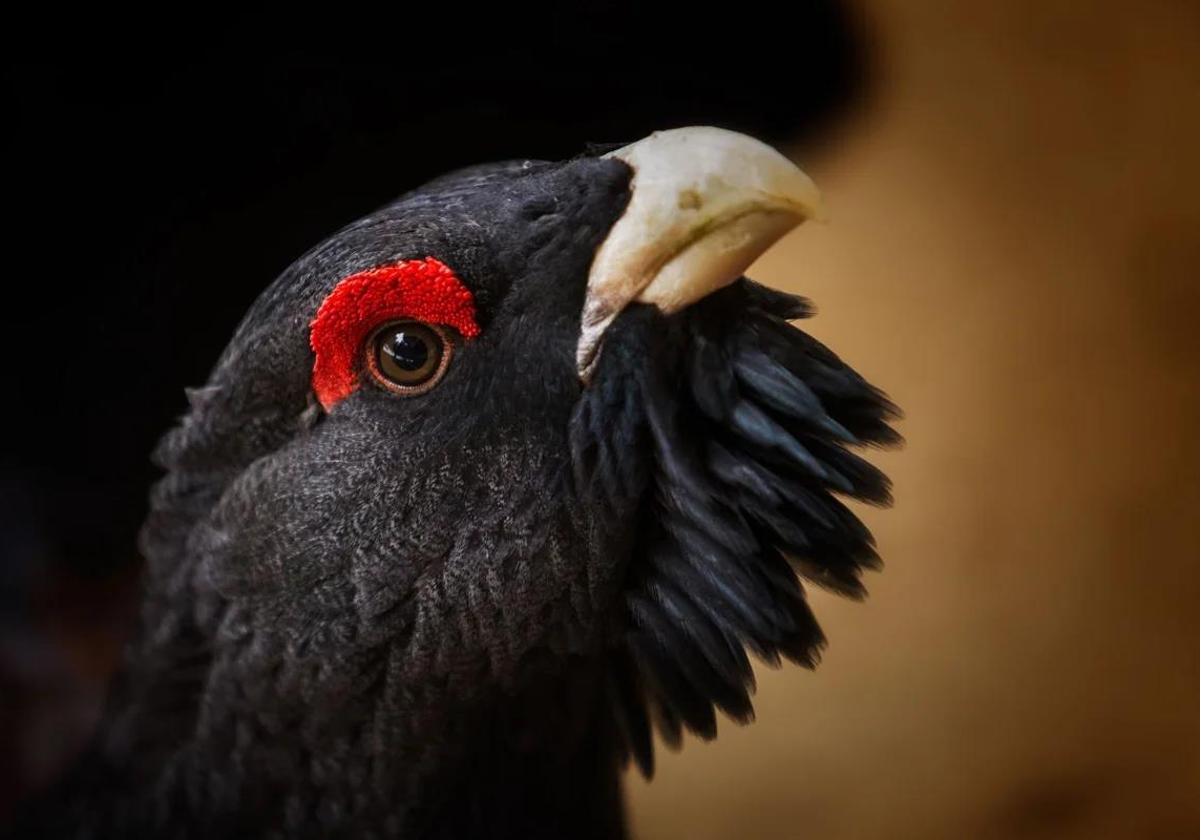
A few years ago, in the clearings of the oak forests of the Cantabrian mountains in Spain, a deep, metallic sound would resound every spring: the song of the capercaillie (Tetrao urogallus). This ritual, a mating call made up of a mixture of clicks and whistles, was used to attract females to the 'cantaderos', courtship sites where the males would unfurl their spectacular fan-shaped tails and bristle their black beards beneath their beaks. Now, that song barely survives in a handful of mountains in León and south-western Asturias. After this summer's wildfires, which devastated thousands of hectares of this bird's natural habitat, and with only 209 specimens counted, it was feared that this bird had been mortally harmed.
Several environmental experts sounded the alarm last week, with reports pointing to damage in areas important for the conservation of bird life, indicating that populations of birds such as the black vulture, the red kite, the Iberian imperial eagle and the capercaillie could be compromised. However, the first available data provide an unexpected respite, at least for the species that is an emblem of Cantabria. "The capercaillie is far from extinction," was the firm declaration to ABC newspaper made by Felipe González, SEO/BirdLife's delegate in Cantabria and researcher with the Ministry for Ecological Transition (Miteco)'s expert group on the species. "After the initial scare, we have good news: our capercaillies were able to avoid the fire. We even know that a radio-tagged female with three chicks in Degaña survived the flames intact," said González.
Homeless
The capercaillie is one of the most unique and iconic birds of the Iberian peninsula. It arrived, having escaped the last Ice Age some 20,000 years ago. The male can reach almost a metre in length and weigh over four kilos. It sports a dark plumage with greenish highlights, a striking red ruff over the eye and a 'beard' of ruffled feathers that distinguishes it from other species. The smaller, brownish females raise their chicks alone after nesting on the ground. However, its distribution range has suffered a precipitous decline. At the end of the 19th century, it occupied some 30,000 square kilometres across the Cantabrian mountains. In the last 50 years, its area of distribution has reduced by 90%. Moreover, this summer's fires devastated some of the most valuable areas for the species. In a matter of days, flames devoured entire forests in southwestern Asturias and northern León, key breeding and feeding habitats for the capercaillie.
The fear was understandable: an ill-timed fire can wipe out nests, broods of chicks and adult birds in a matter of hours. Yet the monitoring data of radio-tagged specimens gives reason for hope. "All the tagged individuals continue to emit a signal," said González, adding that "this doesn't mean there haven't been casualties, but it does show that the species has withstood a blow that could have been fatal."
Multiple threats
However, fire isn't this bird's only threat in the wild. For decades, the capercaillie has been facing other threats. From habitat loss due to rural abandonment and pressure from predators such as wild boar to the fragmentation of their populations and inbreeding. Still, in the midst of so much adversity, encouraging news has emerged. The latest genetic census, conducted in 2023, totalled a count of 209 specimens. "This may seem insignificant, but it is a slight increase from 196 in 2019. This is the first time in decades that the counted population has grown," said González, who also points out that the species, which had hit rock bottom, "could be in a position to start a recovery".
Even so, not everyone shares his optimism. "The fact that the latest census was slightly higher is good news, but it shouldn't lead us to lower our guard," warned María Fernández, professor of ecology at the University of Oviedo. "With just over 200 specimens, the capercaillie remains in an extremely fragile situation." In 2018, Miteco declared the capercaillie to be in critical condition, forcing the approval of urgent conservation measures by the Ministry responsible. Since then, specific actions have been deployed in areas currently inhabited by this bird.
One of the pillars of the strategy is the captive breeding centre at Valsemana, in León. After years of difficulties, technicians have fine-tuned their reproductive techniques and have managed to produce the first viable clutches. "We have now found the formula for the chicks to thrive," said González. "This will allow us, sooner rather than later, to have specimens ready to strengthen the wild populations. It's a long process, but it has already yielded results in species such as the Iberian lynx. Fernández, however, urged caution: "The capercaillie is a very sensitive species. What works for the lynx won't necessarily work here. It's not enough to breed individuals: we need forests in good condition, connectivity and freedom from disturbance."
A case of political management?
The capercaillie also continues to be a case of political to-ing and fro-ing. The Principality of Asturias, despite the legal obligation, has not yet approved a specific recovery plan . Castile and León does have one, but overall coordination currently falls to the Ministry in Madrid, which is leading efforts. "It's true that Asturias has this unfinished business," González admitted. "But the important thing is that the state plan is working and that the three levels of governance - the central Ministry, regional government and the principality - are working together on the ground."
Aside from all the above, another new development in the conservation of the Cantabrian capercaillie is the focus being placed on its genetic diversity. A CSIC study (Spain's main research council) has demonstrated the feasibility of mixing subspecies of the capercaillie, since they belong to the same biological unit. This has made it possible to translocate individuals from one population to another to increase genetic diversity and alleviate the negative effects of inbreeding. "We no longer talk about different subspecies, the Pyrenean or Cantabrian capercaillie. Now there's only one, the Iberian. This strategy has made it possible to give the capercaillie more options for the future, without compromising the identity of the local population," concluded González.
![[]](http://static.vocstatic.com/voc26/latest/assets/images/favicon/surinenglish/apple-touch-icon-57x57.png)