
Infrastructure
Benidorm is green and blue
The resort on Spain's Costa Blanca, that's a firm favourite with hoardes of British holidaymakers all year round, has been a model of sustainable development for decades
Nicolás Von Looy
Benidorm
The best way to understand why many architecture and town planning experts point to Benidorm as a reference is to use an old anecdote. The Spanish holiday hotspot that is a favour of Brits has been an example of sustainability since the middle of the 20th century. Anyone can try the experiment that explains why at home: take a pack of cigarettes, lay it flat on a table and trace its outline. Then stand it on one of its sides and trace the outline again. Finally, balance it upright on its base and trace the third outline.
If we imagine that pack as a building, the lesson is clear: to accommodate the same number of homes, the third option - building vertically - is the most efficient and sustainable because it takes up the least amount of ground area.
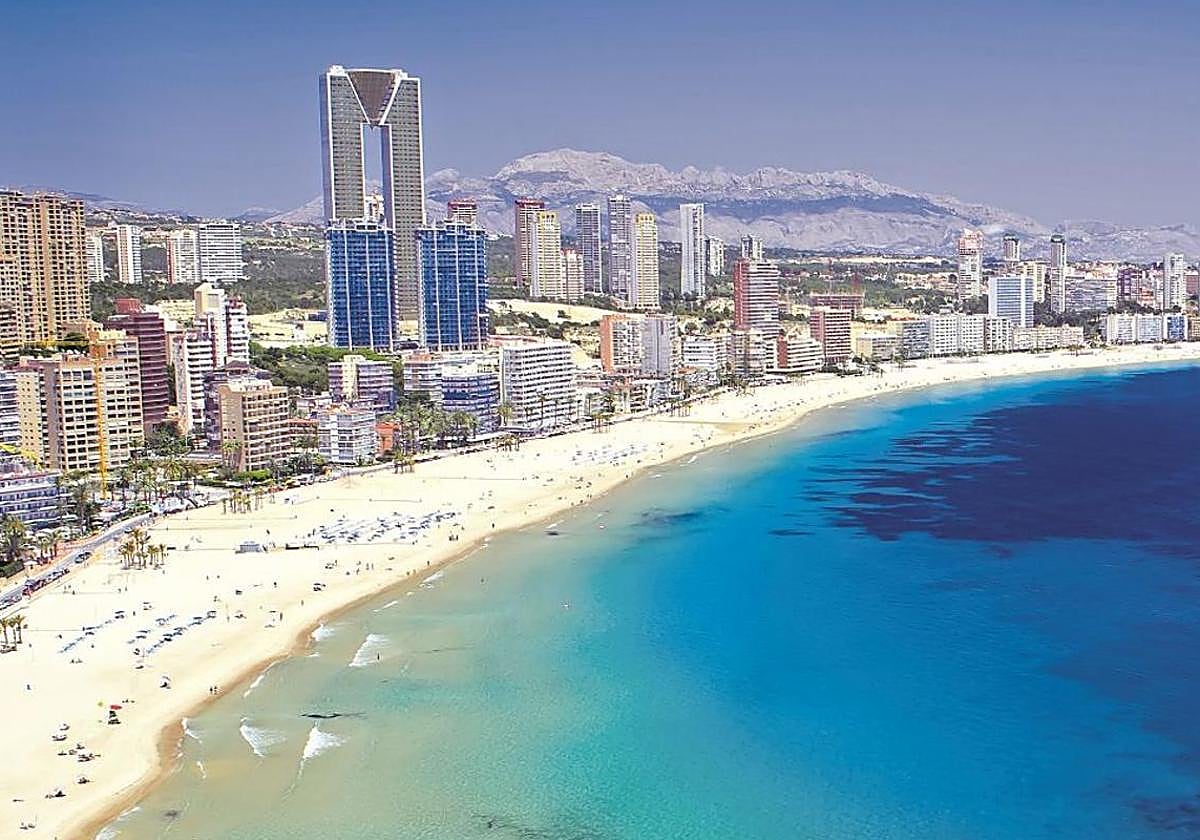
Benidorm has received awards and recognition for the urban and tourism sustainability it has been building for decades. This is why people say that "if you look from the sky, Benidorm is green and blue". It is "the town of skyscrapers" and one where the blue of the coastline and the green of its parks create an urban map.
40%
of tourists
which the Valencia region in Spain receives go to Benidorm
Benidorm accounts for barely 1% of the population of the Spanish region of Valencia, but receives more than 40% of its tourists every year. The town of 75,000 inhabitants competes in both the national and international markets with entire countries in the tourism sector.
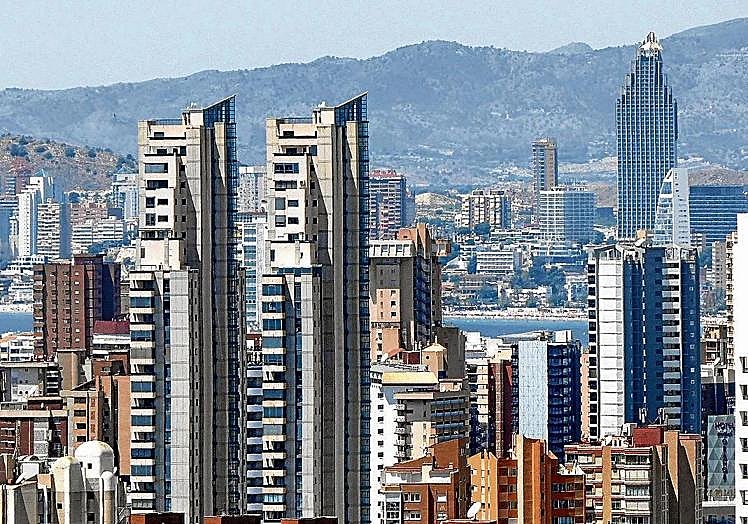
High-rise construction is, in itself, the most sustainable. In Benidorm, it is characterised by wide spaces and avenues, which allows constant flow of air. It is no surprise that Benidorm is one of the cities with the best air quality in Spain, according to the World Health Organization (WHO). Most of the balconies and terraces also have views of the sea thanks to this design.
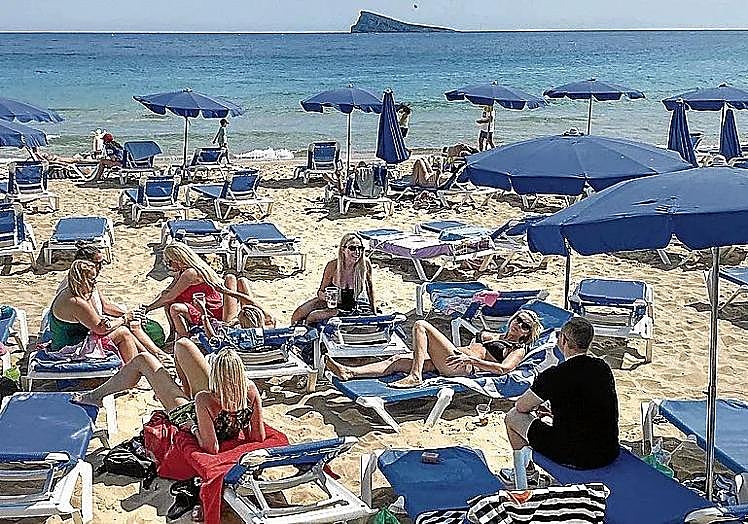
Whether this sustainable drive in the 50s and 60s was the result of chance is a matter for the experts to assess, but at this point in time it has become a conscious effort in which the resort's main industry - tourism - plays a fundamental role. For years now, the sector has been announcing new initiatives almost every week related to making better use of basic resources in the area, such as water, or moving towards zero emissions.
The water problem
Benidorm, like the rest of the Marina Baixa area, historically suffers from an enormous deficit in water supply. It was already apparent back in the days when this corner of the Mediterranean was a small town of trawlers and merchant seafarers. It was the biggest challenge when well-known mayor Pedro Zaragoza - the man who invented tourism as we know it - saw in this activity the only way out when the traditional trades only promised poverty.
70%
of the movements getting around
are made on foot, by bicycle or personal mobility vehicles
Agreements were then signed with irrigators and other towns in the surrounding area for the transfer of water. For more than half a century, the town has not ceased to improve its network, the use of which today exceeds 96%, compared to a European average of 73%. Water consumption in 2025 is 18% lower than a quarter of a century ago, despite the population growing by 40%.
Benidorm is also a town free of traffic jams. In the busiest weeks of the summer and on holidays such as Christmas and Easter, traffic is heavier than usual, but there are never any traffic jams for kilometres. The reason? The forward-thinking vision of the generation led by Zaragoza. One well-known anecdote tells of a high-ranking Franco-era official who refused to approve the construction of Avenida del Mediterráneo as Zaragoza had planned, because it would be wider than Madrid's Paseo de la Castellana.
The commitment to sustainable mobility has been resolute in the 21st century. More than 70% of journeys in the city are made on foot, by bicycle or personal mobility vehicles through its more than 140 kilometres of cycle lanes and cycle paths. On 1 July, the low-emission zone (ZBE) came into force without causing chaos among residents and tourists, because road traffic had already been restricted in these areas for years.
'Low-cost' caricature
Benidorm's success has been such that over the years there have been many attempts to replicate its model elsewhere in Spain and the world. Unfortunately, some copies have ended up becoming a 'low-cost' caricature of the famous resort. One such example is Wonsan Kalma - the project of North Korean dictator Kim Jong Un with which the Pyongyang regime has created a resort with more than 40 hotels, 20 casinos, camping areas, an artificial lake and, of course, a beach that bears no resemblance to the coveted sandy beaches of Benidorm.
96%
of use
of the water supply network, compared to the 73% of the European average
As Benidorm heads towards the centenary of its re-foundation as a major Mediterranean destination, it is not only an eternal leader in tourism but also an established international benchmark for sustainable urban planning.
Benidorm, aesthetically speaking, can be liked or disliked. Its vertical buildings will convince some and scare others, but what is undisputed is that the town is green and blue more than ever. "We will only be the best town to visit if we are the best town to live in," said the mayor.
![[]](http://static.vocstatic.com/voc26/latest/assets/images/favicon/surinenglish/apple-touch-icon-57x57.png)