
Religion
What happens when you leave the Jehovah's Witnesses?
Seven former members of the religious organisation recount their experiences and the after effects
Samuel Baeza
Malaga
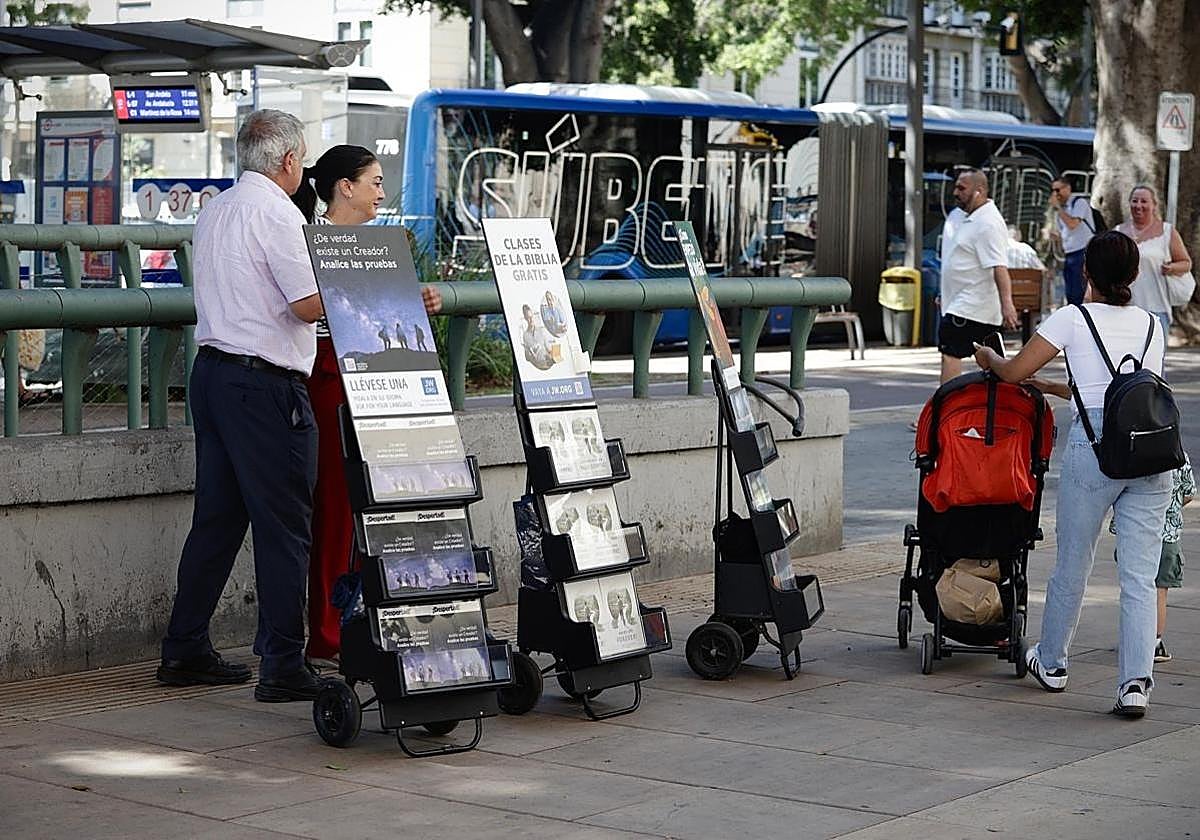
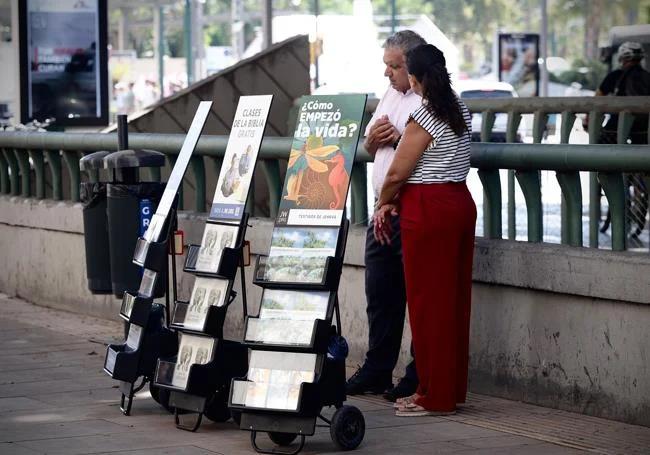
On the Malaga city street corner where Calle Granada begins, four Jehovah's Witnesses are chatting quietly. Two of them, Leticia and Sebastián (fictitious names), are husband and wife. They used to be Catholics. In their trolley-carts they carry publications from The Watchtower and Awake! In the latest issue, a headline looms urgently: 'What's happening to respect?'
"It seems somewhat old-fashioned. The Bible contains moral principles that help us a lot and that apply to all periods of life. We encourage people to get to know our work, but from reliable sources," says Leticia, using a permanent marker and in a peaceful, calm voice.
"I've heard from people who've left that they can't talk with the family that remains inside."
"Obviously, they interact less."
"No, they say they lose contact altogether."
"That is not the case. Under normal circumstances, there is not so much common ground to talk about anymore. That's why you have to go to reliable sources. There's a lot of fake news out there now."
According to them, all the predictions about the end of the world are coming true, but what they don't know is the exact day and hour. "When Jesus was on Earth, he gave a series of signs. He said: when you see flowers and trees blooming, you know that summer or spring is coming, so also are there signs that bring us closer to the end," says Leticia.
"Some who leave, not all, do so with bad intentions, trying to hurt us," Leticia says of the ex-JWs. For her husband, their sole purpose is to destroy, claiming the Witnesses have no positive message, but he believes that what they preach helps families. However, for those who have left the organisation, it's a different story.
"When the frog is in a pot of boiling water, it doesn't die because of the water, but because it doesn't get out in time." Sonia Alanis (born in Cordoba in 1977) was born into a family pot of Jehovah's Witnesses. Her parents, both Bible students, left the organisation, but her mother took it up again when she was only seven years old. She was a regular pioneer - the highest rank a woman can hold - and confesses that it's a "bloody sales machine". Dancing was her release to express herself, even though the congregation's leaders, also known as elders, considered such movements to be "sensual dances" and contrary to the organisation's core values.
Men clearly predominate over women among Jehovah's Witnesses, and only men reach the top echelons of the hierarchy.
Her mother did something that broke the mould. When her daughter confessed to her that she wanted to stop being a Jehovah's Witness, she said, "Before being a Jehovah's Witness, I'm a mother." That's a pretty isolated occurrence, as normally, "They don't look at you, they don't talk to you, they shut you out."
"If a woman has to pray in front of a man, she has to cover her head as a symbol of respect," she explains, even recalling that she once had to cover her head with a paper handkerchief. Nor can women aspire to high office because the man is the head of the family.
Alanis had to give up her first love because he was a 'worldly' man and, as long as he was not a Jehovah's Witness, they could not be together. Ana García (born in Vigo, 1985, but using her fictitous name as she prefers not to be identified), could not be with her true love either. She liked her best (female) friend, but she was never able to declare that openly.
"Who will give me back the chance to live my first love in a normal way?", she wonders while seated on her sofa at home.
A physiotherapist by profession, as a child she was required to study the daily text. She spent 23 years inside to movement, which gave her a generalised anxiety disorder. "At the age of 13 or 14, I told my parents that I needed to take some pills because I didn't feel well. They replied that bad emotions are cured by having faith in Jehovah."
Family and social isolation
In early 1978, a century after the organisation was founded in the United States by millenarian Charles Taze Russell, a young couple arrived at the home of Elena Vargas (born in Madrid in 1956 - she has also requested anonymity), preaching eternal life. Having no faith, she and her husband joined the organisation. She was baptised by immersion in a pool. Little did she know what awaited her afterwards: ostracism and 12 years of litigation as she battled to see her children.
She separated from her husband and took the children with her. She looked for a house behind where they all used to live so that, when the children took the bus, they could say goodbye to their father, but they were clear: "We want to go with Dad because we identify more as Jehovah's Witnesses." She said: "I just want to see you happy." Nowadays she only sees her grandson once a fortnight, and not always even that.
The demands also extend to clothing. "I was a quiet, good girl, but when I was 16 or 17, I began to see a different reality. I didn't like wearing a skirt to meetings, but I couldn't even consider wearing trousers because Satan instils doubts in you", recalls Marta Benítez (born in Cordoba in 1978). Her four siblings and her mother, who were once Catholics, continue to follow this religious movement, which the court in Torrejón de Ardoz has ruled as a sect. For them, Benítez is now a threat; in fact, she has not seen her siblings for years: they can only meet up for essential events.
"Shut up, shut up, shut up, just talk to Jehovah!" said Marta's mother in response to her doubts.
When studying philosophy at secondary school, she saw windows to the outside world, the way out of what for her was like being in prison. In the first year of English philology, she stopped going to the meetings because she had too many exams. "One day I told her: 'I don't have to study today, but I'm not going to go either'."
For Abel L. (born in Marbella in 1988), being an obedient child and isolating himself from those who did not follow his principles led him to suffer bullying at school. At school it was "pretty brutal" and, although his parents tried to help him, his mother would tell him: "You must have done something for the teacher or your classmates to reprimand you so."
The kids laughed at him because he didn't celebrate his birthday or go to the disco with them. As a Jehovah's Witness, he was regarded as the black sheep. Some would be curious about whether he was accumulating merits to be promoted in the ranks:
"Oh, Abel wants to be appointed now...," said a brother in the congregation.
"There is competition among the men. You crave power, ego, your aspirations are to move up in the cult," says Abel. He never became a ministerial servant, much less an elder, but his father was an elder. They were the ones who called him with a hidden number to summon him to a judicial committee for "spreading contrary doctrines" in the congregation. They came to his house and tried him for apostasy. They made him cry, but he wanted to go back to get his family back. "They knew I didn't do it out of love for God, but out of self-interest, and they called me a hypocrite."
Alberto Márquez (born in Barcelona in 1966) did have a love for God, which is why he switched from spending 32 years of his life cloistered among Jehovah's Witnesses to preaching in Malaga's evangelical baptist church. He could not leave God behind, but he left the JWs with his face still on show.
Born to a card-carrying communist father and Catholic mother, his grandmother immersed herself in the organisation in Germany and got him involved in Malaga. He was baptised as a Catholic, then as a Jehovah's Witness and then into the evangelical church. At the age of nine, he used to speak in a pulpit about the Bible, feeling special at his school, Alfonso X: "I used to tell the children that Christmas is a pagan holiday. I argued with everyone."
At 18, he was selling doughnuts from five in the morning until one in the afternoon, although he dreamed of becoming a lawyer. "I would have liked to have been a judge, but no, what for? They said: 'if the Kingdom of God is coming, there's no point'," he says.
"I was such a fanatic that, when my sister-in-law got married in church, I stood across the street with my ex-wife to make it clear I was against the wedding."
Elders and in-house justice
"When are you going to be baptised, Pablito? Armageddon is coming", they told Pablo M. (born in Malaga in 1969). He felt pressured and so, at the age of 12, he was baptised at Los Cármenes football ground. One day his mother gave him money to buy sweets at a kiosk and he ended up buying some plastic soldiers. He had to throw them away because they were deemed violent and Jehovah doesn't like them.
As a congregational elder, he took on "thousands of responsibilities". He added: "I think I did some calculations and I spent at least 30 or 40 hours a week (unpaid) and, on weekends, I prepared speeches, as well as doing the bookkeeping and secretarial work." He ended up officiating on the notorious and illegal judicial committees, although his thoughts and feelings were very different to those of the other elders. "We expelled one woman because she wanted to divorce a ministerial servant who had mistreated her and another for supporting an abortion."
He ended up outside of "the truth" because of an extramarital affair. "I felt tremendous relief, although I cried my eyes out in the committee hearing. Upon leaving, he perceived the world as a jungle and felt so bad that, when he sinned, he started investigating the JWs. From then on, he distanced himself completely.
"When you see Jehovah's Witnesses on the street, what do you think?"
"What a terrible shame."
He is now an atheist. Some are agnostics. Others are still believers in God. Meanwhile... the pot keeps on a-boiling.
![[]](http://static.vocstatic.com/voc26/latest/assets/images/favicon/surinenglish/apple-touch-icon-57x57.png)