
Gaza conflict
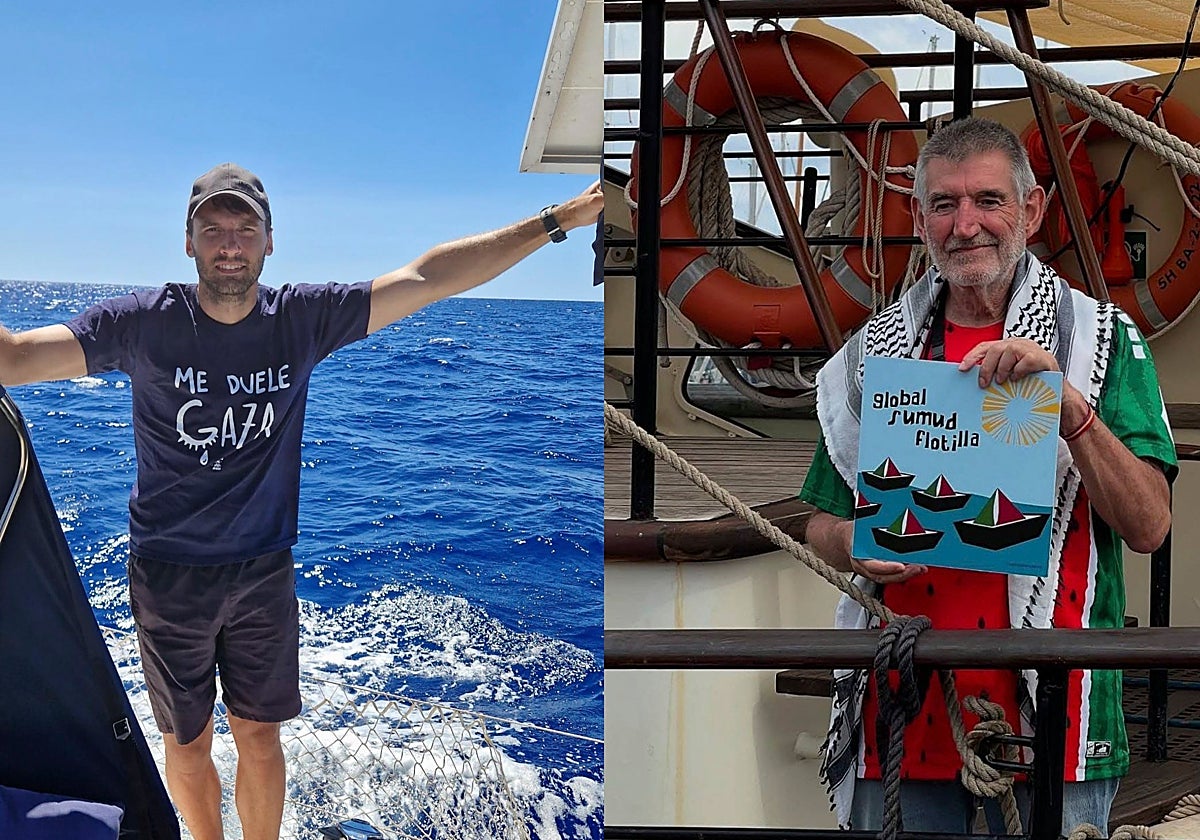
These are the two men from Malaga and the Costa who are part of the humanitarian aid flotilla travelling to Gaza: 'being here is a privilege'
Rafael Borrego, 30, and Manolo García (72) say they are "happy" and "unconcerned" even though they run the risk of being captured and imprisoned by the Israeli authorities

Malaga
The Global Sumud Flotilla travelling to Gaza has sailed from Barcelona, southern Italy and Tunisia, but the crews are made up of activists from all over the world. Joining the flotilla is one crew created with the aim of taking humanitarian aid to Gaza among whom languages from five continents are spoken. A Thai man shares a cabin with a Venezuelan, an American checks the ship side by side with a Czech, and a Spaniard checks the supplies with a French man. In this 21st century Tower of Babel are Manolo García, 72 and Rafael Borrego, 30, two Malagueños who have decided to take action in the Israel-Gaza conflict.
Borrego's story
Borrego, 30, has a strong presence on social media (@rafaborregop), is a lawyer, political scientist and staunch defender of refugee rights. As soon as he saw the opportunity to take part in the latest and largest of the missions carried out by this international initiative he decided, "given the inaction of governments", to join the crew to take action on the issue.
Borrego, who grew up in Fuengirola and Mijas, has spent many years defending and promoting the rights of refugees and working with NGOs. In 2019 he spent a few months studying in "Palestine or Israel, depending on who you ask," he says. This experience gave him first-hand knowledge of the reality on the ground and he knew that the Hamas attack on 7 October 2023 would unleash a wave of highly destructive violence. "Already on the second day I knew that a huge massacre was coming, because I already knew the brutality of the Israelis, which was a bit more alien to the world at that time," he said.
Since then, Borrego has used social media (he has nearly 50,000 followers) to raise awareness of the situation in Gaza. "We could already see that a genocide was coming. It's just that it's taken the world a year and a half to realise it". He has faith in social media to act as a tool to generate movement. "If we had had TikTok or Instagram at the time of the Iraq war, surely many more people would have joined together against what the United States was doing".
The flotilla
The fleet, made up of dozens of boats (it is estimated that, with the boats that will join from Italy and Tunisia, the flotilla will number around sixty boats and some five hundred volunteers), is mostly made up of second-hand boats and private donations, according to Borrego.
The start of this new humanitarian mission has been somewhat turbulent, with the withdrawal of part of the fleet back to Barcelona (the initial point of departure and in which the ex-mayor of Barcelona, Ada Colau and the popular activist Greta Thunberg are travelling) due to bad weather. The flotilla has now landed in the waters of Menorca, waiting for those who had to return to Barcelona and for more favourable weather conditions. At the time of this interview, Borrego was hoping to resume the journey that same afternoon. Shortly afterwards, they were on their way to Tunis.
The Malaga native is travelling in a ten-metre long boat with six other crew members, packed with all the food and medical equipment they are able to carry: "It's not the most comfortable. Probably because it's not built for such a long journey". Although there are much larger vessels in the flotilla with crews of more than 20 people.
This is the largest-scale mission the flotilla has sent to date, so the contingencies include the possibility of sabotage. In fact, one of the activists, Yasemin Acar, claims that there are drones chasing the ships. To finance this mission, the Global Sumud Flotilla has covered all the expenses through donations from individuals and the delegations of different countries. "The Malaysian delegation, it seems, is one of the ones that has been able to contribute the most. This is not a European issue. This is a matter for the whole planet," says Borrego.
Garcia's story
Manolo García has been involved in activism since he was young, during the Franco era. He currently chairs the Spanish-Cuban Friendship association of Malaga and is a member of the board of Unadikum, an association focused on solidarity with Palestine. For more than a decade now, the defence of this people has been one of his priorities. In fact, this is the third time he has been on board a flotilla, although it is the first time he has left port.
The Malaga activist was also part of the flotilla that tried to leave Athens in 2011 and the one in Istanbul last year, both of which were unsuccessful due to political pressure. "I am very happy. This third time, at last, we are sailing," he says. In addition to the attempted incursions aboard the flotillas, García participated in the Cairo march on 15 June (which also ended up cancelled due to heavy government pressure, with numerous arrests and deportations) and in 2012, García was in Gaza, taking advantage of the fall of Mubarak in 2011 and the arrival of the Muslim Brotherhood (Mohamed Morsi), which brought some help to the Palestinian people with the reopening of the Rafah crossing: "It was not a total opening, but they did allow what was not allowed before: a daily transfer of people between Egyptian and Palestinian Rafah, which my association took advantage of to send solidarity teams to Gaza and collect aid."
García is travelling on the Sirius, a much larger boat than the one Borrego is on. It is a 107-year-old brigantine sailing ship with two longer masts, although it has also been adapted to run on fuel, "which is how we are going, on diesel". The age and condition of the boats is, together with the storm, the first problem the flotilla has had to face. "It's like an old car: you fix one thing, you start it up, and another one comes out".
However, these problems are only the beginning of a mission that has four possible scenarios: the mission is successful and they manage to deliver humanitarian aid, they are stopped at some point by bureaucracy, the crew members are detained and, finally, they are attacked.
Neither García nor Borrego, nor the crew in general are afraid or discouraged. "I think most of humanity, if they could, would get on one of these ships. According to García, more than 30,000 people signed up to take part. "Above all, being here is a privilege."
![[]](http://static.vocstatic.com/voc26/latest/assets/images/favicon/surinenglish/apple-touch-icon-57x57.png)