
Health
SAS ordered to compensate patient 67,000 euros after doctor left part of needle inside following operation in Malaga
Some ten years after the error, the high court of justice in Andalucía (TSJA) has handed down the sentence and ordered the region's public health service to pay compensation to the woman, who suffered problems with her left wrist

Malaga
The Andalusian public health service (SAS) has been ordered to pay compensation of 67,000 euros for the after-effects suffered by a patient following a surgical operation in which part of a needle was left inside her wrist. The ruling handed down by the high court of justice of Andalucía (TSJA) resolved events that occurred in 2014, when the woman from Malaga, who is now 63 years old and who is also a doctor, underwent an operation at the city's Hospital Virgen de la Victoria.
The patient was suffering from “instability” of the left wrist as a result of an injury sustained in 2012. In January 2014, she underwent surgery that consisted of fusing two or more bones in a damaged joint to relieve pain or correct deformities. The surgion who performed the operation used a Kirschner needle (also known as a K-needle), a long, thin surgical instrument made of stainless steel, which is used in orthopaedics and traumatology. They were designed by surgeon Martin Kirschner in 1909 and are used in a variety of medical procedures, although their use also carries risks such as infection or breakage.
Two months after the operation, the doctor decided to remove the plaster cast and remove the needle. She then prescribed the patient specialised rehabilitation treatment at home, which began at the end of March 2014. Since that time, the woman alleged in her complaint, that she began to experience increasing pain in her wrist joint.
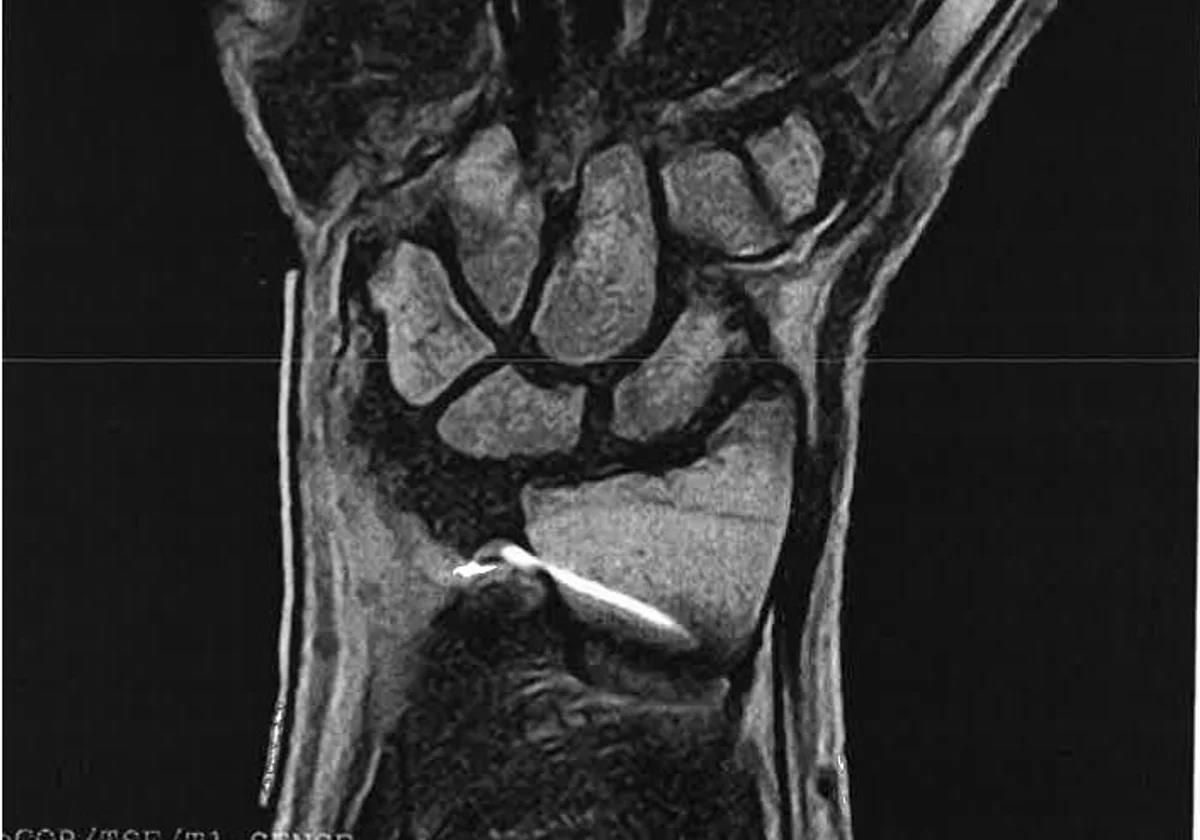
It was not until October of that year - some seven months later - when an MRI, prompted by the discomfort, revealed that the patient had “a metallic object, likely from a previous surgical procedure,” inside her wrist.
The test showed damage to the joint, specifically a dorsal radioulnar subluxation, a rupture of ligaments in the same area, a rupture of the joint capsule and bone erosion, according to the contentious-administrative appeal filed by the patient, represented in the proceedings by the Martín Fernández law firm.
In November 2015, the woman underwent further surgery, performed under private health care, to remove the fragment of the K-needle that had remained inside her wrist after the first operation.
The case was referred to the administrative court number 7 in Malaga, which had to determine whether the injuries and after-effects originated from a pre-existing condition (she suffered from polyarthritis, but it only affected her feet), or whether they were the result of the removal of the needle, due to the prescribed rehabilitation with the fragment still inside the body and the subsequent procedure to extract it.
The ruling, subsequently confirmed by the TSJA, includes the opinion of the Andalusian advisory council, which found "malpractice". But the problem, the ruling stated, lay in what damage could have been caused as a result of that fact. The administration concluded that - after the SAS initially refused to provide compensation and appealed the first ruling - everything was due to the polyarthritis condition that the woman had been suffering from.
In support of its arguments, the SAS called several doctors as witnesses, including a doctor it described as a "super-specialist". This doctor stated that the fact that part of the needle was left in the wrist by mistake, when it was not intended, "was over-information and not essential information".
The court considered this doctor's statement an "insult to intelligence, said in terms of defence, and an absolute lack of respect for patients". "This doctor did nothing more in the courtroom than give vague answers, some of them nonsensical, in favour of the SAS."
However, for the judges, 'it became clear that the K-needle was not completely removed due to a lack of skill on the part of the doctor and failure to notice it (despite the size difference from not removing it entirely) or because, if she was aware of it, she did not report it".
Lawyers Esther Martín Fernández and Jesús Martín Fernández confronted these testimonies with those of the medical expert Tomás Salas Casanova and a rheumatologist from the regional hospital who have followed the case since 2014.
The specialist was adamant that the patient had no pathology of the left wrist, that the result of the rupture of the triangular fibrocartilage, as well as the dorsal ulnar fibrocartilage, were not caused by her underlying rheumatic disease, and that these injuries are "post-traumatic" related to an "incomplete extraction of the K-needle that broke after the first surgery".
Based on all of the above, both the trial judge and the court of appeal have concluded that there was a cause-and-effect relationship between the surgical treatment received and the sequelae suffered by the woman, for which the SAS must compensate her with 67,000 euros plus interest.
![[]](http://static.vocstatic.com/voc26/latest/assets/images/favicon/surinenglish/apple-touch-icon-57x57.png)