
Environment
Invasive oriental hornet continues its spread throughout Malaga province and threatens native bees and insects
Experts are worried about the increasing presence of this "super predator" in our streets, gardens and on the beaches of the Costa del Sol
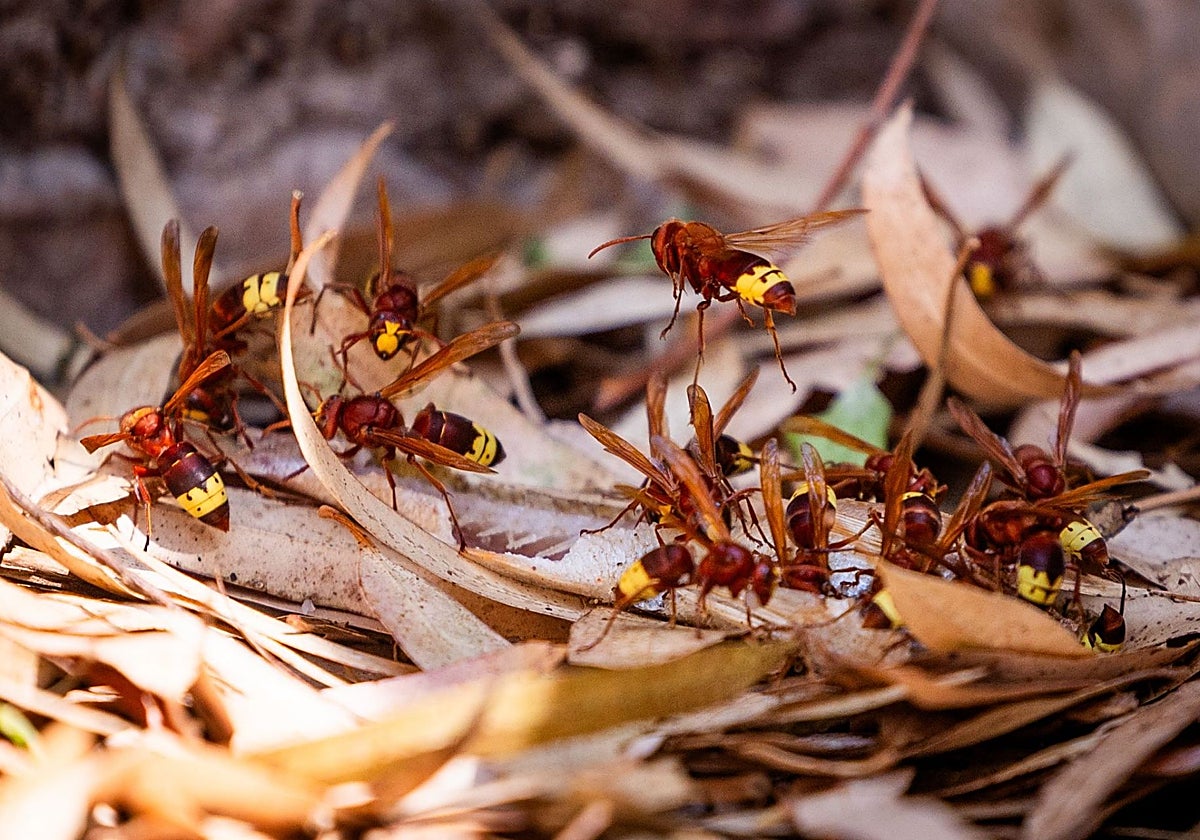

Malaga
"It's a species that we're no longer going to be able to eliminate, it's here to stay..." This is the pessimistic forecast made by Raimundo Real, professor of zoology at the University of Malaga (UMA), when asked about the disturbing and increasingly abundant presence of the oriental hornet in our streets, gardens and on the beaches. This dangerous, invasive species has continued to spread throughout the Costa del Sol province this year, as the academic expert explained, and also as demonstrated by the data gathered on the removal of nests and swarms by provincial authority's Consorcio Provincial de Bomberos (CPB) fire brigade network.
Calls have come in from all over the province from members of the public asking for the help of specialists to deal with these insects found in their homes, gardens and residential areas. As many as 107 cases have been attended to between June and August of this year, compared to 68 last year. This represents an increase of almost 60% from one season to the next. Not all are due to this invasive species as other wasps and bees are included in the stats, although it is the Vespa orientalis (often listed as "unidentified") that is driving up the numbers, according to the list of fire brigade call-outs consulted by SUR.
"Oriental hornets have already settled in Malaga and, since last year, they have spread further and have now occupied the whole province", confirms this professor of zoology. However, in reality, this year's hornet cycle has been something of an anomaly. Also, if we haven't seen even more specimens buzzing around this summer, it is precisely thanks to the weather conditions this year that have slowed down the population boom for this invasive hornet.
The 'Dana' storms helped
"Their presence has been less dense in spring and early summer because of 'Dana' storms and flooding," says Professor Real. The queens spend the winter hidden in small nests, usually on the ground, so it is possible that overflowing rivers and streams wiped out many of them.
"We must encourage natural species that are predators of hornets"
Raimundo Real
Professor of Zoology at the UMA
Despite that, many more remained alive and have already managed to form their hives in the ground and in other hidey-holes and the workers have started to emerge from the nests. Their presence is more noticeable these days because worker hornets are now looking for protein in carrion (dead animals) as well as in rubbish. Worst of all, they also prey on native bees.
As Raimundo Real explains, the purpose of this meat is to feed the larvae, since adult hornets only eat fruit. That is why this summer they are being frequently seen near beach bars, searching for scraps on the ground, as well as showing up in rubbish bins. "The first piece of advice is not to leave meat or fish waste in sight, it should always be well-covered."
The greatest harm is caused when they attack bees, which are essential for the ecological balance of all biodiversity. In addition to killing many individual bees, they cause what is known as "fear syndrome" in hives, causing the bees to barricade themselves inside and so they then die of thirst and starvation.
"Trapping is most effective in spring to eliminate the queens"
Joaquín Becerra
Beekeeping technician at Coag
That's not all. Juan Molina, president and veterinarian of Malaga's association of beekeepers, notes that they also catch grasshoppers in large numbers, as well as butterflies, ants and other wasps. "It's a super predator. The white-faced hornet has been studied and found to hunt almost 2,000 species of insects, and this one could be the same or worse."
How to combat this invasion?
The solution is difficult to address, although there are options. Firstly, ecological control, by encouraging species that are natural predators, such as the bee-eater, honey buzzard and kestrel that feed on these insects, among other prey. "These are species that specialise in hymenopteran (membrane-winged) insects, so it would be positive to nurture and protect these types of species." Native hornets, such as the European hornet (Vespa crabro), also compete against these invaders and often have an advantage. Furthermore, it is expected that, over time, ecosystems will readjust and other predatory species, such as bats, ants and lizards, will emerge.
"It's a super predator, it preys on almost 2,000 species of insects"
Juan Molina
President of Malaga's association of beekeepers
Regarding insecticide control campaigns, the professor warns that they are "double-edged swords", because they also affect native species. Therefore, they should only be used when there are concentrations of oriental hornets and it's done under surveillance to prevent the good insects from also falling prey to the poison.
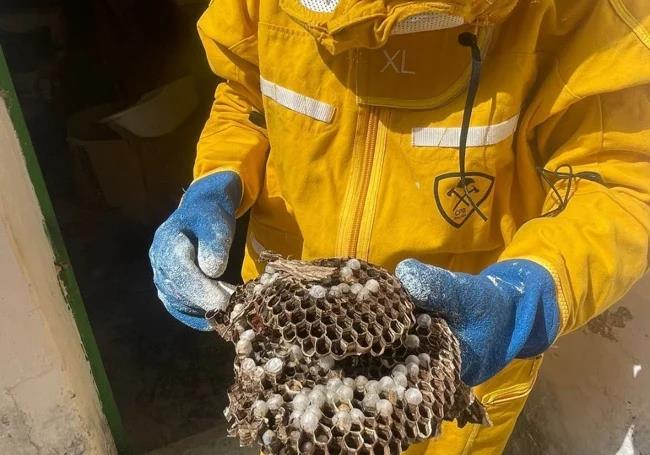
However, the best measure remains the locating and removal of nests. Unfortunately, such tasks are time-consuming and costly, which is why they only step in to do this in urban areas where more people are affected, but not in rural areas. "Local authorities must be notified so that they can send fire brigades or operational services, but it must always be done by specialists because these insects are dangerous."
Checkmate for the queens
In reality, these hornets are not usually aggressive, but they do attack when trying to defend their nest. Moreover, they can sting multiple times as they do not lose their stingers and they are so long that a special protective suit is required.
Added to this is the seasonal factor, as Joaquín Becerra, beekeeping technician for the agricultural organisation Coag, points out: "The fight must focus on the moment when it's most vulnerable." When temperatures are milder, at the beginning of spring, the hibernating queen emerges and is responsible for building the nest. For approximately six weeks from the time she emerges, she is alone, collecting cellulose and food for herself and the larvae. "During this time, trapping is the most effective method, as removing a single specimen (the queen) leads to the demise of that nest."
This is why trapping efforts should be focused on early spring as the best time, even though this is the time of year when fewer specimens are seen and they are not particularly bothering people or beehives. "At that time, there is only one hornet, but then, in a few months, each nest will have thousands of workers," says Joaquín Becerra.
A new threat for beachgoers
The negative impact of the oriental hornet is beginning to be felt not only in the environment, but also in the main economic activity of the Costa del Sol province: tourism. This species is colonising large swathes of Malaga's beaches, as observed by Jaime Pereña, a researcher attached to the UMA's chair of climate change. "I was on Sacaba beach, with only a few people still there, around midday, when I heard the lady next to me say to her son: 'Be careful, it's going to sting you. Don't do anything to it, it's too big'. There were two or three oriental hornets hovering around their sunshade and I warned them to be careful because they were not the usual wasps, but an exotic species whose sting is very painful." This was not an isolated incident. "On the other side, I saw another girl swatting two more hornets. But, in just over 50 square metres around me, there were more than 10 of them flying, not landing, near the shore, probably seeking the cool sea breeze. What's more, they only landed on the white pebbles, probably because they are the ones that burn the least." After sharing what had happened on that beach, reports of similar situations arrived from other places, for example, on beaches in Rincón de la Victoria. "This makes me think that this species may be occupying the beaches for two reasons: firstly, because it's cooler than inland, especially near the shore. And also because of the rubbish left by beachgoers and because they prey on other insects that flock to the beaches." His conclusion? "Whatever the case, this new type of beachgoer is here to stay..."
![[]](http://static.vocstatic.com/voc26/latest/assets/images/favicon/surinenglish/apple-touch-icon-57x57.png)