
Rail network
Mayors unite to demand a better train service along the Costa del Sol
Civic leaders on the coast have warned of the 'collapse' of mobility and demanded the improvement of railway stations, more double-track sections, more frequent trains and an extension of the line to Estepona


Fuengirola
Next to the old Iberian broad-gauge railway station building in Fuengirola, located close to where the first train from Malaga arrived on 31 July 1975, the mayors of the western Costa del Sol met to discuss the transport situation in Malaga province. They all demanded that the Spanish government improve the C1 commuter train line.
The building is now just a memory, as the tracks and station are no longer the same as they were 50 years ago. Nor are the trains or the number of stops, but one thing has not changed: the 31-kilometre route.
All the mayors of the four municipalities through which the C1 commuter line runs - Malaga city (Francisco de la Torre), Torremolinos (Margarita del Cid), Benalmádena (Juan Antonio Lara) and Fuengirola (Ana Mata) - and the mayors of the municipalities where a connection is demanded - Mijas (Ana Mata), Marbella (deputy mayor Kika Caracuel), Benahavís (José Antonio Mena) and Estepona (José María García Urbano) - joined forces to urge Spain's Ministry of Transport to "not make excuses" and take action. The province is undergoing growth in various aspects - population, urban planning, tourism and economic activity - and railway transport should be able to match that. For this reason, the councillors are asking for an improvement in the service: including the doubling of more sections of track; the extension of stations and tunnels to improve frequencies and provide the line with greater capacity; a train line to Estepona.
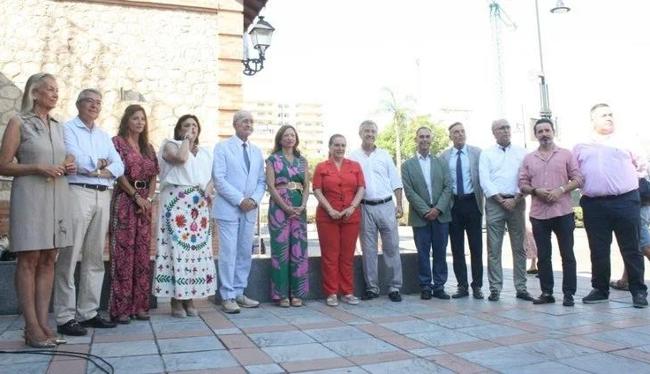
The event, organised by the right-wing party PP, was also attended by head of the provincial authority Francisco Salado and president of the Partido Popular in Malaga province Patricia Navarro. According to Navarro, the Costa del Sol train is a "fundamental infrastructure" - the most "important and decisive" for the future.
Demand, viability and tax reinvestment
With more than 16 million passengers a year and an occupancy rate of 171% that forces 7 million people to travel on foot, the C1 is "the most important public transport infrastructure in southern Spain" and the "most profitable" commuter train line. However, "the transport service is beginning to show signs of collapse". Not only rail travel is affected by this - the A-7 motorway is suffering from daily traffic jams and many people have no access to an alternative offered by public transport.
According to studies carried out by private consultancy firms and by the employers' association of construction companies (Seopan), new and modern connections, with more features, can not only make the railway system in the Costa del Sol "one of the most profitable infrastructure projects in Spain" but also make the economic return "double the necessary investment in a short period of time".
Moreover, to justify their claim they have pointed out that Marbella is the only European town with more than 150,000 inhabitants that is not served by a railway line. If the growth trend persists, Mijas and Estepona are expected to exceed 100,000 inhabitants in just a few years, while Malaga province will most probably exceed 2 million "in five years".
Another justification for their demand, according to the mayors, is that Malaga province contributed to the national tax revenue with 5.5 billion euros last year. For this reason, the Costa del Sol deserves to be rewarded with a reinvestment in the "most important and decisive" infrastructure.
Furthermore, the PP has criticised the "favouritism" observed in the central government's investment towards the development of the Catalan Rodalies railway system. Among the demands of the mayors of the western Costa del Sol is an end to what they describe as "discrimination" against the south of Spain.
![[]](http://static.vocstatic.com/voc26/latest/assets/images/favicon/surinenglish/apple-touch-icon-57x57.png)