
Transport
Lack of state budgets and timelines hinders transport improvements on the Costa del Sol
Spain's Ministry of Transport has already assessed the requirements of the coastal commuter train service and several major roads, but work has not yet started

Malaga
If the third session of the government and stakeholders round table on transport links last Tuesday was of any use, it was to confirm that the Ministry of Transport already has a full list of what needs to be actioned on many fronts to achieve transport link improvements on the Costa del Sol. What it does not have ready-to-go is the budget to contract and implement them. What is worse, the way things are going, everything suggests that central government will not have them in the medium term either.
Both in the case of the C1 commuter railway line and in terms of several major roads, there are already sufficient studies into their feasibility, there are even fully-scoped projects. However, actual work has not yet begun. At the end of the meeting, central government's secretary-general for sustainable mobility, Sara Hernández, gave a run-through of the infrastructure projects already under way although, for the time being, they are only on paper.
However, she estimated the number of tenders put out this year across Malaga at 211 million euros, "which is a much larger investment than the entire amount invested in the last decade". Of this total, 180 million euros went to improvements to lines C1 and C2 and train stations along these tracks. To this, she added another 49 million euros for improved transport links in municipalities in the province and a "committed investment" of 250 million euros for roads for which the state is responsible. Despite this, the transport situation in the metropolitan areas surrounding Malaga city and along the coast is steadily worsening and no progress has been made because funds have not been allocated to any of the necessary major projects.
MA-20 motorway to Torremolinos
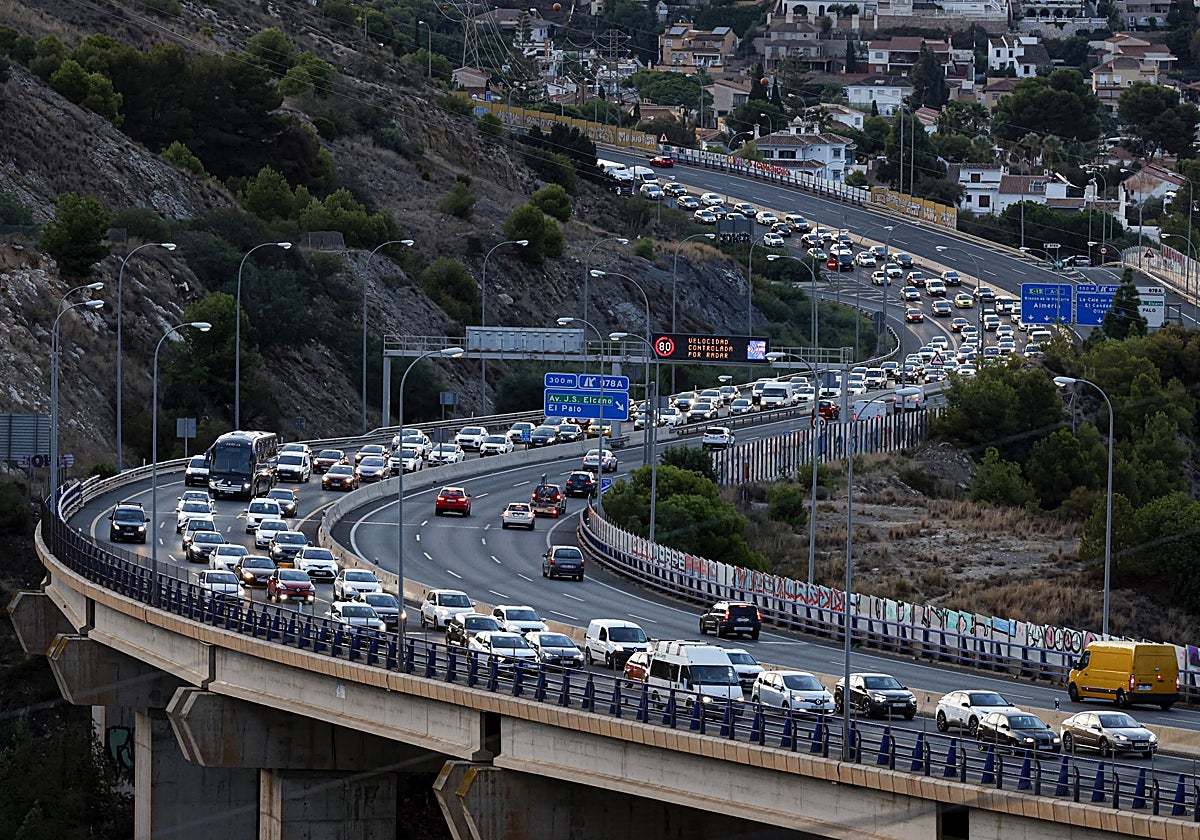
Regarding roads, the main project discussed at the meeting will not be possible in the short term. Since April of this year, the expansion of the MA-20 motorway between Torremolinos and Malaga (a 9-kilometre stretch) has been in the environmental processing phase, which includes another viaduct over the Guadalhorce river. Therefore, of the 250 million euros previously announced, 190 million euros would be allocated to this project alone, a project that cannot start until the environmental assessment is completed, many months from now. This is also an initiative that has been in the pipeline for central governments during the last 15 years.
What of municipal proposals?
As for other proposals, there has been no word from the Ministry in Madrid about the battery of proposals presented to them by the councils of Malaga city and Rincón, following a joint technical study. Basically, what they are asking for is a mere 14 million euros, which could be used to renovate seven access points to the A-7 motorway between the two municipalities and thus avoid traffic bottlenecks.
Malaga city and Rincón are demanding 14 million euros to renovate seven access points to the motorway and avoid bottlenecks, but central government has not responded to their request
Although central government did not clarify this either way, the PP opposition party asserted that these municipal proposals had been "rejected" outright. The PP's party president in Malaga, Patricia Navarro, condemned the "disregard" shown for these local government proposals and "the lack of willingness" to listen to these local councils that are suggesting "immediate and low-cost solutions". Navarro stated that no response has even been acknowledged, after this document was officially sent several weeks ago to Óscar Puente's national Ministry of Transport.
Studies on paper only
For the rest, as far as roads are concerned, everything depends on the two studies being drafted: one for access to Malaga city from Rincón de la Victoria and the other for the coastal corridor from Malaga city to Estepona. "We are drafting the studies for the eastern and western areas to evaluate measures that can alleviate rush-hour traffic, analysing whether new junctions, extensions of, and widening roads into, dual carriageways are necessary. This will allow us to have a roadmap, because we must have a strategy for the whole corridor," said Sara Hernández.
In this regard, in addition to the aforementioned MA-20, she mentioned the Caleta de Vélez junctions and the new northern access point to the Costa del Sol airport. Still, once again, no budgetary or timetable commitments were made.
Cercanías trains on the Costa
In the railway sector, the overall objective and the necessary measures are even clearer and more technically defined, although work on the ground has not yet begun. In the case of the C1 line, the Cercanías de la Costa line, the Ministry's goal is to increase capacity by 60% and improve service frequency by five minutes, reducing the current 20-minute intervals between trains to 15 minutes.
The first phase of the functional study conducted by Adif foresees the need to double the track between the airport and Campamento Benítez. However, five stops will also need to be adapted to accommodate 100-metre-long trains - namely Los Boliches, Carvajal, El Pinillo, Plaza Mayor and Centro Alameda. Benalmádena station will also need remodelling to extend the platforms there to 200 metres.
Diagnosis
Therefore, these projects are now ready to begin on the ground although, for the moment, there are no plans or set date. In addition to this, there is a second phase, with plans currently being drawn up, which also proposes the imperative of doubling the track in the Torremolinos, Benalmádena and Campo de Golf sections. This is in addition to other renovation work to be done on control, command and signalling facilities.
In conclusion, neither in the area of state-owned roads nor on the railways is there any indication that the Spanish government's investments, so urgently needed to alleviate the serious transport shortages endured daily by the people of Malaga, will reach the province in the short or medium term.
The coastal motorway will continue without the discounts received by other Spanish provinces
The coastal motorway will continue without the discounts enjoyed by similar roads in northern Spain. While it is true that discounts are already offered for frequent use, it is equally true that the AP-7 must be used very intensively for these discounts to be noticeable in drivers' wallets. In contrast, on other national roads (state-owned), such as the AP-9 in Galicia, paying for the outward journey is enough to get the return for free.
At the round table meeting last week, an undisclosed internal report from the Ministry of Transport was revealed, according to which such discounts would only result in a transfer of between 0.5 and 1.1% of traffic from the A-7 to the AP-7 toll road. Given that the average daily traffic intensity rate (ADI) on the Benalmádena bypass is around 98,000 vehicles, this would mean that between 500 and 1,000 cars would be transferred to the toll road each day. According to the Ministry of Transport, 298,000 drivers using this road had already benefited from some kind of frequent-use subsidy last year. Central government's secretary-general for sustainable mobility, Sara Hernández, justified this by the fact that the AP-7 only has three connections with the A-7 at Calahonda, San Pedro and Manilva, while most journeys on the Costa del Sol are internal and are made on the toll-free road, which has more connections.
The approach taken by the governing authorities ruled by the PP is very different, as they once again denounce the comparative grievance. For Cristóbal Ortega, vice-president of Malaga's provincial authority and general coordinator of the Partido Popular, "the [Spanish] government is hiding behind phantom reports and false price reductions to avoid subsidising the exorbitant tolls and continue making money." Again, Ortega pointed out the substantial subsidies on other motorways, such as the AP-7 through Alicante and the AP-9 in Galicia. Finally, in relation to the aforementioned Ministry study, he warned: "It's hard to believe that implementing subsidies on a par with those in other regions wouldn't cause many drivers to opt for the toll road to avoid the congestion on the A-7 motorway"
![[]](http://static.vocstatic.com/voc26/latest/assets/images/favicon/surinenglish/apple-touch-icon-57x57.png)