
8 March. International Women's Day
The history of the fight for women's rights in Malaga
This was the Spanish province where the first women's centres and shelters were opened and where women first took to the streets against domestic violence
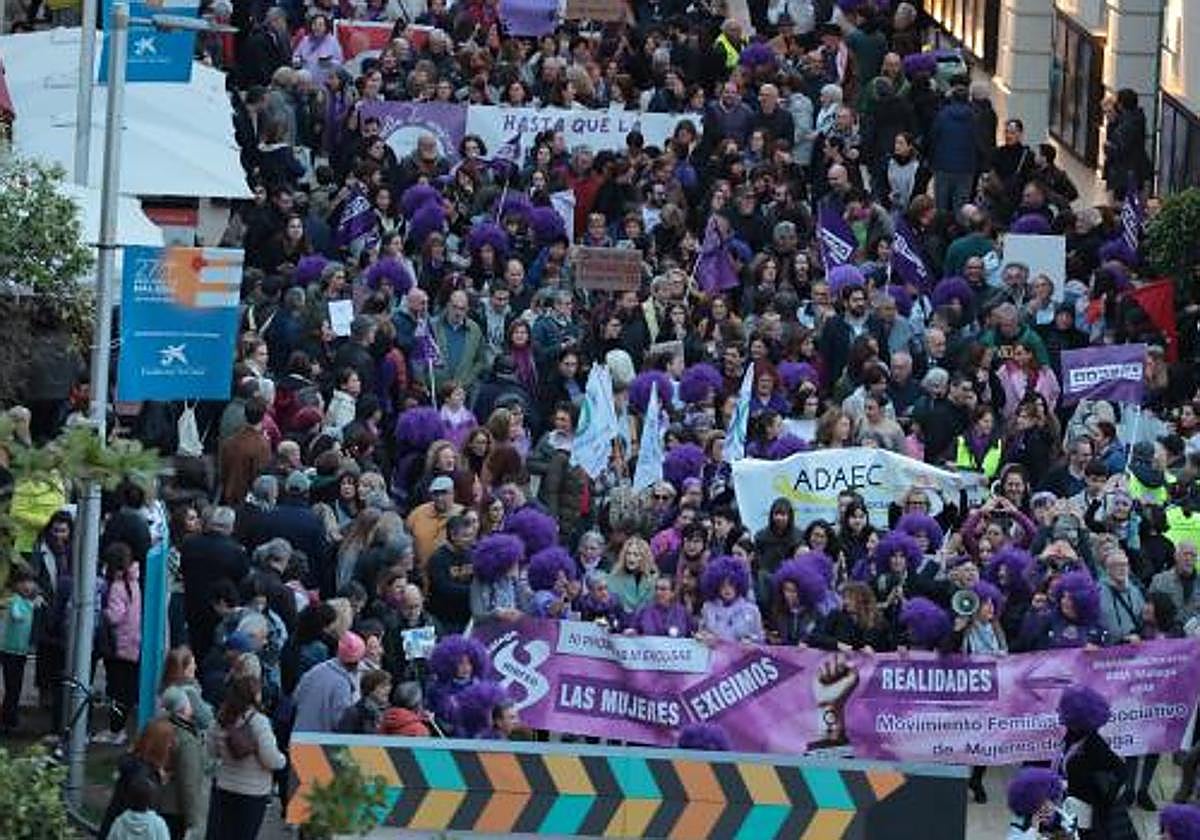

Feminism has deep roots in Malaga province and in many respects is a pioneer. One of the first Centros de la Mujer (women's centres) in Spain was created here, and that grew into the Instituo Andaluz de la Mujer (the Andalusian Institute for Women). Spain's first shelters for victims of domestic violence were set up in this province and this was the first place where women who had used those services joined forces; this was as early as the 1980s, when domestic violence was still a taboo subject. And it was also in Malaga where the Marea Violeta movement emerged in the new millennium, a movement that was to be later exported to the whole of Spain.
It was in this province, in Fuengirola, that the first gender-based murder registered as such took place. The victim was Diana Yanet Vargas, and the feminist organisation of Malaga appeared as private prosecutors in the trial.
In Malaga city there was a mass trial against an abortion clinic and it was here that the women behind the Coño Insumiso, a model of a vagina that was carried in procession on 8 March in 2013 in the style of a Holy Week Virgin, were prosecuted and sentenced.
Feminists in Malaga have taken an in-depth look at the history of the movement in this area since 1975, the year of the death of dictator Francisco Franco, the World Conference of the International Women's Year in Mexico and the start of the United Nations Decade for Women.
Last year saw the 50th anniversary of the abolition of marital permission in Spain; until then, a woman, on marrying, became a minor because she could not open a bank account, work, receive a salary, get a passport, take out a loan or file a complaint without her husband's permission.
From the end of the dictatorship to the Malaga Women's Assembly
Local, national and global milestones are intermingled in the rich history of the feminist struggle: "When we started to open the doors and windows in Spain, we found a great effervescence at a global level; it was very important," says Rosa Gómez Torralbo, a feminist who was part of the Andalusian Institute for Women from its beginnings.
She also recalls that even in the anti-Franco struggle there were feminist groups in Malaga, such as the Movimiento Democrático de Mujeres (Democratic Women's Movement), linked to the Spanish Communist party.
In the post-dictatorship period, Aupepm (Asociación Universitaria para el Estudio de los Problemas de la Mujer - University Association for the Study of the Problems of Women), worked on issues such as abortion, affective-sexual education (which was not called that, but which included workshops on self-knowledge), divorce and equal working rights.
These were issues that were also discussed at the state feminist conference in Granada in 1978, where 3,000 women gathered. Back in Malaga, participants began to form groups for reflection and debate at local level, especially the Asamblea de Mujeres: "We were a very diverse assembly of women, from many small groups, some linked to political parties or trade unions, others not," Rosa Gómez continues.

The trade unions were also active from very early on, especially Comisiones Obreras, and from the beginning they were very involved in the call for 8 March to be commemorated, when the day was not so much International Women's Day but rather International Working Women's Day.
This trade union is credited with playing a very important role in bringing together women in workplaces such as Siemens, Pryca, Tabacalera and Confecciones Sur, from 1976, when it was set up and legalised.
-kBLD-U2301073588795AtF-624x385@Diario%20Sur.jpg)
Carmen Olmedo and the Women's Centre of Malaga
It was in 1978 that the Diputación provincial authority created the Centro de la Mujer in Malaga, one of the first in Spain. Its vocation was mainly to provide assistance for family planning and legal and psychological advice, among other services.
Its director, Carmen Olmedo, was later entrusted with the preparation of a project to design equality policy at regional level, for which she formed a team of which Rosa Gómez Torralbo herself was a member.
Carmen Olmedo, therefore, laid the foundations of the Andalusian Institute for Women, one of the pioneer women's organisations in Spain, working to improve training to favour women's access to employment and promoting the first studies and research on the situation of Andalusian women.
Because from the original welfare function of the Malaga centre, the Andalusian institute went on to have a much more advanced, proactive and transformative mission. An example of this is the audiovisual production course '80 Women of '88', which brought together women from all over Andalucía for eight months in what is now Malaga's La Térmica cultural centre. And, as a result, as an anecdote, it's said that Canal Sur was the regional television station with the most female employees.
.jpg)
"In Andalucía there was a very high level of illiteracy and there was a very good programme of education for adults, 99% of whom were women; they did not want to take the exam so as not to have to stop going to class, because it had become a meeting place for them"
Indeed, a major focus of these women's associations involved training plans for women: "In Andalucía there was a very high level of illiteracy and there was a very good programme of adult education; 99 per cent of students were women and they didn't want to take the exam so as not to have to stop going to class, because it had become a meeting place for them," Rosa Gómez explains.
Lola Rodríguez, the first president of the group against domestic violence, Violencia Cero, says that she became involved in feminism through these adult education classes.
"At the centre there was the possibility of setting up a women's association, Arenas del Sur, in Puerto de la Torre, and there I started to put on my purple glasses, to get to know what the feminist movement was all about. Because until then I knew I had been a feminist since I was born, but, of course, without training, without tools," she recalls.
Later, the Agora Federation joined in, which also encouraged the flourishing of women's associations. "Although from today's perspective what they did might not seem like feminist advocacy work, it was of tremendous value. They opened up the world to women, very much so," recalls Pilar Iglesias Aparicio, of the Puntos Subversivos feminist women's association.
Abortion
"We wanted to give women a space where they could meet each other, ask for information about feminist groups, sexuality, addresses for abortions in London or Tangiers. In fact, we were in contact with Spanish-speaking women's support groups in London"
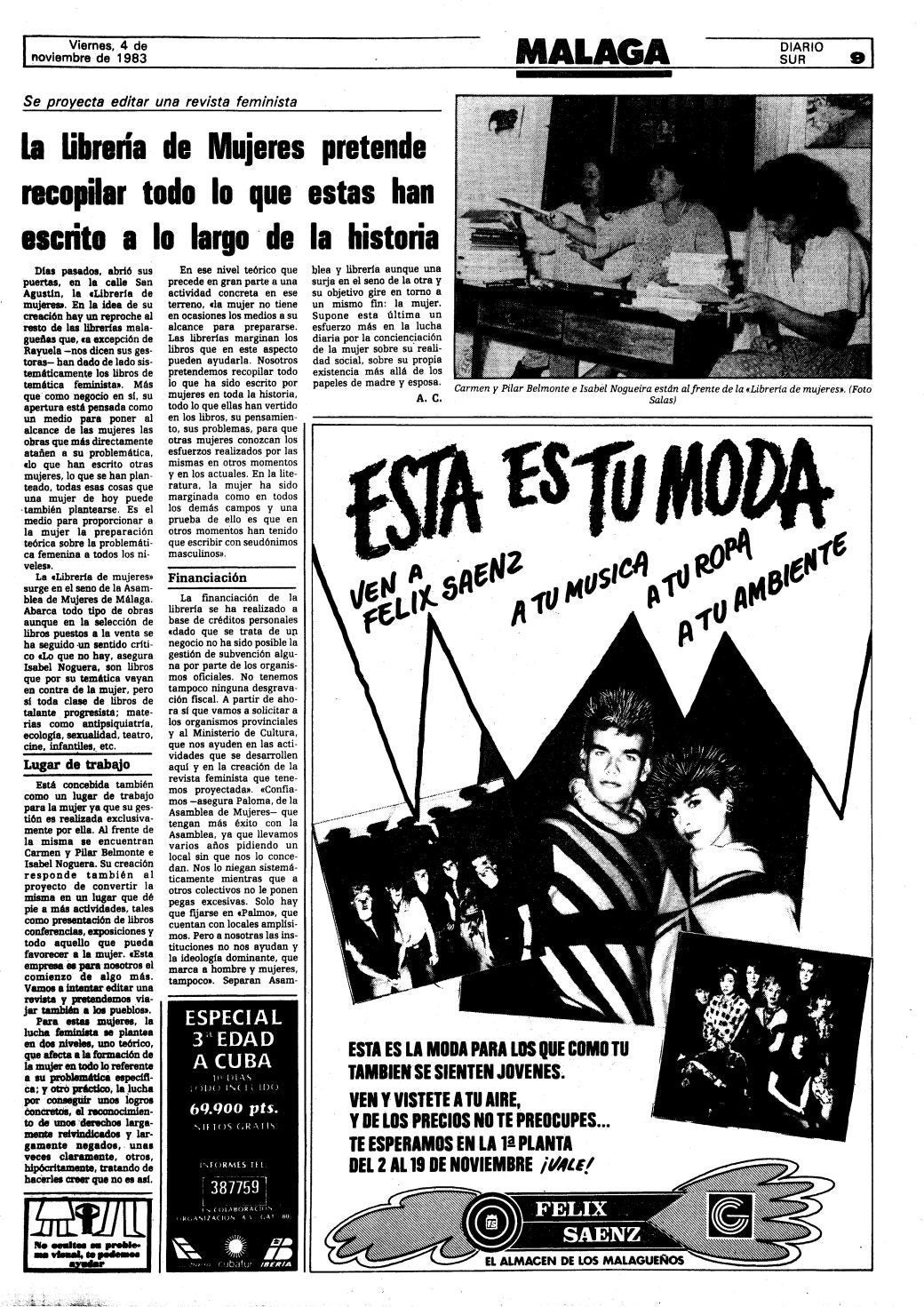
There are many examples of feminism in Malaga. One of them was the setting up of the Librería de Mujeres (Women's Bookshop) in Calle San Agustín in 1983. Carmen Pérez Pinto recalls that it was set up as a cooperative and with voluntary work, and that it was closely related to other similar establishments that were opening in Spain, such as in Barcelona, Madrid, Valencia, Granada and Cadiz.
"We wanted to provide a space where women could meet, ask for information about feminist groups, sexuality, addresses for abortions in London or Tangiers, which is less well known. In fact, we were in contact with Spanish-speaking women's support groups in London. Advice was also given on the importance of family planning. In addition, as a bookshop we also offered books on sexuality, on taking care of our bodies. But above all, it was a place where women were listened to," explains Pérez Pinto.
The bookshop was open until 1987: "Our work was voluntary. Whoever wasn't studying at the same time was working. When you finished, you went to open the bookshop for three or four hours. That was really exhausting... It is also true that things changed and in 1985 the law on abortion cases was passed and shelters for women victims of violence were opened," reflects Carmen Pérez Pinto.
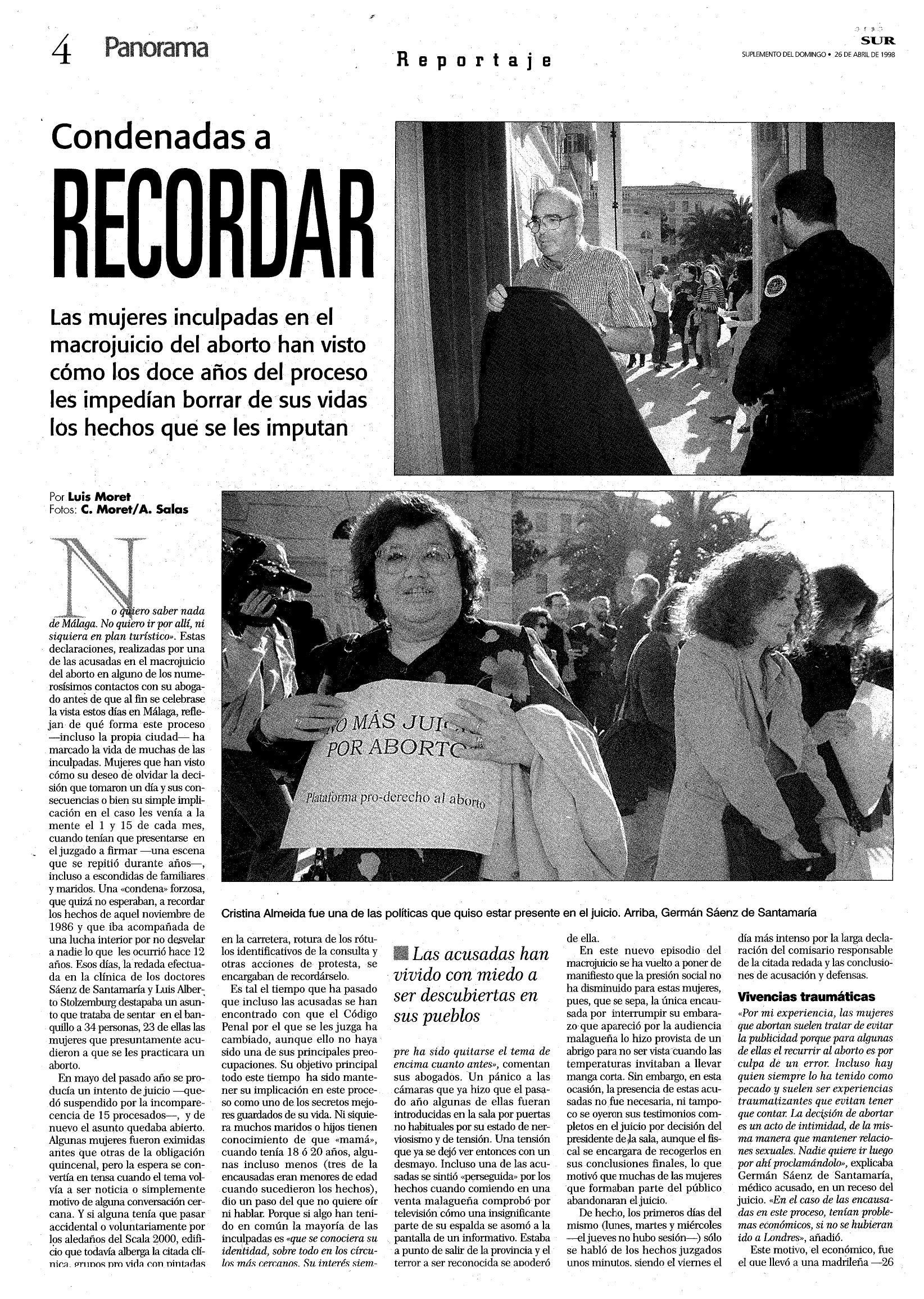
Regarding the abortion law, they agree that it did not satisfy the feminist movement, and their analysis invites them to take a small step back in time: they recall the arrests of women and doctors from abortion clinics in Basauri, in Seville and also in Malaga. Precisely, in the capital of the Costa del Sol, there was a trial that was opened in 1986 against 23 women and eight workers of the clinic of Dr Germán Sáenz de Santamaría and Luis Alberto Stolzemburg.
"Between the 1980s and the 1990s, the feminist movement in Malaga was involved in the demands for the right to free abortion in the health system, something that is still not being fulfilled," comments Carmen Martín, president of Plataforma Violencia Cero
"In the trial, the accused were acquitted in 1998, not because the judgement was in their favour, but because the alleged offences were time-barred. And we had to wait until 2010 to have a proper abortion law, with time limits; we are talking about a long time," Rosa Gómez points out.
And years later in 2014 they saw the law threatened by the then justice minister, Alberto Ruiz Gallardón, so the Spanish movement organised the Tren de la Libertad in which the women from Malaga took part. They won: the reform proposed by the minister did not go ahead and he had to resign.
Pioneers in highlighting gender-based violence
In Malaga, as early as 1988, the first association of women victims of gender-based violence in Spain was set up, after what were probably the first shelters for them were opened in 1985, also in this area.
This was no coincidence, the Centro de la Mujer had been set up almost a decade earlier, there was a lot of listening to the demands and needs of women; there was an awareness that a specific resource was needed for these people.
"Carmen Olmedo had the political power, the economic power and above all the vision that what was done had to be done," analyses Barbotta. In fact, Olmedo's greatest legacy is considered to be her treatment of gender-based violence as a global, structural and public problem. Olmedo's plan would be taken as a model by the central government for the 2004 law against gender-based violence.
The definitive awareness of the scale of this social problem that made the drafting of the law possible came after a fatal case of violence against women. Ana Orantes, who had suffered abuse from her husband for decades, was murdered by him in 1997 after telling her story of a life of beatings on a television show.
In Malaga, the condemnation of this murder took the form of the collection of signatures by feminists to demand the approval of the law that would not be passed until 2004, just when the Malaga women travelled to Vigo to take part in the World March of Women that brought together 20,000 people from nearly 6,000 associations from more than 160 countries.
A couple of years earlier, the platform against gender-based violence, Violencia Cero, had been set up. And Lola Rodríguez, its first president, remembers that when a woman was murdered in Malaga, they went to the cemetery to accompany the family.
Since then, in addition, every time a women dies at the hand of her partner or ex they call a rally. And for several years they met on the 25th of every month in the Plaza de la Constitución to denounce domestic violence.
But the platform's influence was such that the councillors standing on the steps of the city hall after each gender-based murder was the result of a motion it presented, as was the monolith that was installed in 2003 in the Paseo del Parque and which, according to the women who recall its history, was the first in the whole of Spain.
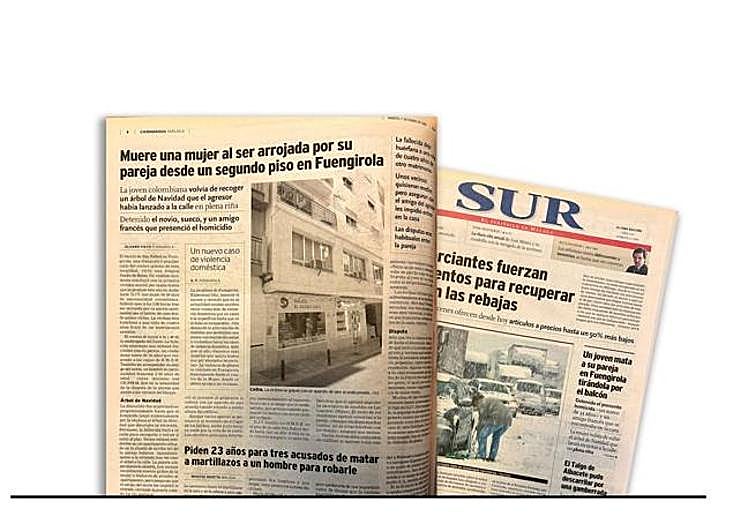
In addition, in relation to gender violence, Plataforma Violencia Cero filed a private prosecution for the murder in Fuengirola of Diana Yanet Vargas, the first victim of gender-based violence registered by official statistics, which began to count femicides in 2003.
Her crime took place on Three Kings Day. Her killer threw her off the balcony. Lola Rodríguez, when she heard about the case, contacted an official at the town hall and learned that the woman was Colombian and had no family in Malaga. No one claimed her body.
About a month later she was buried in the Fuengirola cemetery with the only company of half a dozen feminists.
Now, every 25 November, International Day for the Elimination of Violence Against Women, the demonstration is headed by a huge banner, bigger and bigger every year, on which are inscribed the names of all the official victims of domestic murders, the first of which is that of Diana, whose life was cut short at the age of 28.
"We were the first to sound the alarm to the whole feminist movement about the cuts and setbacks in equality after the announcement of the closure of shelters for battered women in Castilla-La Mancha"
The feminist movement worked hard to bring back 8 March events, especially from 2008 onwards. They criticised the fact that the day had become a holiday, a celebration of progress, where women were given a flower and the administrations organised an event, a party or a concert. They wanted it to return to being a day of protest, because there was still a long agenda to be fulfilled.
Division over gender
The last few years have been years of division, as has already been pointed out, triggered by the approval of the trans law, above all because of its main ingredient: gender self-determination. For feminism, gender is a social role imposed on people because of the sex with which they were born.
Gender, therefore, is not a choice, it is an imposition, and especially burdensome for women, because the role assigned to them is subordinate, powerless, dependent and submissive. That there was going to be a clash between feminism and transgenderism was a given.
And it was something that feminists in Malaga already sensed in 2009, during the feminist conferences in Granada (thirty years after the first ones). They denounced that there was already a glimpse of the rise of other demands that wanted to take over the feminist agenda. Queer Theory, which understands both gender and sex as fluid, was making inroads in Spain.
In addition to the division, there has also been great recent activity, with a succession of events that Rocío López, president of Fórum de Política Feminista de Málaga, enumerates: in 2016, the La Manada gang rape; in 2017, the #MeToo movement that began in the United States; in 2018, the first women's strike, which was worldwide, and then officially called in Spain for 2019.
Then came the pandemic. But, says López, after Covid, feminists remained active on the streets, many of them very young. But perhaps not so many involved in the associations, in the organised movement. Perhaps because of what Rocío López points out: she has always been a feminist, but it was only when she had a stable job that she was able to get really involved.
![[]](http://static.vocstatic.com/voc26/latest/assets/images/favicon/surinenglish/apple-touch-icon-57x57.png)