
Weather
Scientists warn the sea off Costa del Sol is seeing increasingly higher temperatures and becoming more tropical
The new ecosystem in the Alboran Sea, which is the part of the Mediterranean closest to the resorts of Malaga province, is creating the perfect environment for the arrival of exotic species such as lionfish even whale sharks

Malaga
If you have ever been to holiday resorts in the Caribbean or the Pacific, you will know what the sea along the Costa del Sol could become like: water that feels like a warm cauldron, with totally different species of fish than the norm. Bathers on Malaga province's beaches and elsewhere are already experiencing it: the sea water is getting warmer every summer and it's happening earlier than usual. Now, a scientific study by Malaga's own oceanographic centre - part of the Spanish institute of oceanography (IEO) which in turn is part of Spain's national scientific research council (CSIC) - has gone a step further to investigate the consequences of this phenomenon.
Related story
The research paper, entitled 'The tropicalisation of the Mediterranean Sea as reflected in changes in fish diversity: a case study in Spanish waters' was conducted by Davinia Torreblanca and José Carlos Báez. It looks into the arrival of new species in the Alboran Sea, which is the part of the Mediterranean closest to the Costa del Sol, thanks to the fact that they are increasingly found here in conditions similar to their native waters.
The paper begins by describing the favourable temperature for the development of species native to this part of the Mediterranean. From there, the paper presents the analysis of the temperatures in which new species, both invasive and vagrant, are developing in this habitat. "What we've seen is that the temperature of the Alboran Sea has increased significantly, such that the favourable temperature for this new ichthyofauna (the species of fish found in a given location) to live is up to 6C higher," said José Carlos Báez.
New fauna
"The issue is that species from increasingly warmer waters are becoming established in the Alboran Sea and growing accustomed to living in these waters that are now up to six degrees warmer than before," he reiterates. Therefore, "a process of tropicalisation is taking place, because the new species are of tropical origin." To make matters worse, this is happening more rapidly in the Alboran than in the Levantine-Balearic basin (the part of the Mediterranean between the southeastern stretch of the Spanish mainland and the Balearic Islands).
6
degrees above normal temperatures for native species living in the Alboran Sea. This is the favourable temperature at which the fish and algae species that are establishing themselves on Andalucía's Mediterranean coastline live in their native waters, according to the IEO study.
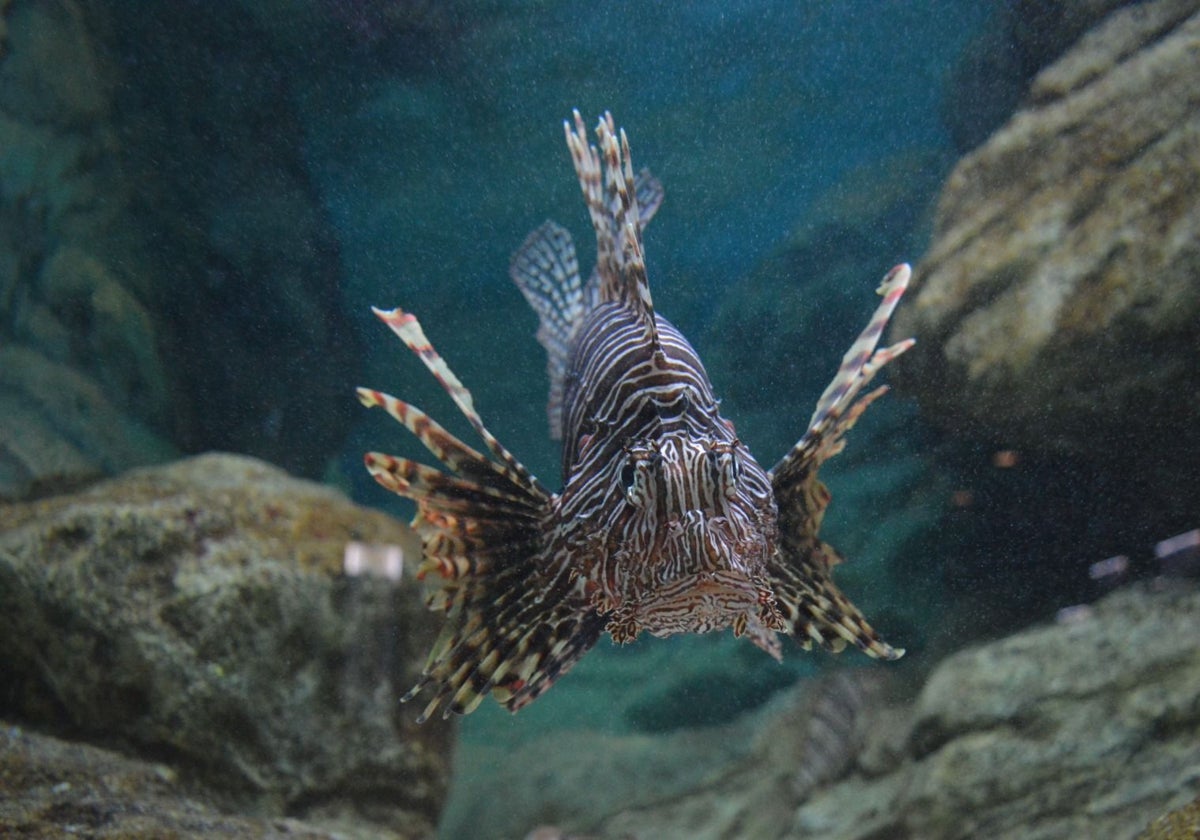
Initially, the researchers hypothesised that this was related to the Alboran's connection with the Atlantic, due to the proximity of the Strait of Gibraltar. However, this possibility clashes with the fact that one of the most potentially harmful species that have appeared, the lionfish, which has already been spotted in Cabo de Gata, did not arrive specifically via Cadiz. "We believe that it entered via the Suez Canal, on the other side of the Mediterranean, and yet it has appeared here. The conclusion is that the Alboran Sea is getting warmer and 'tropicalising' faster than the rest of the Mediterranean."
The marine biologist warns that, although only one specimen has been documented to date, there is a risk that the species could become established and threaten the ecosystem, as it is a voracious predator and its spines are poisonous. However, this is by no means the only exotic species to have arrived. A whale shark has also appeared in Ceuta, which is the most striking case according to the scientist, as it is a common species in tropical waters around the world and very vagrant. Specimens of tropical grouper, "with colourful spots" have been observed in the Strait. Such is the case with new species arriving, but it is also possible now to see more often the variety of grouper known as island grouper (native to the Canaries), "which has gone from being an occasional species, rarely sighted, to being fully established, as though it were native to these waters."
Added to this is the problem of the arrival of other, more harmful types of jellyfish and, of course, the huge swathes of invasive Asian seaweed (Rugulopteryx okamurae), which are also tropical and are wreaking havoc on the beaches of several municipalities along the Costa del Sol, but especially in Estepona.
Changes in the ecosystem
The scientist warns that ecosystem change is having a direct impact on the general population living on the coastline of Malaga province, "because it affects the ecosystem resources provided by the Alboran Sea, and let's not forget that this is the main economic engine of the Costa del Sol." It's no longer just that the water is warming up, the change is "more profound, serious and worrying and it's becoming tropicalised. It's changing rapidly. And this change affects the inhabitants of the Alborán basin in every way, including the people of Malaga."
Among the direct effects are those that affect the resources that the ecosystem can provide. For example, in terms of local fishing, where seaweed damages the fishing nets. It also changes the type of species that are caught, which are no longer typical and also are increasingly invasive, due to new competition. Water quality is also changing, tending to decline, with effects correlated to pollution. This even affects the ports, where accumulations of invasive algae can hinder maritime traffic in this area, as happens in other parts of the world.
Record at the weather buoy in Malaga port: 25.7C in June
The clamour of voices raising their concerns over the warming of the water in the Alboran Sea is growing. The last all-time high was set in June this year, right at the start of summer. Specifically, the buoy in Malaga port marked a maximum of 25.7C during the weekend before San Juan. Furthermore, peaks of up to 7 degrees above the historical average are occurring along the Costa del Sol. The average seawater temperature in June in the Bay of Malaga has been 18.5C since full stats began in 1984. For 2025, daily values of 19-20C have been recorded. To find the highest average in June you don't have to look far: it happened in 2017, with 20.7C. Last Monday, 4 August, the water temperature reached 26.7C at 3pm and on the 2nd August it was 26.6C.
![[]](http://static.vocstatic.com/voc26/latest/assets/images/favicon/surinenglish/apple-touch-icon-57x57.png)