
Railway infrastructure
What will it cost to repair the landslide and flood-damaged tunnel on the high-speed Malaga-Madrid train line?
Spain's railway infrastructure company Adif plans to install a 24-metre-long metal beam to strengthen the structure, with the aim of reopening it to traffic in February or March

Málaga
The serious landslide and subsequent flooding of the high-speed train tunnel in Abdalajís on the line between Malaga and Cordoba, has kept tunnel 1 closed to rail traffic since mid-summer. Thankfully, services have been maintained with only slight delays thanks to the other tunnel, which is independent of the damaged one. However, there is no doubt that the first tunnel must be repaired, as trains would grind to a halt completely if there were a breakdown in the current only available tunnel.
Since the incident on 22 July, railway infrastructure company Adif has been working to reopen the tunnel. The first phase consisted of a study of possible technical solutions. Technicians installed a monitoring system in the affected area, with which they obtained real-time information about the tunnel's state.
7.2
kilometres is the length of tunnel 1 of the high-speed line in Abdalajís, although the area affected by the landslides is only 24 metres long
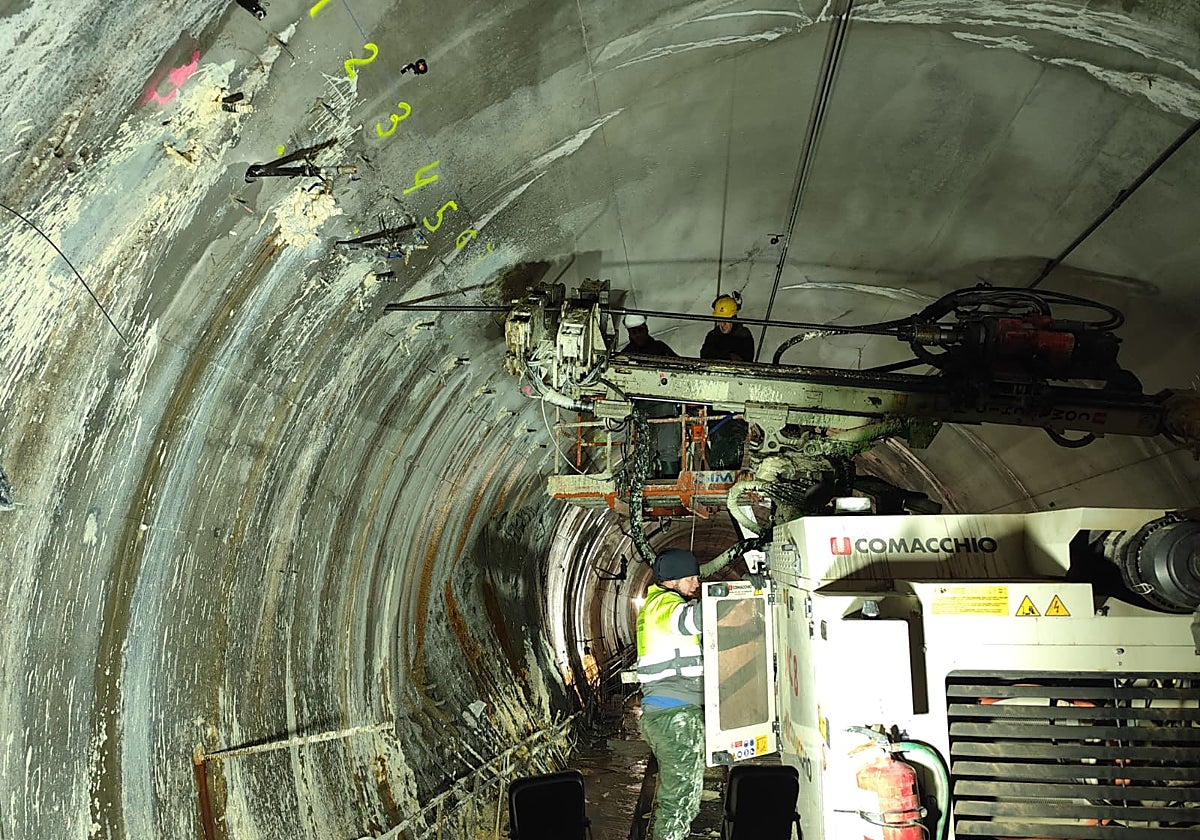
As a result, it has been estimated that the work necessary to repair the damage will last six months and cost 4.5 million euros. According to Adif, the work is currently focusing on structural reinforcement of the damaged wall.
Structural reinforcement
Workers are currently installing a metal beam to strengthen the structure and protect themselves in the following phases of the work on the 24-metre-long damaged area (the total length of the tunnel is 7.2 kilometres). The idea is to prevent new landslides "in an area subject to the pressure of the nearby aquifer". Once this operation has been completed, the vault of the damaged section will be rebuilt.
The technicians in charge of the project foresee that the bulk of these actions will be completed by the end of this year. After that, it will still be necessary to adapt the tunnel's drainage system. Therefore, the reconstruction will be completed during the first quarter of 2026 (around February or March).
From that moment on, high-speed trains will be able to run through both tunnels again.
What happened?
After the heavy rainfall last winter and spring, the Abdalajís aquifer burst, directing its flow to its original place - inside the underground tunnel built for the high-speed train connection between Malaga and Madrid in 2007.
Since then, the damage has been more than evident inside tunnel 1, especially since a 24-metre-long wall was severely punctured. Meanwhile, water is pouring in through both the wall and the subsoil. The most significant damage is at kilometre point 113, where, in addition to the debris accumulated after the bursting of the tunnel, water has covered the track for some 300 metres of rail.
Experts consulted at the time warned that the damage to the wall was so serious that the solution would not be a quick one, as has been proven. However, they were also optimistic, insofar as this may have prevented greater damage, since hydraulic pressure is relieved through the subsoil rather than from the side of the wall.
The danger of operating the high-speed rail line between Malaga and Madrid with only one tunnel
The Cordoba-Malaga high-speed railway line, which connects the capital of the Costa del Sol and the Spansih capital city of Madrid, was once equipped with two tunnels independent of each other. During the construction of these tunnels with two boring machines, a large aquifer in the Valle de Abdalajís was punctured. Since then, the town has been supplied with water brought in tanker lorries by railway infrastructure company Adif.
The underground tracks can be operated in both directions to facilitate both north-south and south-north traffic. After the incident that prompted the closure of tunnel 1 this summer, traffic has been maintained through tunnel 2, with rail passengers hardly noticing it.
However, there is no doubt that the current situation complicates things and requires that things be resolved as soon as possible. Thousands of passengers now depend on the stability of a single tunnel. In the event of a train breaking down inside it or a rail or electric power catenary failure, there would be no alternative and the high-speed line from Malaga to Madrid would be completely halted.
![[]](http://static.vocstatic.com/voc26/latest/assets/images/favicon/surinenglish/apple-touch-icon-57x57.png)