
Health
More than 4,700 people in Malaga province need respirators due to oxygen dependence
Recent advances in concentrators, portable power sources and ventilators have increased the quality of life and life expectancy of these patients

Malaga
The afternoon and evening of 28 April, when a national power outage struck Spain, were difficult for oxygen-dependent people, i.e. those who require supplementary oxygen to breathe properly. Patients and their relatives overwhelmed the emergency phone line because they could not use the concentrators or ventilators that depended on the electricity grid. It got to the point where the Local Police and civil protection groups had to take gas cylinders to those households. Many went to the hospital to have their batteries recharged or plugged directly into the flow of the generators that the health facilities have.
The regional ministry of health in Andalacía states that there are around 4,700 oxygen-dependent people in the province of Malaga. As pneumologist Carlos Rueda from the Hospital Regional Universitario explained, "oxygen-dependent patients are basically people who live with an amount of oxygen in their blood, called saturation, which is below an admissible limit and requires supplementation". In other words, the patient must receive oxygen to maintain adequate levels.
Among the patients who need this supplementary oxygen are those suffering from diseases such as chronic obstructive pulmonary disease (COPD), fibrotic pathologies (related to excess tissue or scarring, for example pulmonary fibrosis), "which evolve quickly or over time, leading to fibrosis of the lungs, making them unable to absorb oxygen, so these patients need supplementation fairly early on". Dr Rueda also added embolic diseases to the list. There are patients who only need oxygen in acute moments; there are those who require it over a long period of time; and there are those that suffer from heart failure - "the heart not only mobilises the blood, but also takes it from the lung and transmits oxygenation; when this is not done properly, that is, when the transport vein is very deficient, you have to maintain that oxygen load".
The oxygen bottle is now symbolic
Dr Rueda confirmed that traditional oxygen bottles are largely a thing of the past. "In general, what we use in chronic oxygen therapy, meaning that you are going to live on oxygen for a while or for the duration of your recovery, is a concentrator - a machine capable of making the amount of oxygen concentrated, hence the name," he explained. With each inhalation, the level of oxygen in the blood increases. These devices are plugged into the electricity supply. "This improves your quality of life." They make noise and generate heat in the room, but one of the major breakthroughs in pulmonology has come with portable sources. "It's a wonderful invention, because it allows a patient who couldn't leave the house due to dropping oxygen levels and inability to walk, to now be able to do so," said Dr Rueda. They've become more common in recent months and, if needed, can even be plugged into a car battery, among other previously unthinkable settings. They allow users to go outside and even return to work.
"In general, patients with respiratory insufficiency will most likely have a large device at home, which can keep it running for 15 or 16 hours at home, and then a portable device, which has less autonomy," he explained. "In general, if a person is autonomous and not absolutely dependent, they tend to have both sources," he said, although some people only use a portable device to help them in their day-to-day activities.
The degree of quality of life varies from patient to patient. To have breathing as a conscious action where each breath of air requires an effort can be complex for some people. "Air doesn't cost money, it doesn't cost effort, but in these cases it does become costly," he said. With the advances in medicine, many people are starting to gain increasing degrees of independence.
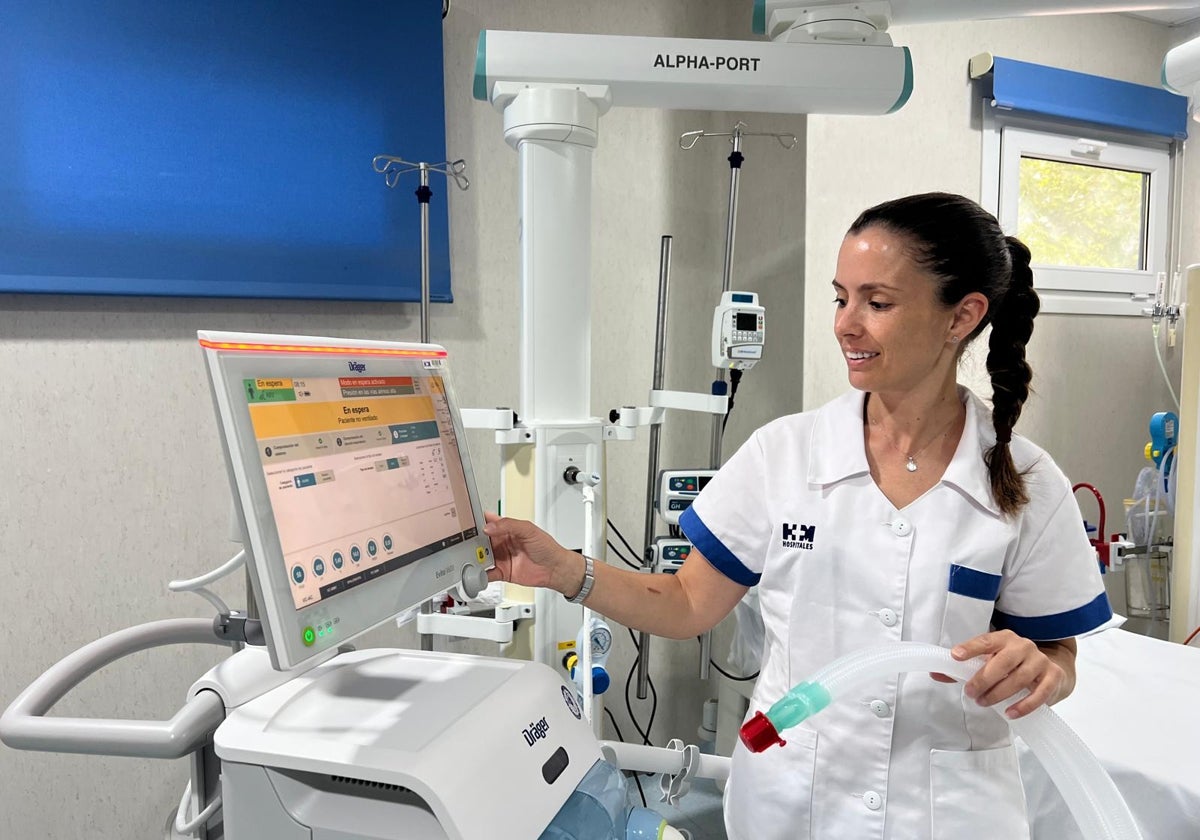
Life expectancy also improves thanks to oxygen, treatments and rehabilitation. In addition, the surgical approach can help in emphysema and transplants are growing with "incredible" survival rates, but much progress has also been made in the field of ventilators, which are essential not only in the treatment of respiratory diseases but also in neurological diseases. For example, in patients with ALS, those with very advanced COPD or people with obesity. "Sometimes your brain no longer transmits the command to breathe properly. Or your weight might press down on your lungs too much. Or the lungs might be of poor quality," Dr Rueda says. "We can regulate without having to intubate. Instead, we can do what's called a ventilation: we give the whole muscular and respiratory system a rest and we put a mask on you to start the ventilation and we bring you back to your normal breathing," he said.
For example, the affected person can be ventilated for one hour at night, especially during sleep, which allows them to maintain a more normal quality of life during the day.
The UCRI - medical excellence in the Hospital Regional
The intermediate respiratory care unit (UCRI), open at the Hospital Regional since 2021, intervenes in more challenging cases concerning patients with severe respiratory problems but who do not need to be in the ICU. Those patients often don't require intubation, so the doctors ventilate them. These are patients with COPD, hyperventilation associated with severe obesity, heart failure or severe pneumonia, among other pathologies. During the pandemic, there were patients with bilateral pneumonia, prior to intubation. "This unit is a differential in our hospital," Dr Rueda said.
'There are patients who are very dependent on the ventilator, others who require less ventilation and then those who require it practically all day long'
"There are patients who are very dependent on the ventilator, others who require less ventilation and then those who require it practically all day long. In general, they will have two of these devices. There are battery-powered ventilators. Some ventilators come with a battery pack. If the power goes out, it won't run properly after four hours. That's when the second ventilator kicks in and keeps things running. The problem is that the system has a limit and that was the big issue during the blackout, when the entire system came under stress," the expert stated. In addition, on 28 April, phones didn't work and many people could not contact the emergency services.
On the day of the blackout, the hospital moved extra ventilators and spare oxygen bottles to wherever they were needed. Many people went to the shopping centre and even to the bank where they were able to plug in their devices, while many others went directly to the hospital.
![[]](http://static.vocstatic.com/voc26/latest/assets/images/favicon/surinenglish/apple-touch-icon-57x57.png)