
Environment
Pioneering conservation project restores original flora and fauna in San Pedro river area
With the support of central government and the EU, Marbella town hall has eliminated the reeds and other invasive species to reduce the risk of flooding

Málaga
If you were to stroll directly along the Guadaiza riverbed, you would find it hard to believe that you were in the heart of the bustling Costa del Sol. The river, which is vital to the urban water supply, along with the Guadalmansa, Guadalmina and the Verde river, is also a green lung for San Pedro Alcántara in Marbella. Numerous species of riverside vegetation grow there, providing shelter for fauna ranging from mallards and herons to the Spanish pond turtle. There are even records of the presence of otters.
The problem is that, in recent years, like almost all the rivers and streams in Malaga province, the Guadaiza has been invaded by exotic plant species, which not only threaten native species, but also block the riverbed and increase the risk of flooding during heavy rainfall. Faced with this issue, Marbella town hall has become a pioneer in Malaga province with the complete renaturation of the Guadaiza river. According to mayor Ángeles Muñoz, the project fulfils several practical objectives, such as flood prevention and ecological restoration, while aiming to be "a symbol of urban sustainability and social cohesion".
Biodegradable mats against reeds
The project has won a grant of almost 2.8 million euros from Spain'sMinistry of Ecological Transition, within the Next Generation programme, surpassing numerous other proposals at national level. The experts employed for the tasks of this initiative only act against truly harmful species, respecting the natural composition of the area. This same model of action will serve as an example in other watercourses.
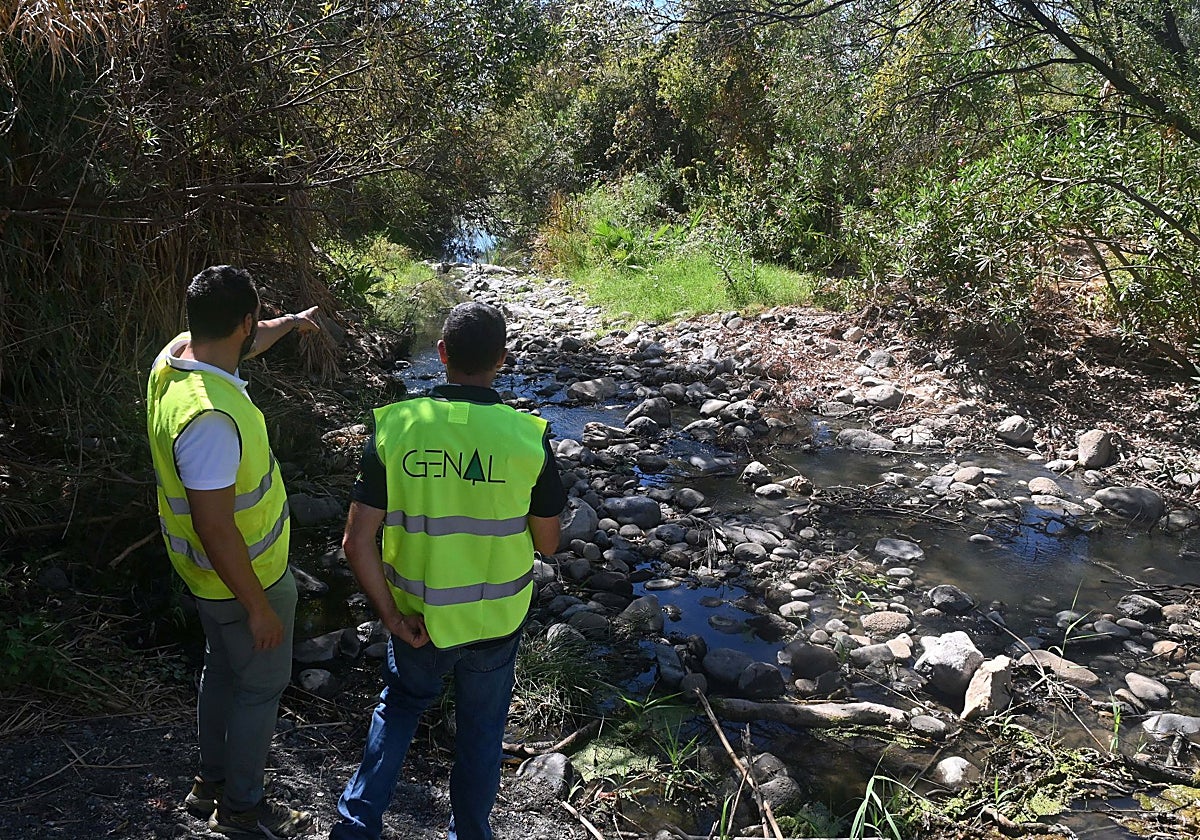
Several Malaga province companies are involved in the project: main contractor and coordinator Inditec, alongside Genal and Ituval. José Antonio Gómez is the technical forestry engineer in charge of the work. In the current phase, the specialists are removing the reeds at the roots. Immediately afterwards, the land is covered with biodegradable mats. According to experts, "this is the best measure to eradicate invasive reeds", while it also avoids the use of chemical herbicides.
The project has won a grant of almost 2.8 million from Next Generation funds
Large eucalyptus and acacia trees are being removed. "We are not just cutting them down, but removing their roots with the help of a heavy-duty crane, giving the native vegetation space to recolonise. In addition, to support spontaneous regeneration, up to 8,000 specimens of species, such as willow, myrtle, tamarisk and oleander, among others, will be planted.
"We have seen that natural regeneration is going very well - oleanders and a lot of tamarisks are sprouting, while other plants that were overshadowed are recovering." In addition, the Guadaiza riverbed is home to a series of lagoons, where mallards, herons and egrets, eels and Spanish pond turtles.
A specialised company has captured more than a hundred pond turtles, which have been moved upriver (with authorisation from the regional government of Andalucía), as there they have more water and can be protected from the work taking place. "With the rains, they will come down again and recolonise their territory." At the same time, as part of the control of invasive fauna, numerous red-eared sliders have been moved to a wildlife refuge.
The experts have not had the chance to see any otters, but they have identified their tracks and located other signs that they roam around this part of the urban waterway. "There is a lot of wildlife here and more to come when we finish," Antonio Gómez believes.
Flood control
The plan also includes the mobilisation of boulders and the treatment of sediments in the riverbed, especially at vulnerable points such as under the bridges, so that water can flow unhindered, which would prevent overflows caused by the rainfall expected in the coming autumn.
According to the mayor, this will serve as a "pilot model", which can be applied, with "similar criteria of renaturalisation, awareness and prevention" in other watercourses.
"In November 2024, after the heavy rainfall episode we had in Marbella, we managed more than 500 tonnes of dragged reeds, through the Costa del Sol environmental complex. These have been transformed into fertiliser for parks and gardens," Ángeles Muñoz stated.
![[]](http://static.vocstatic.com/voc26/latest/assets/images/favicon/surinenglish/apple-touch-icon-57x57.png)