
Employment
Malaga province leads rise in self-employed workers, who call for more rights and lower fees
While the number of new 'autónomos' is slowing down in Spain, uptake remains strong on the Costa del Sol - largely driven by women, foreigners and new industries
Nuria Triguero
Malaga
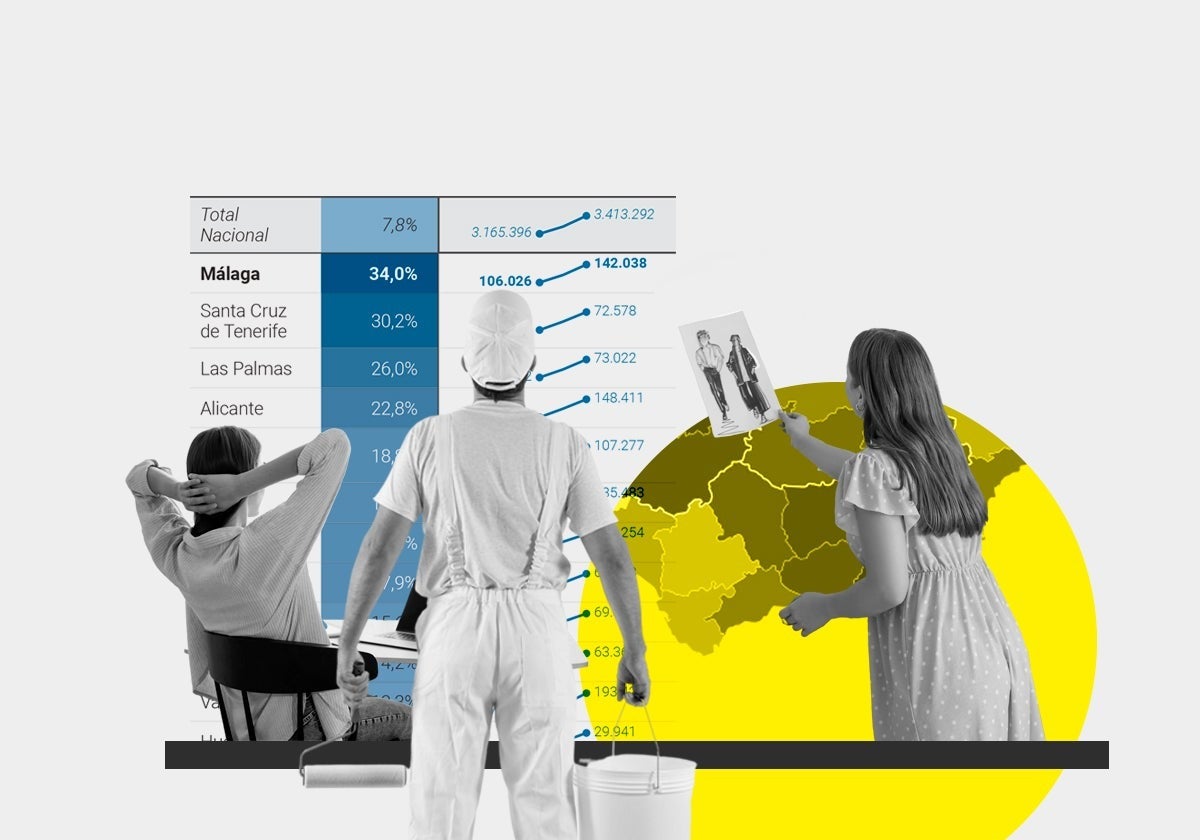
For several years now, Malaga province has claimed the record for growth in number of registered self-employed workers in Spain. In the last decade, the province that includes the Costa del Sol has gained 36,000 self-employed workers (an increase of 34%), while the national average has been lower than 8%.
Related story

Currently there are 142,000 self-employed workers, (or 'autónomos', as they are known in Spanish), in the province: one in every five working people locally. The trend is showing no signs of slowing down, with another year-on-year increase of almost 4,500 in the past year.
However, the profile of self-employed workers has changed, with women leading the growth. Over the past ten years, there has been a 45% increase in female self-employed workers, compared to 28% among men. Although women are still a minority, they represent 38% of the total number of self-employed workers in Malaga province now.
Foreign-born workers
The other group that has fuelled this boom in self-employment is immigrants, who have doubled from 17,400 to more than 36,000 over the past decade. They now represent a quarter of the total number of self-employed workers in the province. The most common nationalities within this group come from Latin America (Argentina, Venezuela and Colombia).
Retail, construction and the hospitality industry are the most common fields for those who work for themselves. Although retail remains the sector with the highest number of self-employed workers, it has started to slow down.
"The lack of family members to take over small shops, competition from online and large supermarkets and rising costs have taken their toll," says José Luis Perea, secretary general of the self-employed workers' association (Ata).
In contrast, other sectors have at least doubled the number of self-employed workers. The largest pull has been the information and communications sector, with a 141% increase, followed by real estate (+125.5%), education (+92.8%), science and tech (+81%) and arts and recreation (+73.8%). Construction, on the other hand, is the sector with the second highest number of self-employed workers, despite a smaller increase rate.
Is this boom in self-employment good or bad? Public authorities have always welcomed the fact that there are many self-employed people as evidence of an innovative economy. However, self-employment in Spain is considered by many to be a precarious and uncompetitive field, especially given the high fees payable, (which the government has decided in the end not to increase for next year amid an outcry).
People also say that more advanced societies have lower percentages of self-employment. Some politicians have started to say that the slowdown in self-employment nationally is a good thing.
So, is it positive or not that Malaga keeps growing in self-employment numbers? Secretary general of the Andalusian union of the self-employed (UATAE) Pepe Galván says that, on the upside, self-employment is not growing at a time when there is a rise in unemployment, "as happened during the last big recession".
On the contrary, it is growing alongside a general rise in employment. To compare the two, affiliation to the Social Security for wage earners in Malaga province has grown by 49%, while self-employment has grown by 34%.
Galván says that the UATAE does not encourage people to register as self-employed lightly, considering that this bears debts and a type of responsibility that salaried workers don't have.
However, Galván adds that the situation has changed and only three out of every ten self-employed workers are forced to cease their activity in the first two years, compared to eight out of every ten during the 2008 crisis.
"The survival rate is around 70% and that is the best sign. We are celebrating not because self-employment is growing, but because it is being maintained," he says.
Both UATAE and Ata attribute this "healthy" growth of self-employment in Malaga to the economic dynamism of the province, led by tourism and technology and, to a certain extent, construction.
The fact that there are more self-employed does not mean they have fewer challenges. The problems remain the same: few rights, many fees and a lack of social benefits, with "six out of ten self-employed people" not being entitled to the latter.
"It is ridiculous to have to pay contributions for a benefit that you don't receive," Perea says.
![[]](http://static.vocstatic.com/voc26/latest/assets/images/favicon/surinenglish/apple-touch-icon-57x57.png)