
Three new exciting building projects compete to completely transform El Bulto area of Malaga
Urbanismo - the city council's urban planning department - has published the trio of proposals submitted by Sierra Blanca, architect José Seguí and Urbania's joint venture with construction company Guamar
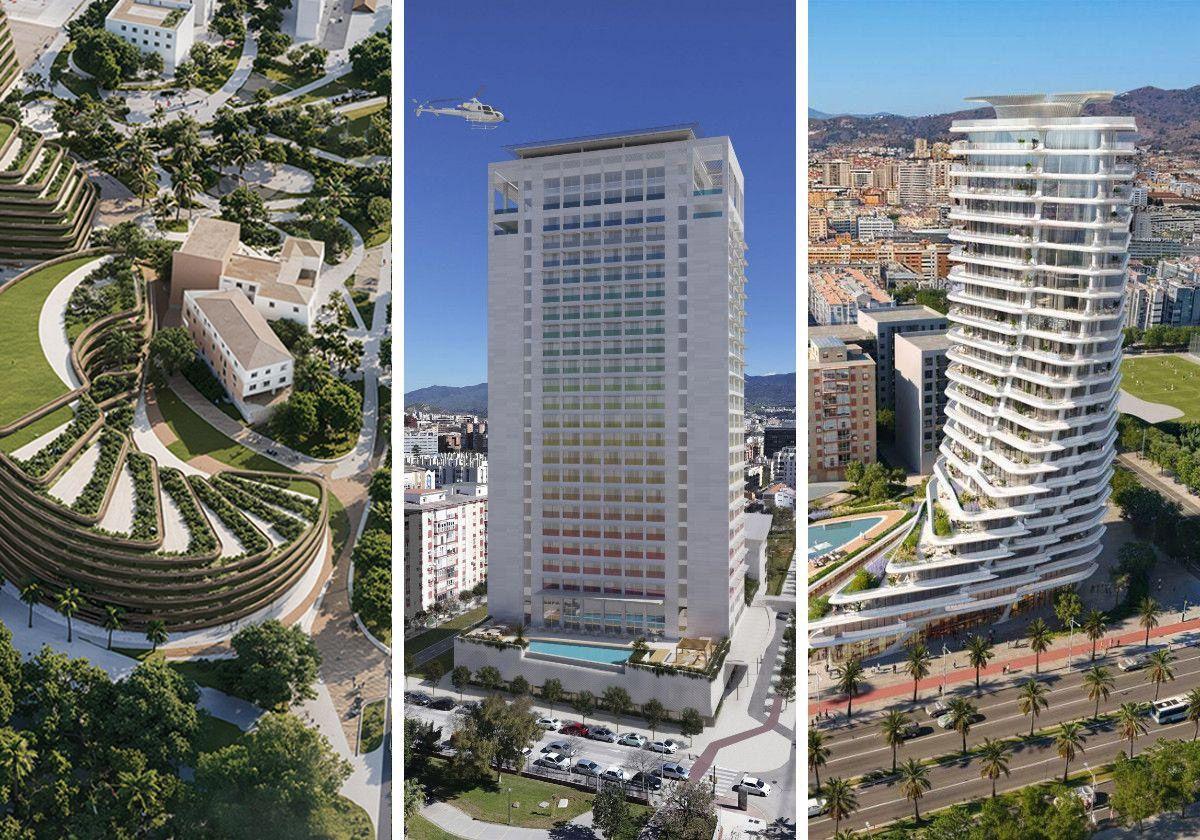

Malaga
On Thursday this week, Malaga city's municipal urban planning department (Urbanismo) made public the three proposals vying to lead the transformation of the El Bulto area as its urban development agent. In this area of some 47,000 square metres, the planning options allow for one tower block or several buildings to house 179 private housing units ('renta libre' - no government subsidies and can be sold on the open market), 82 VPOs (social housing with government subsidies for low-income households, not for resale) to rehome local residents of El Bulto, plus the possible relocation of several existing properties, including the Cottolengo residential shelter owned by the local diocese.
Initially, Marbella-based developer Sierra Blanca offered to act as the development agent for the El Bulto project but, following Urbanismo putting it out to open competition, two other companies also want to take on this role. One is a joint venture between developer Urbania and construction firm Guamar. The third party is the studio of architect José Seguí, bidding as both project designer and project manager.
Once Urbanismo awards the role of developer for El Bulto to one of these three, that company will have to take on management of the planning as well as the development projects in the area in exchange for acquiring part of the construction rights held by the landowners. The process is now in the public consultation phase, meaning 20 days for any objections to be lodged or comments to be submitted concerning these plans.
Once that phase is complete, the city's planning officials will score each design according to technical criteria that will assess the volumetric composition and uniqueness of the buildings, their integration into the city landscape, the quality of the public spaces, the possible relocation of the Cottolengo shelter to a new building and a solution for fixing Malaga port's overground railway line, making it possible to relocate it underground in the future, among other issues.
Once the proposals have been technically scored, the winning project will be selected. Once this process is complete, the second phase will begin. This will involve Urbanismo opening a one-month window for companies to submit their legal and financial proposals to develop the project that has been selected on its technical merits, even if it is not their own project.
-
Sierra Blanca
A 22-storey tower for 153 dwellings designed by Zaha Hadid's architectural studio
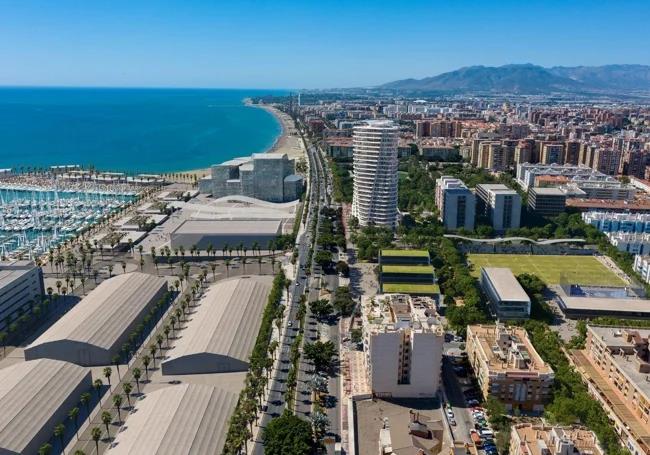
Marbella-based developer Sierra Blanca's project for the El Bulto area features a tower with 22 floors above the ground floor, designed by the studio of renowned Iraqi architect Zaha Hadid, who died in 2016. It would house a total of 153 'renta libre' apartments. The building would also have some tertiary uses for commercial purposes and a 40-metre façade, although its volumetric layout means that the height would decrease towards the Huelin Park area.
This planning idea, advised by consulting firm Ejecución del Planeamiento, proposes this tower on the site currently occupied by the Cottolengo shelter for vulnerable people. The shelter would be relocated to a new building on the corner of Paseo de Antonio Machado and Calle Góngora, according to an agreement that the developer has already reached with the Bishopric, if this project is successful.
The project would keep the Luis de Góngora public school in the same location, but proposes the demolition of the municipal hostel and other buildings owned by the city council in the area. In return, with the new development, which creates a large 21,055-square-metre interior service block, the city council would have two plots of land for facilities "for the uses it deems necessary and appropriate for the area", as specified in the submitted documents.
As requested by Urbanismo, the presented plan maintains the surface layout of the port railway while resizing the surrounding spaces in such a way that the line can go underground in the future. A wide north-south boulevard would be laid out over this underground track.
Likewise, the proposal calls for the construction of two ground-floor buildings with nine floors above on both sides of the Calle Donoso Cortés intersection, each with 40 VPOs and each with ground-floor spaces for cultural and community uses. The goal is to be able to rehome the families who live in the houses that remain in the area, the surviving heirs to the shantytown past for which this area is known.
The football pitch next to the school would be dismantled to create an underground car park with spaces for public and private use. A new north-south-facing football pitch would be built over this parking lot. In total, the proposal envisages 596 parking spaces, of which 267 will be for public use (135 on the street and 132 in the underground car park beneath the new pitch), 106 for the VPO buildings and 223 for the tower block of private apartments. Overall, five plots are reserved for amenities, totalling 17,323 square metres, plus 11,258 square metres of open or green spaces.
-
Urbania-Guamar
A project that renounces tall structures and maintains and enlarges the Cottolengo charitable shelter
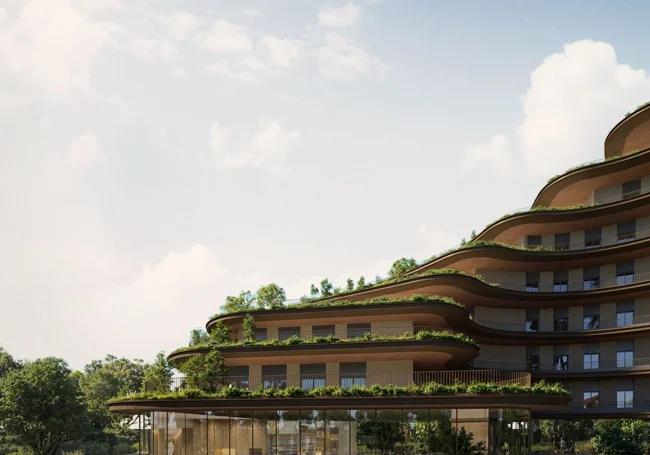
The project by developer Urbania and the Guamar building firm is called 'Invisible' because it aims to create the smallest possible visual impact on the area, despite the city council giving bidders the option to construct a single tall building, and to respect the existing social facilities as much as possible, paying special attention to the Cottolengo charitable shelter. In fact, it is the only proposal to keep the shelter in its current location. Thus, this proposal, which involves the architectural studio Morph and engineering company CAI, seeks to transform this space into an extension of Huelin Park, with abundant, landscaped areas and no vehicle traffic inside the area to be redeveloped, where only the port railway line would remain overground.
As for any new builds, the proposal envisions three buildings with underground parking. In the space to the west of Cottolengo, a building would be erected with a ground floor plus ten more floors (the existing apartment block behind it has a ground floor plus eight) and a circular footprint, with the terraces on each floor gradually decreasing in size to create a spiral effect. This building would house both privately-financed and state-subsidised apartments.
Likewise, a building with a ground floor plus ten floors would be built for free-market, non-subsidised apartments, occupying part of the current football pitch next to the Luis de Góngora school, with its surface area being reduced by half. The third proposed building would be to the north of the Cottolengo, with a ground floor plus eight floors, and designated as a public facility in which the Unicaja Foundation would have a special role to play. This third building would include a unique, subsidised housing project called 'Salta', which would offer its residents spacious apartments equipped with shared, communal areas for working, a swimming pool, a vegetable garden, a laundry room, an area for practising sports and even a space for pets, among many other services intended to foster coexistence and neighbourliness among its residents, under the tutelage of the Unicaja Foundation. Works of art will also play a leading role both in this facility and in the landscaped areas outside.
In total, this project plans to develop some 180 'renta libre' and 140 social housing units in the area. These numbers include those planned for Unicaja's 'Salta' project and those planned for the circular building next to the Sagrado Corazón (Sacred Heart) shelter, owned by the Bishopric of Malaga, which would be completely remodelled and enlarged. To this end, the office area would be extended underground to the basement and underground parking with access from the Paseo de Antonio Machado is also planned. The project also includes expanding the existing chapel to convert it into a church open to local residents.
-
José Seguí
A 27-storey tower for hotel use
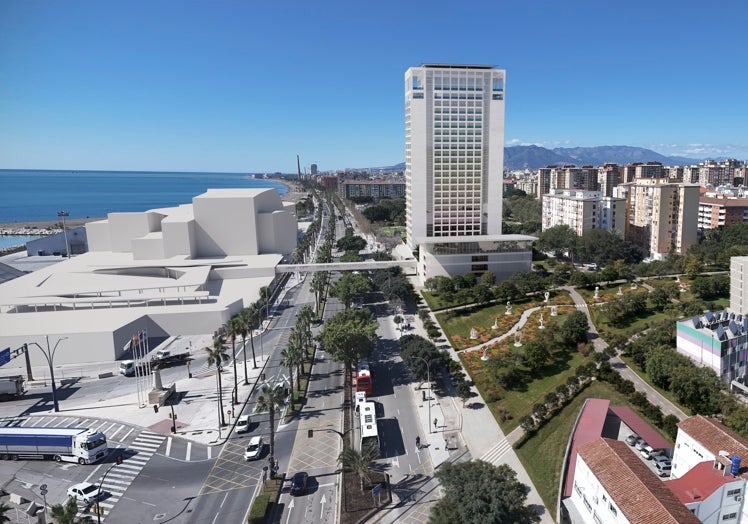
The development proposal submitted by José Seguí's architectural studio focuses on the construction of a large tower with a ground floor plus 26 more floors (102.9 metres high), where the Cottolengo shelter currently stands. This would house a luxury hotel with approximately 300 rooms connected by a pedestrian walkway over the Antonio Machado promenade to the commercial buildings of the future San Andrés leisure boat marina, a project also designed by José Seguí.
This hotel, which would feature conference rooms and a double-height restaurant on its top floors, among other services, would also have some 4,440 square metres of office space and a helipad on its roof to offer guests rapid airport transfers operated by Hélity, a company that already offers exclusive helicopter services at Malaga Airport. This hotel project, therefore, is designed to serve a high-income, high-spending clientele with high purchasing power, who would make use of the future leisure marina, next to which the construction of Malaga's future auditorium has also been proposed.
This project is clearly a departure from the purely residential use specified by city hall in the rules to this open competition for the role of leading the redevelopment of the El Bulto area. While this proposal would require a modification of the planning to incorporate its hotel idea, the rest of this proposal complements the hotel suggestion with residential proposal, one of which is the construction of a new building for the diocese's Cottolengo shelter in part of the space currently occupied by the sports facilities next to the Luis de Góngora school. On that site the studio also proposes to erect a building with a ground floor plus six more floors to house 84 VPO 2-bedroomed or 3-bedroomed apartments, a city council requirement to rehome the families currently occupying the few properties still in the area.
Likewise, Seguí's idea, which does not appear to be accompanied by any investor in the submitted documentation, envisages pedestrianising Calle Donoso Cortés, maintaining the rest of the existing facilities in the area and creating an open-air sculpture museum while also taking into account the current surface area of the port railway's passage through this neighbourhood.
![[]](http://static.vocstatic.com/voc26/latest/assets/images/favicon/surinenglish/apple-touch-icon-57x57.png)