
Heritage
In search of answers to the enigma of the great building from Phoenician Malaga: new dig in Cerro del Villar begins
The work financed by the regional government of Andalucía seeks to outline the chronology of the site all the way back to the Roman period and opens two new excavations near what was once the shore of the ancient island

Málaga
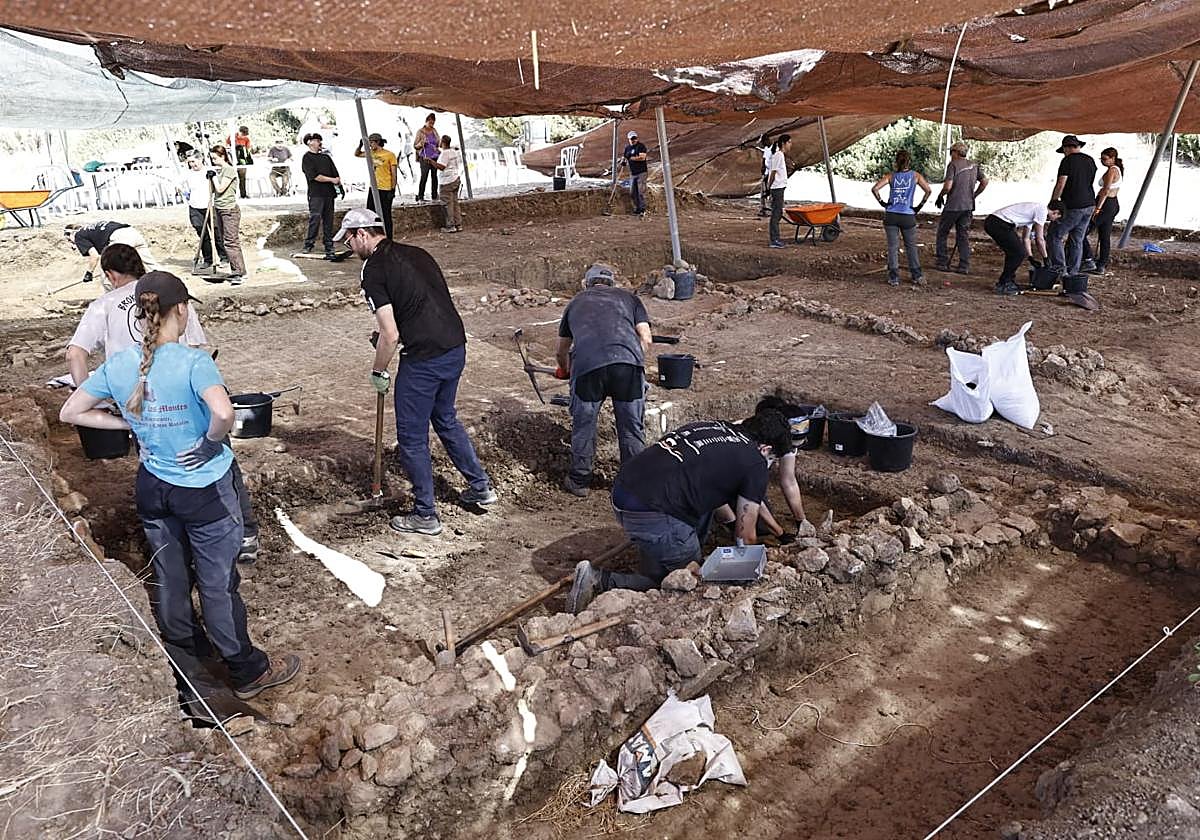
Phoenician Malaga is once again being uncovered. For the fourth consecutive year, the excavation at Cerro del Villar is searching for the origins of Phoenician Malaga on the ancient islet located at the mouth of the Guadalhorce river. Several dozen archaeologists and volunteers began working at the site on Monday, 1 September.
Cerro del Villar is one of the best preserved sites from the archaic period, which dates back to the 8th century BC. In the open pits, you can already see the walls, more than half a metre wide, of a building more than 20 metres long, whose origin and use are unknown. For this reason, the researchers have made it their goal to make progress in the urban planning of the settlement and to answer the questions that remain open.
Although the slow and painstaking work at the foot of the field has only been going on for three days, archaeologists have begun to dig down in search of the oldest stages of this Phoenician site, which was in use until the 7th century BC. Everything seems to indicate that the abandonment of this city was due to various catastrophic events, especially floods and even a fire that was identified in last year's excavation.
In the face of disasters, the population moved to other more stable areas, such as the emerging city of Malaka, leaving Cerro del Villar as a pottery and salting centre. The inhabitants' move explains why another later civilisation did not conquer the land and destroy the Phoenician occupation, which is why the remains are so well preserved almost three millennia after their foundation.
The archaeologists want to take advantage of the excavations' good conditions to answer some of the questions surrounding them. The objective for this year is to discover more about the large building found on the site, which is suspected to be of a public nature. The proximity of the site to the port area or wharf of the island may also provide some answers to the urban intrigue of the Cerro del Villar.
Punic and Roman eras
At the same time, as progress is being made in the study of the oldest stages of the Phoenician site, at another end of what was once the island the aim is to find out the details of the evolution of this site in the periods closest to its occupation, related above all to industrial activities. This is the case of the pottery workshop, where ceramic production kilns from the Punic period have been found in previous years, with numerous fragments of utensils and vessels (6th-5th centuries BC), which shows that the Cerro del Villar maintained its use as a working space, even though the population had moved away.
Curiously, this 'industrial area' - it is not very far from the areas of warehouses that today serve the city of Malaga - continued being used for the same productive purposes several centuries later, with the arrival of the Romans, who also built the pools of a salting factory. The archaeologists have now set out to expand our knowledge of the chronology of this entire production area, which is believed to have ended in the 5th century AD, during the period of the lower Roman Empire.
At the other end of the ancient island, both the Punic pottery production workshop and the later Roman salted fish factory are being studied
The University of Malaga leads the international research at Cerro del Villar. The project is directed by professor and archaeologist José Suárez, with the collaboration of the universities of Chicago (USA) and Marburg (Germany).
The current campaign, promoted and subsidised by the regional ministry of culture, with the support of the city council and Fundación Málaga, is key to the excavations, as it seeks to renew funding for another cycle of excavations from next year onwards. The enigma of this great building or the chronology of the industrial area may facilitate the advance of the study, which is currently the focus in Phoenician archaeology as one of the most important archaic settlements in the western Mediterranean.
![[]](http://static.vocstatic.com/voc26/latest/assets/images/favicon/surinenglish/apple-touch-icon-57x57.png)