
History
Historic wells from old mosque discovered next to Sagrario church in Malaga
Excavations at the religious site will continue until October after structures including a Roman pavement were found
-U17771140754tqb-1200x840@Diario%20Sur.jpg)

Malaga
The plan was to conclude the fieldwork before Malaga city's 'feria', but excavations by their very nature have a habit of unearthing more than the archaeologists bargained for. The latest developments in the excavations at the city's Sagrario church is a case in point and the project is going on for longer than planned.
Archaeologists have discovered a series of wells associated with both the Islamic mosque and earlier constructions from late antiquity (late 3rd century to the 7th century), as well as a ceramic pavement from the city's Roman era. In order to complete the study, the experts have decided to go deeper until they have exhausted the archaeological sequence of this excavation, before looking at how to repair the cracks affecting the 18th century Baroque temple, whose Gothic façade (Puerta del Perdón) dates from the 16th century.
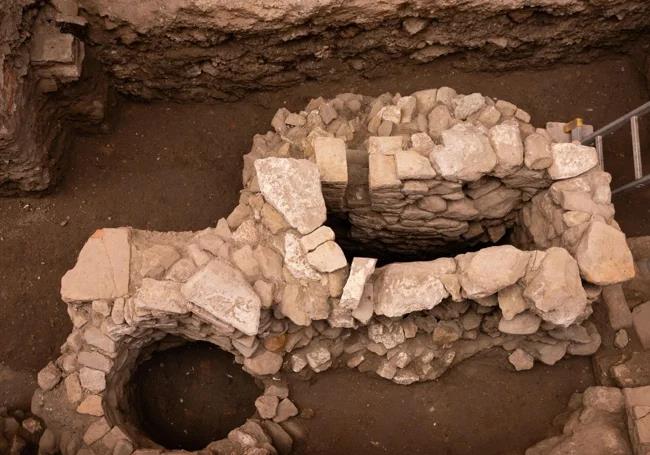
As Juan Manuel Sánchez La Chica, architect at the Cathedral - the monumental complex to which the Sagrario parish church belongs - explained to SUR, the archaeological work is currently being carried out in three parts of the church: inside, in the crypt, where it is almost complete; in the courtyard, where anthropological research has been completed on the bodies buried in what was the parish cemetery linked to the church and in the excavation in Calle Císter, where the latest findings have been made. Here up to three wells have been unearthed, two of which were in use from the Late Antique period - 6th or 7th centuries - and served as drainage for the walls of the mosque and previous constructions.
The third well is different as it is a rectangular waterwheel-type structure dating from the Almohad domination - 12th or 13th century - and could have been used to obtain water, although it is currently under study. In this test carried out in the area outside the road adjacent to El Sagrario itself, the Roman level has also been reached by locating a pavement made from broken pieces. "These are ceramic remains, so we are going to continue with the excavation in this area, the one closest to the Puerta de las Cadenas, until we reach the water table to complete the archaeological sequence," Sánchez La Chica told SUR on Tuesday 26 August.
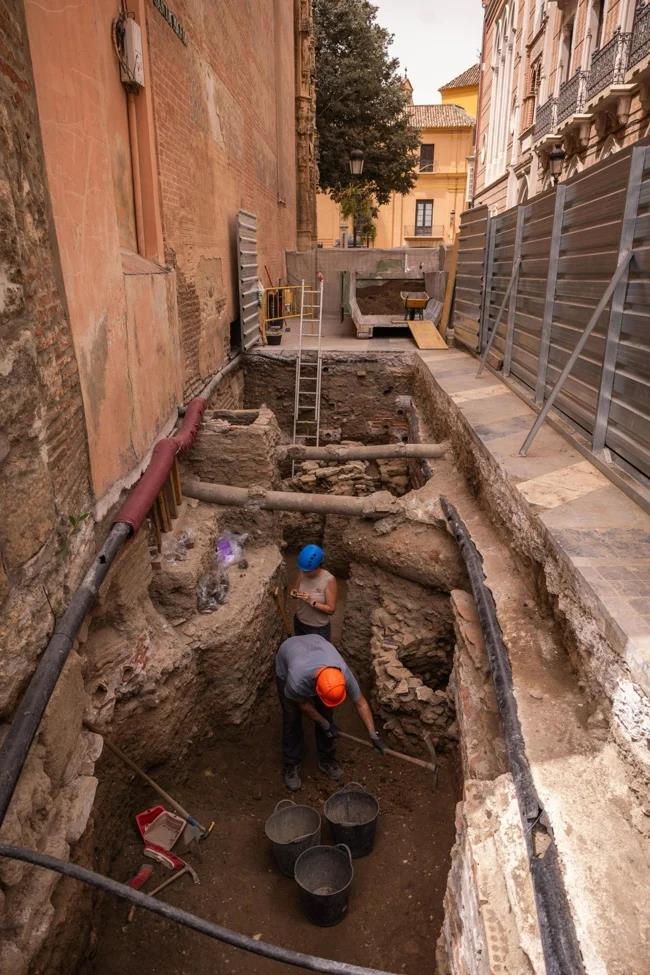
At the same time, these excavations, which have been commissioned by the Bishopric to a team led by the archaeologist Juan de Dios Ramírez, who was also responsible for the excavation which last year uncovered 5000-year-old remains - the oldest recorded in the city - are being carried out at the same time as the anthropological work on the Christian remains in the courtyard, where the archaeological phase is now beginning and structures are also expected to appear.
Solution to cracks
"Based on the results, we will have to re-study the project with what has come to light, although I hope that we will not have to change the solution too much," said Sánchez La Chica, who has set October as the new deadline for completing the work with the aim of subsequently requesting permits to reinforce the foundations of the church, whose state of conservation "worries" him as the cracks run "all the way to the top" of the building. The technicians are monitoring these cracks and "at the moment there is no movement of the ground", said Sánchez La Chica, who nevertheless advocates intervening as soon as possible to stabilise the building, which has even experienced recent episodes of landslides, as happened last March with the head of a sculpture on its valuable Gothic façade.
It was these architectural problems that forced the closure of the El Sagrario in Malaga five years ago. The solution to the cracks and the movement of the ground involves controlled injections of material that would be applied at a depth of eight metres to give consistency to the perimeter on which the church stands. This intervention is awaiting approval once the current phase of excavations, which is yielding new data on Malaga's past, has been completed.
![[]](http://static.vocstatic.com/voc26/latest/assets/images/favicon/surinenglish/apple-touch-icon-57x57.png)