
Heritage
Malaga's underground treasures: regional ministry of culture orders preservation and transfer of several Roman tombs from unidentified cemetery
The finding has an added value: it was not based on documentary evidence or previous historical references to settlement in the area
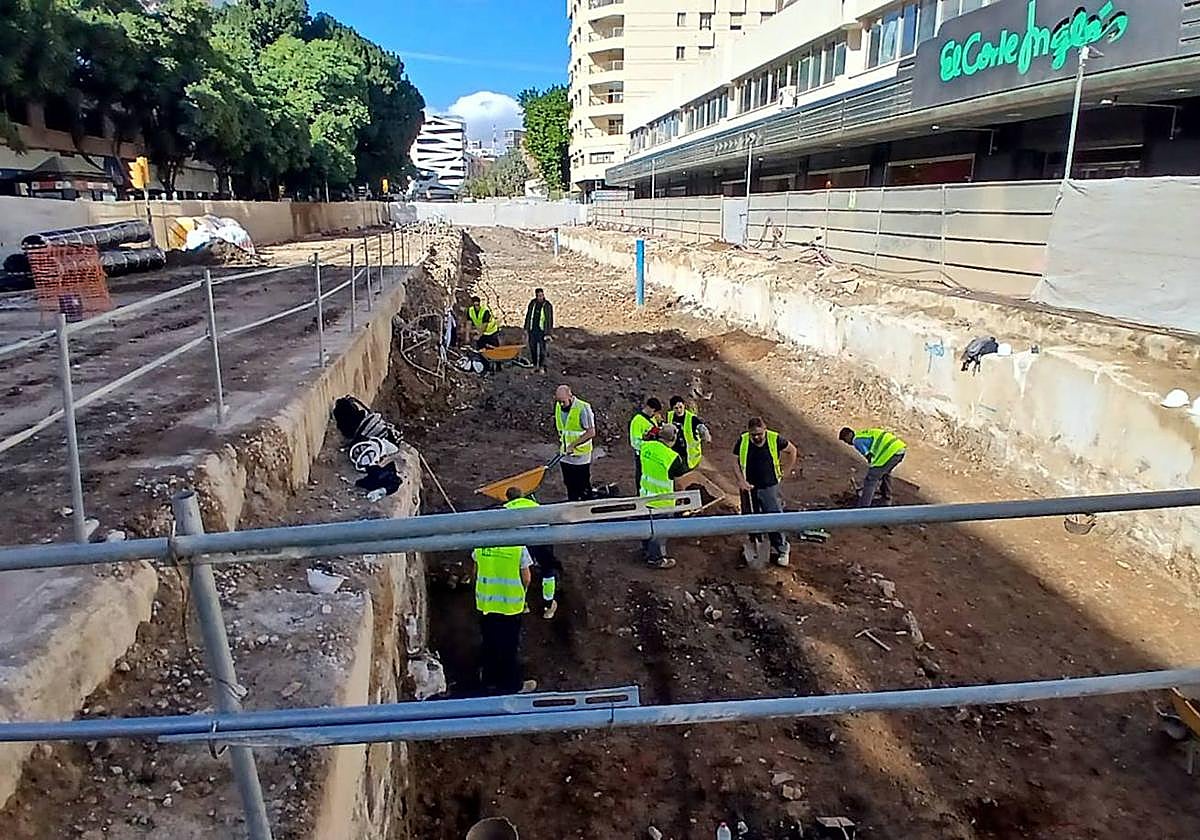

Archaeological discoveries in any excavation that takes place in the city come as no surprise. Some are more valuable than others, according to experts. On this occasion, the work to extend metro line 2 towards the future third hospital in Malaga have brought to light an underground treasure: a Roman necropolis dating from the 2nd to 4th centuries AD.
A team of archaeologists has been working on the site next to the new El Corte Inglés building for some time. Now, the regional ministry of culture has issued a resolution on the matter. The decision is to preserve and relocate the most valuable and monumental tombs.
"The resolution calls for a full archaeological excavation, work on all the graves, and the relocation and preservation of the most significant ones," the regional ministry of public work told the media.
The discovery occupies 400 linear metres on Calle Hilera and work has been underway since May. This discovery was not based on documentary evidence or previous historical references.
The possible existence of an occupation from the Roman period had only been identified in the area of Perchel Norte. In fact, according to the research carried out to date and the bibliography consulted, the sector comprising Calle Calvo, Calle Hilera and Avenida de Andalucía was reclaimed from the sea from the Muslim period onwards, which explains the absence of Roman funerary remains in the area.
Historical value
The research carried out in this area confirms the discovery of a Roman necropolis near Calle Hilera, which opens up a new panorama of research and which could illustrate the possible existence of a suburban area from the imperial period connected with the city and, consequently, a burial route or exit route from the city of Malaga.
During the extensive archaeological excavation work carried out between May, August and the last months of the year, 274 burials were found, all corresponding to inhumation rites and notable for the scarcity of grave goods. A stratigraphic sequence was followed down to a lower layer of soil where the tombs were located.
A high percentage of the corpses were buried in pits with horizontal 'tegulaes' (flat tiles placed over the body as a funerary cover). In terms of burial types, frame tombs covered with tegulae have been found; 'mensa' tombs with a pit and boundaries made with mortar; simple pit graves; tombs with ossuaries; perinatal burials in complete amphorae or selected fragments or in pits lined with bricks, among other types. Funerary enclosures have also been found, some built with masonry and foundations of river cobbles, in varying states of preservation.
296
tombs have been found in this necropolis
Given the scope of the discovery, the resolution of the regional ministry of culture has determined the need to extend the investigation, applying new excavation techniques related to the anthropological perspective and obtaining additional information for the heritage assessment of the property as a whole. This greater methodological work will have to be carried out with the excavation of each funerary complex and individual space with an interdisciplinary methodology, from archaeology to physical anthropology. Specific machinery will also be used in the opening of the sedimentation.
In addition, priority will be given to the excavation, protection and enhancement of those tombs and anatomical remains that are in the best condition and that stand out for their monumentality. They will be transferred to the future museum space of the metro work at Guadalmedina station.
Historical suburban area
These corrective measures, focused between kilometre points 0+110 and 0+500 of the Guadalmedina-Hilera section, will condition the execution of the metro. The next phase corresponded to the extension of the tunnel's roof slab on this section, which will now have to wait for the implementation of the measures contemplated in the resolution.
The regional ministry of public work ratifies its commitment to the preservation of the rich heritage found in the city's subsoil, as is endorsed by precedents such as the protection, transfer and storage of the remains found during the work to extend the metro to the historic centre, where the remains of the old Muslim suburb of Attabanim, among other historical remains, came to light.
![[]](http://static.vocstatic.com/voc26/latest/assets/images/favicon/surinenglish/apple-touch-icon-57x57.png)