
Health
The Malaga cardiologist with 600,000 followers on social media
A heart specialist at the city's Hospital Regional, Aurelio Rojas has turned his medical knowledge into informative posts about health, nutrition and lifestyle topics

Malaga
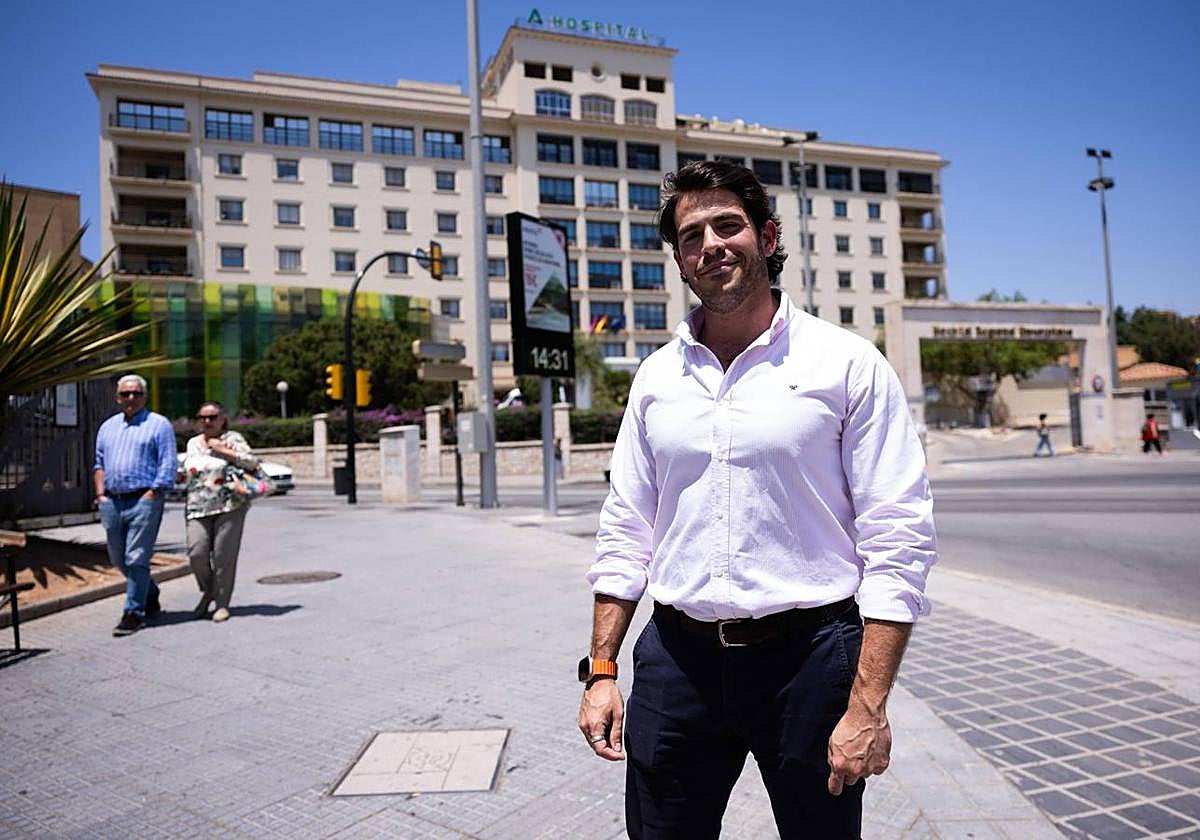
Aurelio Rojas, a cardiologist at the Hospital Regional Universitario de Málaga., has been a popular voice on social media for a few months now. He has turned his medical knowledge into informative posts that a legion of followers read on a daily basis: more than 600,000 on Instagram alone (@doctorrojass).
His online presence has grown since October last year with the same naturalness with which he talks about health, nutrition and lifestyle. "I am a cheerful and simple person", the 35-year-old says. It is his authenticity that explains part of his success, which rests on three pillars: scientific rigour, transparency and entertainment.
Born in Malaga, but with roots in Jaén (his family is from Alcaudete), Rojas has been involved in medicine from birth. His mother, who is a paediatrician, never told him to follow in her footsteps, but he did anyway. He studied at the Faculty of Medicine in Malaga where he excelled. "My first choice was Neurosurgery and although you are advised never to change your order of priorities, I did and at the last minute I opted for cardiology. I don't regret it, I would do it again," he says.
After finishing his degree, he wanted to extend his training outside Spain and learn how other healthcare systems work. He did so in New York, at Lenox Hill Hospital. There, he studied the management of minimally invasive cardiac interventional procedures and after that experience he returned to Malaga and to the Regional Hospital, where he was offered a job after completing his specialist training. He currently works in the diagnosis and treatment of cases of heart failure, valvular heart disease and cardiomyopathy, as well as training new medical students.
On his social media, "fun-loving and extrovert" Aurelio explains an electrocardiogram or how lack of sleep impacts the body, or posts a video of him leaving a shift, at the gym or with the dog that his parents, who live in Marbella, look after.
What started almost by accident - a photo celebrating the publication of a book he wrote with another doctor on cardiac imaging - turned into a health outreach platform that in just three months gained 350,000 followers. "I uploaded that photo with my friend and it got thousands of likes. I thought maybe I could help more people around here," Aurelio explains.
He didn't think of himself as an influencer at first but says, "I receive messages from people who have started to take care of themselves, to exercise, to eat better thanks to what I share. If that's being an 'influencer', then I am, but with a scientific basis".
Rojas does not improvise. He records, edits and writes the content he publishes himself. "I have no help from anyone. This is like my child and I look after him with care". His maxim is rigour. He rejects between 70 and 80% of the collaboration proposals that come to him, especially if they are not in line with his medical principles. "I will not promote anything that has no scientific basis or is not safe. I don't cross that line," he says.
His dual role as a doctor and communicator is not without its sacrifices. His free time has diminished and he admits that he also feels stress at times. "I always say that I see about 40 hearts a day and many of these problems come from stress. It raises blood pressure, cholesterol, triglycerides, weight... It's not easy to get rid of stress, but it is easy to change habits so that the impact on our body is less, such as taking care of our diet, doing physical exercise and improving our rest. People normalise living like this, but the body takes its toll," he says.
He leads by example: he does sport, reads (he is currently reading 'The Secret Dinner' by Javier Sierra), meditates but admits that he does have the occasional treat. "You don't have to be perfect 100% of the time; taking care of yourself 90% of the time is enough. I also eat churros sometimes, even a doughnut and I talk about it on social media". Among his hobbies? Going to the beach "like a good Malagueño" and watching science fiction series.
No free time
His little free time is mainly spent generating content, because he believes that helping others is part of the medical vocation. "It has been a snowball that has been growing and what was initially just a profile on Instagram, I have now added a YouTube channel, courses to help improve lifestyle and a podcast where I interview other health communicators who can provide other points of view. And without profit, says this doctor, who is aware that making money from selling treatments on social networks is an "extremely sensitive" issue.
In his videos he is natural, direct, often funny and sometimes flirtatious. He has taught himself how to make them, although he says that technology has helped him. He talks about rest, nutrition, exercise and stress, all with medical authority but in an accessible way: "I think one of the mistakes in the consultation room is to appear inaccessible. The gown already creates barriers. Showing myself as someone normal has brought me closer to people," Aurelio says.
He has even interviewed people with whom he does not share an approach, but with a clear objective: to dismantle myths and fake news through dialogue. "I don't agree with them, but we have to know why so many people believe them and explain why they are wrong."
His colleagues at the hospital, far from criticising his public side, have supported him. "We spend many hours here, good and bad, and that brings us together. I have never received a negative comment from my colleagues, although I have received some jokes," he says. He is proud of not having haters and the street, the metro or the surgery are now places where he is stopped to ask for a photo. "People are very friendly and if I can help from here or from Instagram, I do it anyway".
Rojas believes that doctors should be present on social media. "If we are the reference in health in real life, we must also be so on the internet. You don't need to be special, you just need to be yourself."
Beyond the algorithms, his purpose is clear: to improve lives, whether in the hospital or by recommending five minutes a day of breathing to calm the mind. "Helping is part of the medical vocation and not just from a consulting room," Aurelio concludes.
![[]](http://static.vocstatic.com/voc26/latest/assets/images/favicon/surinenglish/apple-touch-icon-57x57.png)