
Art and culture
'Let the people judge': Artist hits back at 'insulting' critics over Malaga’s new 11-metre Neptune'
Ceuta-born artist Ginés Serrán hits back at the San Telmo Academy that branded his port statues as 'pretentious', 'grandiloquent', and 'kitsch'
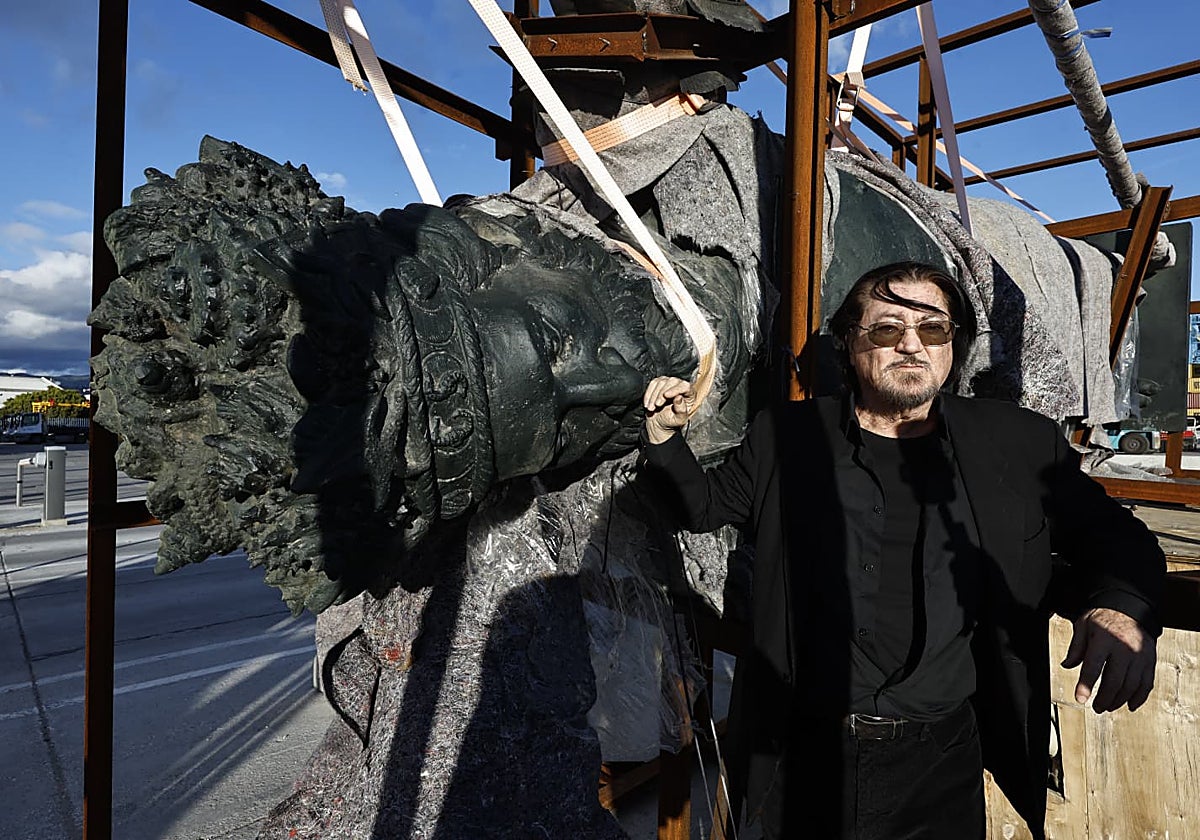

The big toe of Neptune’s bronze foot is the size of a human hand. Lying flat in a Malaga workshop, the sculpture appears deceptively modest; yet it is in these gargantuan details that its true scale is revealed. Once hoisted onto its concrete plinth at the mouth of the city’s port, the sea god will tower 11 metres high.
But as artist Ginés Serrán peels back the protective packaging on a project five years in the making, he is not just fighting the logistics of two-tonne bronze - he is fighting for his reputation.
Earlier this week, the prestigious San Telmo Academy of Fine Arts launched a scathing attack on the project, branding Serrán’s aesthetic "pretentious," "grandiloquent," and "kitsch." In a statement that has sent shockwaves through the local art scene, experts likened his work to "superhero comics of the Marvel universe" rather than contemporary classicism.
Ginés Serrán has been living in Malaga for a year, in an attic in the heart of the city, where he has been finishing this project, the most personal of his career, "in silence", as he said. He is not an artist who seeks the spotlight, so he keeps his distance from the press.
The fine arts academy's statement, however, has made him speak up to defend his work. The experts criticised the aesthetic and the practical suitability of the large sculptures, as well as Serrán's career. The comments came just a few weeks before Las columnas del mar is installed at Plaza de la Marina. Serrán responded: "I would like it to be the locals, the people of Malaga, who judge my work and not four people."
The 76-year-old artist's life sometimes sounds like a movie. He went to New York at the age of 21. He had a total of 25 dollars in his pocket, when he began painting with the Sioux Native American community. Later, he had a studio in the Manchurian region in China. In Italy, Serrán received a distinction from the Medici family. He has been married three times and has two children, also artists. Ginés Serrán is a unique man, capable of having hours-long conversations.
'The academy could have contacted me to learn about the project and see the photos of Neptune instead of saying this is not good for the city'
He is surprised and hurt by the academics' reaction. "I would have been grateful to San Telmo if, before saying anything, they had phoned me. They could have contacted me through the Port Authority so that I could clear up any of their doubts about the project and show them photos of Neptuno, instead of them simply saying that this is not good for the city," he said. He believes that his work will "beautify" Malaga and eventually become an "icon", one of those places where everyone who passes by takes a photo.
The sculptures will, for better or worse, not go unnoticed. The large two-tonne Neptune will be accompanied by a huge Venus, more than five metres high (on a three-metre pedestal), with a shining sun in her hand, in a nod to the Costa del Sol. Behind them will be two lions at ground level, measuring three and a half by almost two metres. "It will be what the children will enjoy the most," Serrán said with a smile. His son Francisco, who assists him in the creative process, accompanied him during the talk with SUR.
Serrán's work will not cost the city "a single euro", as the artist explained. The project is his gift to the city and a tribute to his father Cristóbal, who was born in Villanueva del Rosario. Cristóbal was the son of a shepherd who emigrated to Ceuta to earn a living and find a better life for his family. He loved shells, the same shells that crown Neptune.
Ginés Serrán Pagán was born in Ceuta 76 years ago, but he began his journey around the world as soon as he could, until he settled in New York, where he has been living for 30 years. "I feel that nostalgia for Spain, for my roots, for my blood. It's like a tree: if you don't water the roots, the branches won't grow well. I have watered the roots of Ceuta and I am now watering the roots of Malaga," Serrán said. This search for origins is what connected him with classicism and mythology years ago. He is so passionate about stories about ancient gods that his primal artistic instincts bring life to sculptures that seem almost human.
From what SUR has learnt, not all of San Telmo's academics share the criticism of the artist's work. What most hurts Serrán is that they call his career a "strange curriculum". "I have exhibited in 23 countries. I have an inventory of 1,500 works sold, with collectors in 60 countries. If you ask the AI who Ginés Serrán is, it gives you a whole report. If you Google my name, my sculptures and exhibitions have been all over the world."
In the last 25 years, he claims to have made 30 monumental sculptures across the planet, from Manila to Kentucky. "Not even in the Renaissance did an artist make such large works," he said, showing receipts that prove that one of his projects was sold for 2.6 million dollars in the Philippines. The evaluation of Malaga's Neptune is close to two million, while that of Venus is around one million.
Gift to Malaga
On one wall of his home hang the key to the city of Miami, a medal that recognises him as an ambassador of art in Rome and the distinction awarded by the Medici family. "They say I am the second Michelangelo. They even sent me a letter authorising me to reproduce any of Michelangelo's works in bronze." The artist said that he has eight projects planned for this year, "including in the University of Cambridge, New York, Miami, Qatar, the Philippines, China and Spain". "Why do they talk about me that way? It's insulting and defamatory," he stated.
Of course, Serrán knows that his career has been far from conventional. He is not an academic artist and he has training as an anthropologist and archaeologist. "I was given eight scholarships. I had to get some the highest grades at New York University," the artist said.
He has always painted, but his professional roots are related to another of the fascinating stories of his life. "I started living with the Native Americans, the Sioux, who adopted me as a brother in '92 at a Sun Dance. The tribal leaders would come to the United Nations to speak and stay at my house," Serrán explained. With them, he began to shape his artistic language. "Of course it's a strange curriculum!"
Some of the other comments of the academy make Ginés Serrán grin. According to San Telmo, his aesthetic responds to a "pretentious and grandiloquent pseudo-neoclassicism, with an unmistakable kitsch hook, more typical of the superhero comics of the Marvel universe than of a sincere recovery of classicism from a contemporary point of view". "So, is Madrid's Cibeles and Neptune also Marvel? And what about Rome's Piazza di Spagna? In New York, there's Prometheus at the Rockefeller Center. Or the Statue of Liberty itself. It's just slander," Serrán responded.
His sculptures are of classical, harmonious beauty, but with a counterpoint that distances them from the purely Renaissance. His Neptune carries a gold-plated fishing net, which falls from one of his hands to his feet. With the other hand, he holds the trident. Venus raises a golden sphere, as a symbol of the sun.
The sculptures will be temporary. According to the contract, they will be at the entrance to the port for a "maximum" of 25 years and they could even be removed earlier, if that is deemed necessary.
Trajectory
Serrán's classicism is a response "to the crisis of art". It has reached a point where "anything" is considered a masterpiece. "There is so much shit in the art world that I have no choice but to go to the roots," he said. But that doesn't stop him from painting an abstract and an expressionist painting. "Like Picasso. I am very flexible with my art."
The artist believes that Neptune and Venus suit Malaga. "It is a city by the sea, with an enormous cultural heritage from the time of the Phoenicians, the Romans. You dig in the soil here and find ruins. It is an ancient city, with a legacy and a wonderful history, which tourists also come to know and learn about," he said.
Serrán has always been connected to Malaga. He already had a studio in Marbella in the 70s, when he moved to New York. "I would spend a month there and recharge my batteries," he said. A few years ago, he sold it and bought two houses in his father's village. Then, he set up his Spanish base in the centre of Malaga. But he has not stopped travelling. Four or five times a year, he goes to the workshop he founded 35 years ago in Manchuria, in the north of China, close to Siberia, where he carves his large-scale work in clay on scaffolding. From there, he obtains a fibreglass mould, which he then transfers to another mould in earth and sand, which is placed in the kiln and into which the bronze is poured. "I use the same alloy as the Greeks and Romans: 85% copper and three other metals (zinc, tin and lead). I am guaranteed a minimum durability of 2,000 years," he stated.
"Between fame and glory, I prefer glory, because it's the people who judge, who say 'we love this and it's part of us'. That's what I'm after," Serrán said, alluding to the greatest goal of his life.
![[]](http://static.vocstatic.com/voc26/latest/assets/images/favicon/surinenglish/apple-touch-icon-57x57.png)