
Conservation
Forester assures that the Spanish fir tree is on the increase and 'is no longer in danger of extinction'
However, the regional coordinator of the species' recovery plan in Andalucía warns that large forest fires remain the biggest threat moving forwards

Malaga
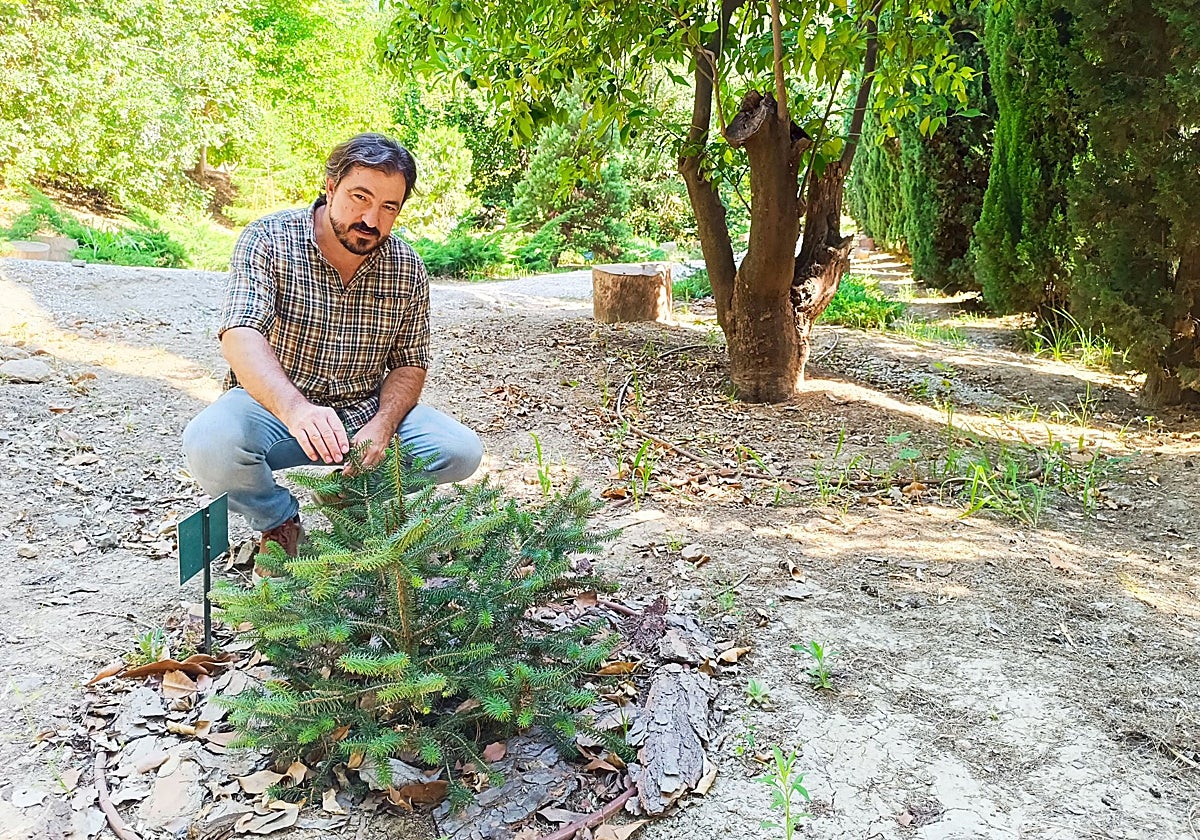
Gabriel Gutiérrez Tejada, 52, takes over from one of his teachers, José López Quintanilla (Pepe Quintanilla), as regional coordinator of the Spanish 'pinsapo' fir tree recovery plan. The technical advisor to the Junta de Andalucía's department of forestry policy and biodiversity is at the forefront of the conservation of one of the species most emblematic of Malaga province and the Andalusian region. Gutiérrez Tejada, who describes himself as a "forester", approaches the field of conservation with novel ideas, which he is already putting into practice in the forest.
-What conditions did you find the Spanish fir in when you started?
-I found them in great condition, thanks to the previous coordinator, who was not only coordinator of this recovery plan, but dedicated practically his entire professional life to managing forests of Spanish firs. In fact, that is the reason why he was selected in 2011, and since then he has not stopped carrying out recovery actions, in one way or another. Therefore, compared to the situation in the 19th century, of regression of the species in its traditional areas, what I find now, when practically the first quarter of the 21st century has passed, is a species that has truly recovered. If we ignore formal classifications, we could say that the Spanish fir is no longer at risk of extinction, instead it's expanding. It is naturally occupying new niches in its potential area with ease - thanks to the hardworking forest management team. In addition, the team led by Pepe (Quintanilla) has had the ability to create a whole human ecosystem, very well meshed throughout the area of recovery of the species, mainly in the provinces of Malaga and Cadiz. The team is being reinforced with new members in both provinces and possibly (in the very short term) in others, where we are going to start testing climatic refuge projects and expansion areas, with the collaboration of other autonomous communities - such as Aragon.
New ideas
"We are going to start trialling environmental conservation plans with zones of expansion for the Spanish fir"
-So, can we say that the Spanish fir is no longer endangered?
-We can say that we are working to assess its downlisting as an endangered species - upgrading its status to vulnerable or even to a lower category of vulnerability. Downgarding is only possible on the premise that its habitat is highly vulnerable, particularly to the risk of a major forest fire. That is the key issue.
The threat of fire
-Is fire the main threat to the Spanish fir today?
-Of course, because large forest fires are disturbances that can affect 5,000 to 10,000 hectares, and the area of the Spanish fir forest is less than 10,000 hectares. So a disturbance affecting that area would create a serious problem for us. In any case, in terms of the management of the species, a reduction in the degree of vulnerability is positive because it would make it easier to broaden the possibilities for action in certain areas.
-In what way?
-For example, that the collaborating organisations, such as the Cruz Roja (Red Cross) and possibly soon the volunteers of the Jardín Botánico de La Concepción in Malaga, can use the specimens they are cultivating in collaboration with the recovery plan. They could even take the conservation plans up into the hills, not limited to urban and suburban areas. With tracking, from start to finish, so these plants can be used in future reforestation projects.
-Where is the Spanish fir forest heading? What is it going to be like in the future?
-There is a range of possible outcomes. The forest system we inherited from previous centuries was restricted - we are looking to establish a pure, homogenous and (in some cases) contemporary Spanish fir forest. From then on, we will have a more or less irregular forest, which, depending on the area, will be pure or mixed with other coniferous and leafy species, in descending altitudes. In addition, there are Spanish firs scattered in some grassy areas, with holm oak and gall oak, as well as some in more open areas. In short, the future holds a wide range of possibilities, much greater than that found initially, in which the Spanish fir was restricted to areas above 1,000 metres in altitude and where it rained more than 1,000 litres per metre squared every year. In reality, the Spanish fir is much more tolerant to drought than has been traditionally understood: it has an adaptable temperament, very delicate in its early years, but very robust as the specimen develops. At the same time, it has an enormous capacity to colonise soils of different types. As a result, we are going to find a more extensive area and more varied landscapes.
Classification
"Reducing the degree of vulnerability would make it easier to broaden the possibilities for action in certain areas"
-We have always said that the Spanish fir is exclusively found in Malaga and Cadiz, but it is expanding to other territories. Where can we find Spanish firs now?
-Just as in natural dynamics, at the geological level, the species (more specifically, the Abies genus), has undergone major changes in distribution. The most plausible theory is that of boreal latitudes, where firs still dominate large homogeneous areas, they moved around latitudinally due to glaciations and interglacial periods. In a period of retreat such as that which has occurred during the Holocene so far, small havens for the Spanish fir remain: particularly in the south of the Iberian Peninsula, in the western Betic and in the mountain ranges of Malaga and Cadiz provinces. On the other hand, like the rest of the Mediterranean firs, in these movements up to Cape Nao and even further north within the Iberian Peninsula, we have evidence that it is expanding naturally.
Future
"We are arriving at a more irregular forest, mixed with other coniferous and broadleaf species"
-And repopulations?
-We are expanding the recovery plan to other areas in the provinces of Malaga and Cadiz, where we are going to start trials to locate possible future climatic refuges for the species in the mountains of Seville, in various parts of Granada and Sierra Nevada, in Cazorla (Jaén), and even in Almeria, in the Filabres area. We are talking about locations at an altitude of over 2,000 metres. It is also a species that has historically been used in the Iberian Peninsula and at European level for botanical collections in gardens, and also for experimental reforestation trials.
Managing the hillside forests
-In addition to the Andalusian firs, there is a very important forest in Aragon. How is that going?
-Yes, the Orcajo Spanish fir forest (El Pinsapar de Orcajo), in the province of Zaragoza, where Spanish firs mix with Aleppo and Scots pines. This forest acts as an example, proving that in the face of decline in the two other pine species, the Spanish fir is very resistant, with a great capacity for adaptation and is visibly regenerating. In fact, that's why we are going to sign a collaborative contract with Aragon's regional government: to share experiences and knowledge on species management and to test trials on a larger scale.
Conservation
"The forest action plan must be accompanied by commitment from society as a whole"
-Finally, to what extent is the involvement of society in conservation important?
-It is fundamental for several reasons. Firstly, because it would make no sense to do something behind the back of society's interests. Forestry actions are carried out for the future, with very far-off deadlines, but they must have the commitment of society as a whole. On the other hand, recovery plans for species like the Spanish fir serve to bring different social groups into contact with the forest and to understand its needs at first hand. And it is not exactly leaving them to the hands of fate, as some have advocated in certain regions. Forest management is absolutely necessary, through classical techniques adapted to current times, vulnerable species can be recovered. The Spanish fir is a great example, it has been classified as vulnerable for as far as scientific records show, and it has been possible to remove it from the danger of extinction. In this, society is fundamental, and in fact a large part of the recovery plan in recent years has relied heavily on public collaboration.
![[]](http://static.vocstatic.com/voc26/latest/assets/images/favicon/surinenglish/apple-touch-icon-57x57.png)